Vitra Campus: A Factory That Became an Argument
Images are credited where they are not from the Rugberry house.
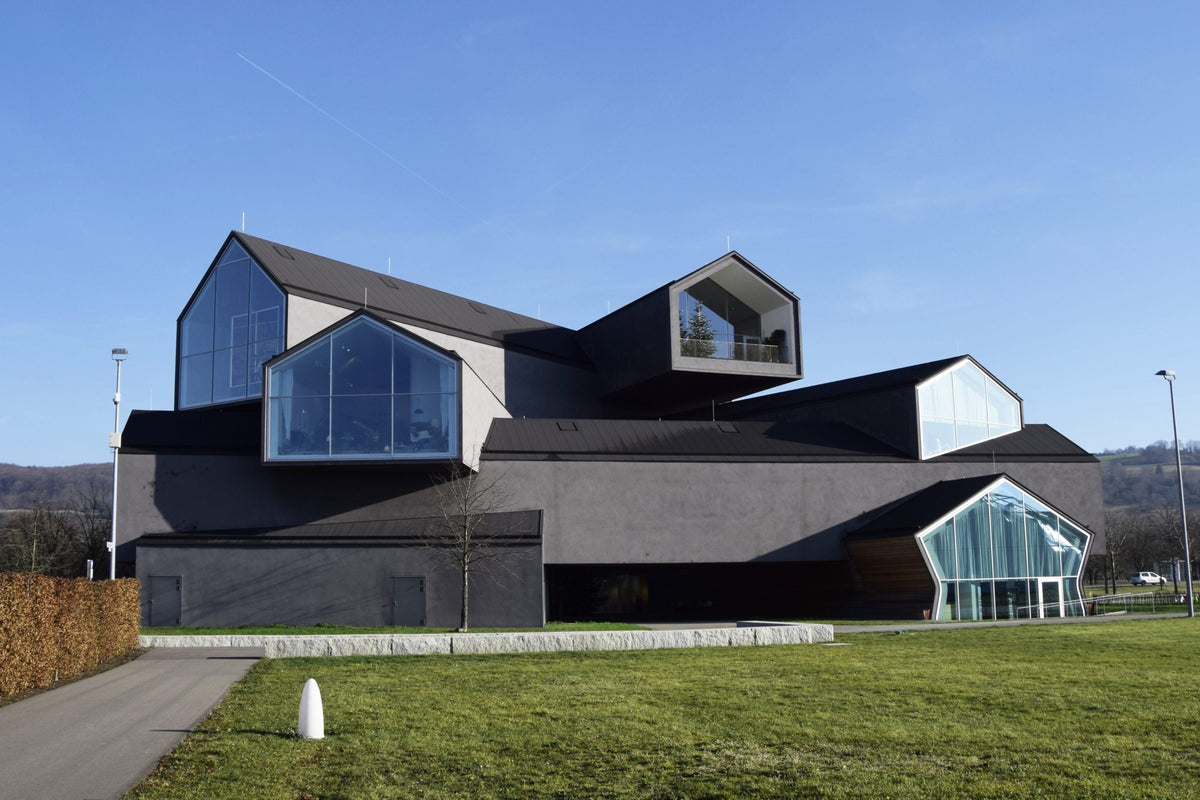
The VitraHaus by Herzog and de Meuron, house shaped volumes stacked over five storeys. Photo: Robbie Conceptuel, CC0, via Wikimedia Commons, licence
Walk in from the road at Weil am Rhein, a few minutes over the German border from Basel, and the first thing you meet is a white building that seems to be falling apart on purpose. Its towers lean. Its walls fold into one another. It looks like a drawing that refused to settle into a plan. Further on, a sharp concrete wedge points across the grass like a blade, and beyond it a stack of black houses sits piled on top of one another, as if a child had been asked to build a village and ran out of ground.

This is the Vitra Campus, and almost none of it would exist without a fire. In 1981 a blaze destroyed over half of the furniture factory that stood on the site. What came next was not a single master plan but a slow sequence of commissions, one architect at a time, that turned an industrial yard into the nearest thing the design world has to a pilgrimage.
Rebuilding one building at a time
The conventional response to a fire is to rebuild quickly and plainly. A factory needs to work again, and the cheapest shed is usually the fastest. Vitra, under Rolf Fehlbaum, took another path. Instead of hiring one firm to replace everything, the company began to invite architects in turn, each to build one thing.
Frank Gehry came first with the museum, completed in 1989, the white tumbling building by the entrance, and it announced that this would not be a normal industrial estate. In 1990 Fehlbaum commissioned Zaha Hadid to design a fire station for the site, a practical response to the disaster that had started it all. Completed in 1993, it was her first major built work. The same year Tadao Ando finished a conference pavilion nearby, low and concrete and as quiet as Gehry's museum was loud.

Then, in 2010, came the VitraHaus by Herzog and de Meuron: 12 house shaped volumes stacked over five storeys, each one the simple outline of a house with a pitched roof, and together the place where the Vitra Home Collection is shown. It is the building most visitors photograph, and the one that most directly asks what a home looks like when it is turned into a display.
A collection of arguments
What makes the campus unusual is not that it holds famous buildings. Many cities do. It is that the buildings disagree with each other, and nobody tried to make them stop. Gehry's museum is a sculpture you can walk into. Hadid's fire station is all speed and angle, a building that seems to be moving even when the doors are closed. Ando's pavilion is about withdrawal, plain concrete and restraint. Herzog and de Meuron's stack is about the archetype of the house, repeated until it becomes strange.
Read together, they make an argument about design itself. There is no single right answer to how a room should feel. There are only answers that are more or less honest about what they want. The fire station has since stopped housing fire engines and now serves as an exhibition and events space run by the Vitra Design Museum, which is its own small lesson: good architecture survives a change of use because it was never only about the use.
The buildings disagree with each other, and nobody tried to make them stop.
Is the building the display, or is the furniture?
Every visitor eventually arrives at the same question. Vitra makes chairs, tables, lamps and objects. The architecture is extraordinary. So which is the product? Walk into the VitraHaus, a building made of house shapes in order to show things for the home, and the answer is not obvious. The architecture is the frame, and the frame is so strong that it becomes part of what is on display.
The honest answer is that the campus works because it refuses to separate the two. A chair is more convincing in a room that has been thought about. A room is more convincing when its furniture has been designed with the same care as its walls. The campus is a reminder that a home is not a container with objects put into it. It is a single composition, and every part either helps or hurts the others.
Calm floors under loud walls
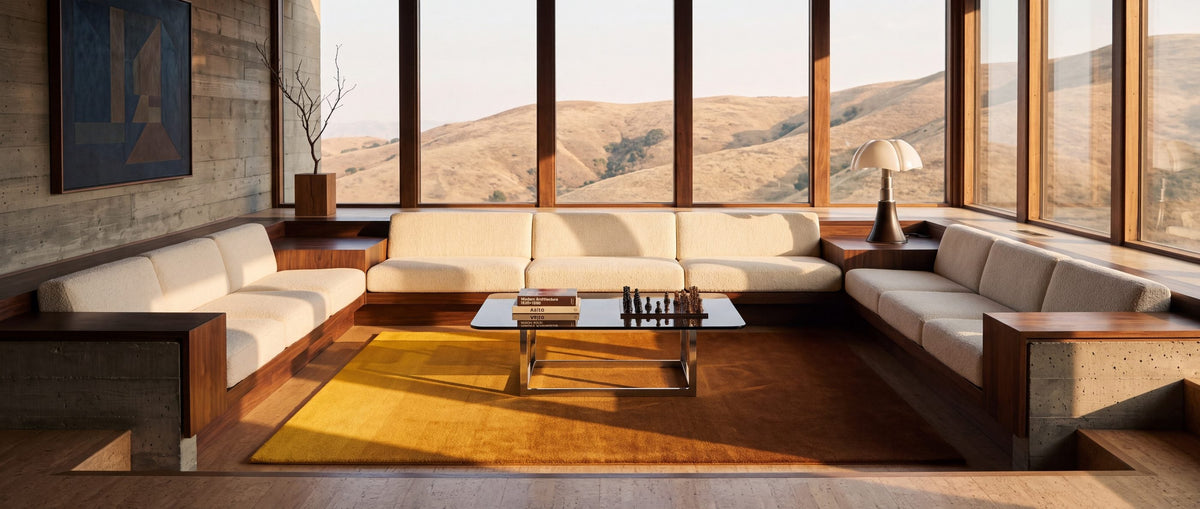
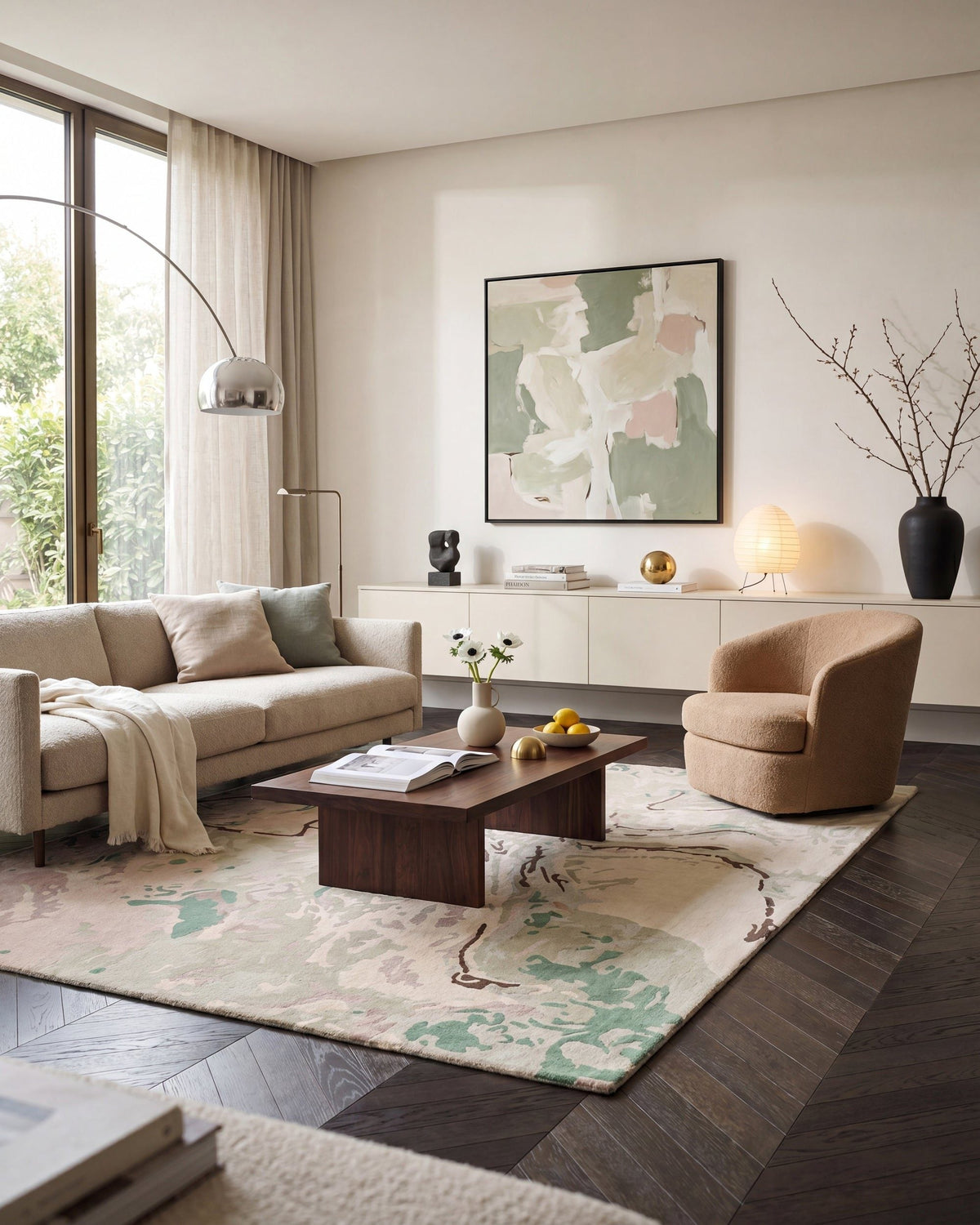
Spend a day among these buildings and one principle keeps suggesting itself. The louder the architecture, the quieter the floor wants to be. A twisting gallery asks the eye to look up and around, not down. A room of strong furniture needs something steady underneath it, a surface that holds a seating group together without competing with it.
It is a principle any home can borrow. When a room contains a statement piece, a sculptural chair, a dramatic lamp, a painting with real force, the floor beneath it has a job to do, and that job is mostly restraint. A rug in that situation is not there to be noticed first. It is there to gather the furniture into a group, to soften the sound of the room, and to give the eye somewhere to rest between one loud object and the next. Sometimes the rug can be the statement itself, but then the furniture around it must step back. Two shouting things in one room rarely make a conversation.
Water, and a place to sit
The campus keeps changing. In 2026, in time for Art Basel, a new Water Garden by the landscape architect Bas Smets opened in front of the Gehry museum, with three large fountain sculptures by Hella Jongerius. It gives visitors something the campus never quite had: a place simply to walk, sit and rest between buildings. The museum itself opens daily from 10am to 6pm, and most people who come for an hour end up staying for the day.
That may be the best measure of the place. It began as a disaster, became a series of experiments and grew into somewhere people want to linger. A factory that burned down turned into an argument about how things should be made, and the argument is still going, one building at a time.
Follow @vitra on Instagram for their own work, in their own words.
Rugberry notes
From the Rugberry house
The campus is a useful lesson for anyone designing a rug: decide first whether it is the quiet ground or the single statement, and let the rest of the room answer that choice. A quiet ground suits a room built around one strong chair, while a single statement rug wants plain, low furniture around it.
If that way of thinking appeals, our modern rugs lean toward clear shapes, while textures and solids are for rooms where the furniture should speak first. The Rugberry Design Lab lets you recolour a Rugberry design to suit the room it is going into.


In the Rugberry house
- Modern rugsClear shapes for rooms built around furniture.
- Textures and solidsQuiet grounds for loud pieces.
- Rugberry Design LabRecolour a Rugberry design for a particular room.
Rugberry has no affiliation with the studios featured. Images are from the Rugberry house unless credited.