


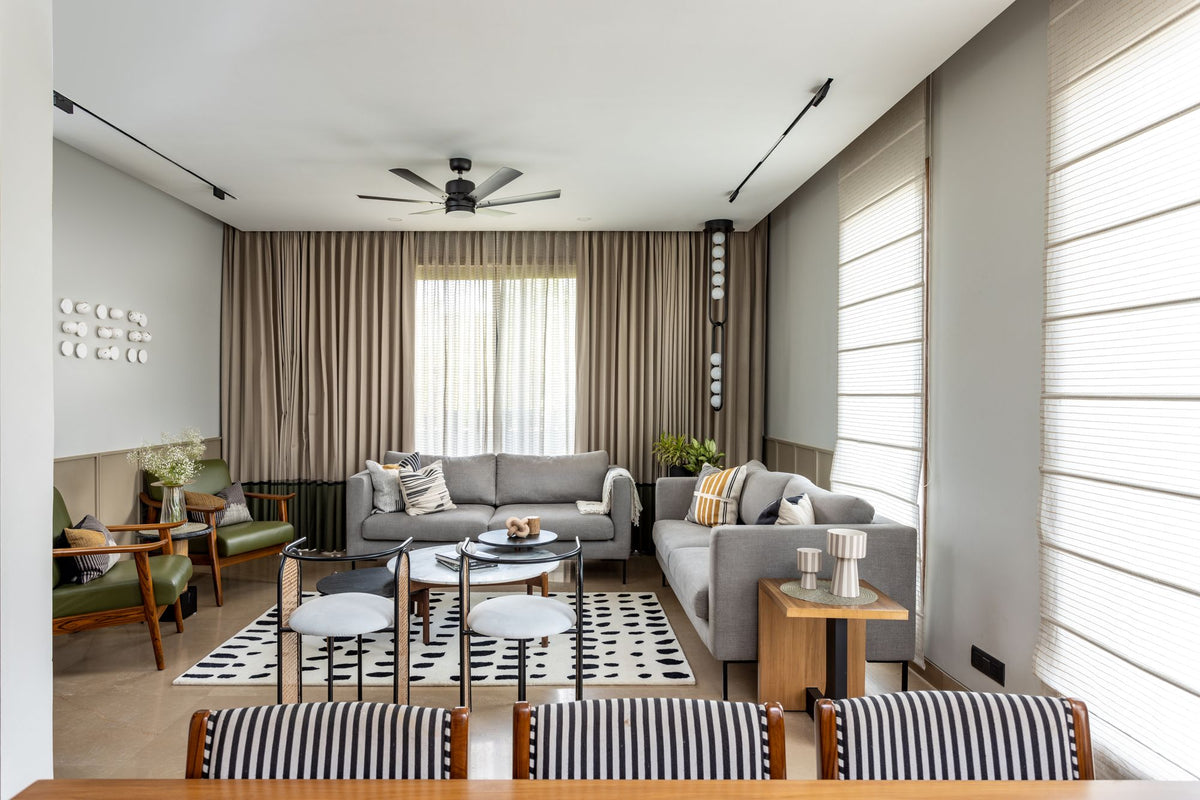
How Much Floor Should Show Around a Rug
In most rooms, leave about 30 to 45 cm of floor between the rug and the walls. Treat that as a starting guide, then adjust it for the size of the room, the marble border on the floor and what has to open around the rug.
In short
- A floor border of 30 to 45 cm between rug and wall suits most Indian living rooms and bedrooms, and works as a guide rather than a strict rule.
- In a room narrower than about 10 ft, a border of 20 to 30 cm keeps the rug large enough to hold the furniture.
- When an Indian marble floor has an inlaid border band, the rug should sit fully inside the band or cover it completely, because an edge that stops halfway across the band looks like a sizing error.
- The floor border should be roughly equal on opposite sides of the room, since a difference of more than about 10 cm between left and right is easy to see.
The border is the strip of bare floor that frames a rug. Get it right and the rug looks chosen for the room, get it wrong and even a fine rug looks borrowed.
How much floor should show around a rug?
About 30 to 45 cm (12 to 18 in) on each side in a typical living room or bedroom. That is enough to read as a deliberate frame without making the rug look small.


Below about 20 cm, the rug starts to look as if it was meant to be wall to wall and fell short. Above about 60 cm in an average room, it starts to float, unless the furniture is holding it in place.
How does room size change the border?
The border scales with the room: narrower in small rooms, wider in large ones. The table shows what Rugberry's stock sizes leave on each side in common Indian room sizes.
| Room | Rug | Border, long walls | Border, short walls |
|---|---|---|---|
| 10x12 ft (305x366 cm) | 6x9 ft (180x270 cm) | about 62 cm | about 48 cm |
| 11x13 ft (335x396 cm) | 8x10 ft (240x300 cm) | about 47 cm | about 48 cm |
| 12x14 ft (366x427 cm) | 9x12 ft (270x360 cm) | about 48 cm | about 33 cm |
| 14x17 ft (427x518 cm) | 10x14 ft (300x420 cm) | about 63 cm | about 49 cm |
| 16x19 ft (488x579 cm) | 12x15 ft (360x450 cm) | about 64 cm | about 64 cm |
The figures assume the rug is centred and use the cm sizes listed on Rugberry product pages. Check your own room with the method in how to measure a room for a rug.
How do marble inlay borders and skirting change the guide?
An inlaid marble border sets its own line, and the rug should respect it. Many Indian homes have a band of contrasting marble or granite, 10 to 30 cm wide, running around the room a short way from the walls.

- Inside the band: the rug sits within the inlay with an even margin of the main floor around it. This is the calmest choice and suits most living rooms.
- Over the band: the rug covers the inlay completely on all four sides. This works in a room where the inlay is busy and you would rather hide it.
- Never halfway: a rug edge that stops in the middle of the band draws a third line across the floor.
Skirting matters too. Measure the border from the face of the marble or tile skirting, not from the plaster, because the skirting stands 1 to 2 cm proud of the wall.
A rug edge that stops halfway across a marble inlay band draws a third line across the floor.
Where should the border be wider or narrower?
Widen the border wherever something has to open or swing, and narrow it where the room is tight and the rug must hold the furniture.

- Wider in front of wardrobes, so the shutters clear the rug edge, usually 60 cm or more.
- Wider at a pooja unit or a puja shelf, where people stand or sit on the floor and prefer bare stone.
- Wider at balcony sliders, where the raised track and monsoon water both make a rug edge a nuisance.
- Narrower in a small bedroom, where 20 cm of floor is better than a rug too small to reach the bedside.
The rug placement guide covers where the furniture itself should sit on the rug.
Does the border matter in an open plan room?
In an open plan room the border is set by the furniture, not the walls. Where one side of the rug faces open floor, keep that side at least 45 cm beyond the outermost chair leg so the rug still frames the group.

Where the rug faces a wall on the other side, apply the 30 to 45 cm guide there. The two sides do not need to match, because the eye reads them against different things.
How do tone and pattern change how the border reads?
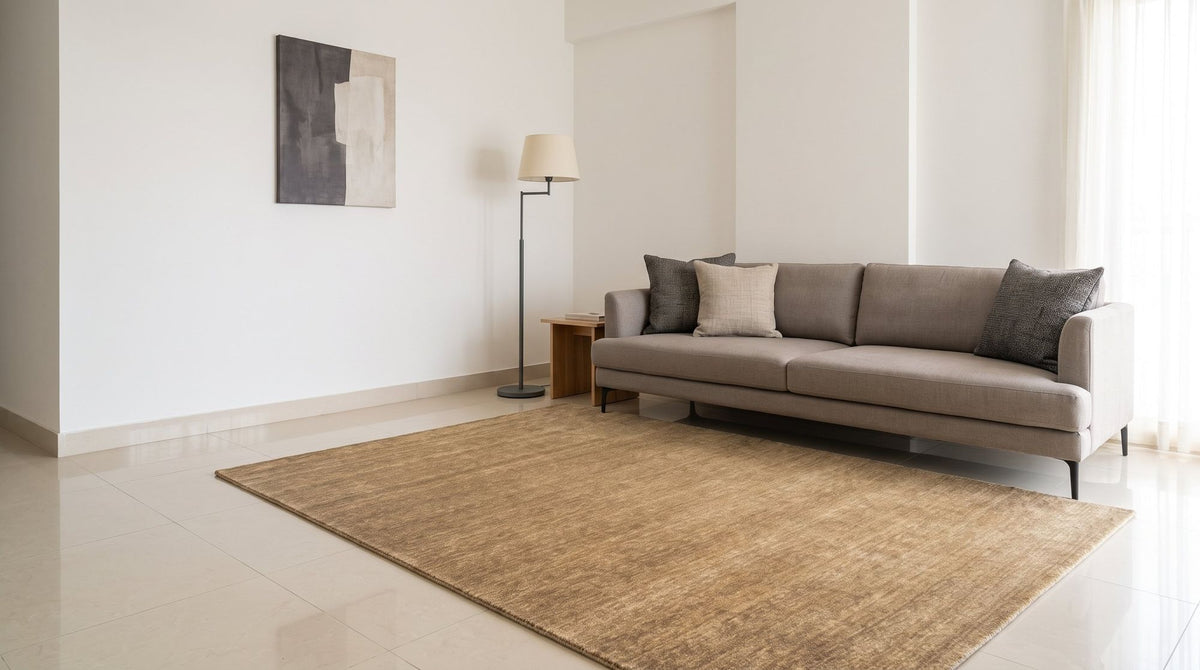
A rug close in tone to the floor makes the border soft, while a strong contrast makes it sharp and every centimetre counts. That is why pale rugs on pale marble forgive a slightly uneven border.


The Arctic Wool Rug, hand tufted New Zealand wool in a pale, still ivory from about ₹37,000, almost dissolves into white marble at the edges. The Greige Wool Rug, a warm leaning grey from about ₹40,000, does the same on grey vitrified tile, and the Grain Wool Rug in Sandstone sits quietly on beige stone.
For a dark rug on a light floor, measure the border carefully and centre the rug with a tape, because the contrast will show any error. Rugberry's 8x10 ft rugs suit most 11x13 ft rooms with a near even border.
Frequently asked questions
Is the 30 to 45 cm border a strict rule?
No, it is a guide for a typical room. Small rooms can go down to about 20 cm, large rooms can go well beyond 45 cm, and doors and wardrobes may need more.
Should the border be the same on all four sides?
Opposite sides should match within about 10 cm. The long and short sides can differ, because rug and room proportions rarely match exactly.
Where should a rug sit on a marble floor with an inlay border?
Fully inside the inlay band with an even margin, or covering it completely. A rug edge that stops halfway across the band looks like a mistake.
Frame the rug with floor, and let the room breathe around it. Material first.



Leave a comment
This site is protected by hCaptcha and the hCaptcha Privacy Policy and Terms of Service apply.