How a Herders' Blanket Became the Bhujodi Weave
Images are credited where they are not from the Rugberry house.
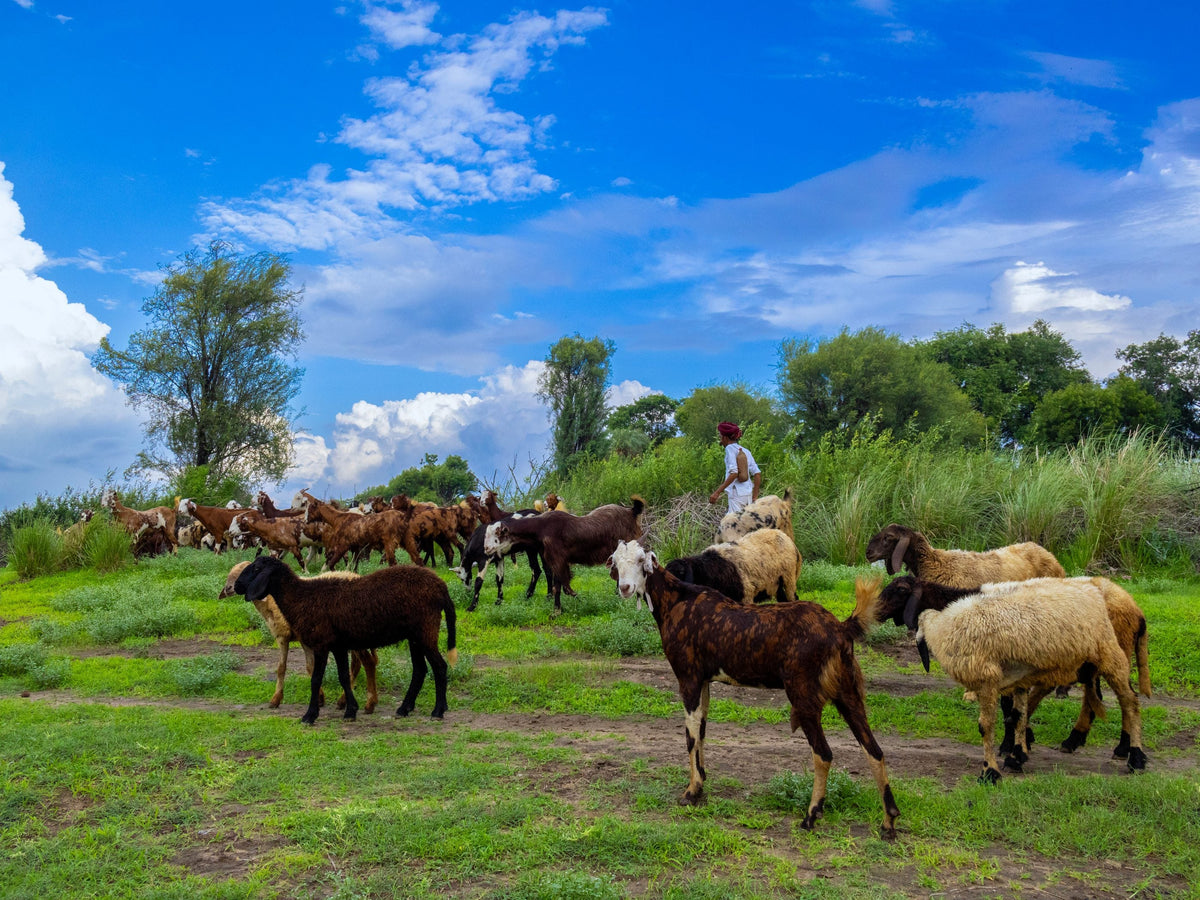
A Rabari herder with his sheep and goats at Jawai, Rajasthan. Photo: Kingshuk Mondal, CC BY 4.0, via Wikimedia Commons, licence
Picture the edge of the Rann in the monsoon. The sky is low and grey, the wind comes flat across the salt, and a herder walks behind his animals with a heavy wool blanket over his shoulders and head. It sheds the rain. At night, spread on the ground, it becomes his bed. In the morning it goes back over his shoulders. It is not a garment for display. It is the difference between a good night and a bad one, and it was woven a few kilometres away by a family he has known all his life.
That blanket is the dhabla, and it is the beginning of the story of Bhujodi, a weaving village about 8 km southeast of Bhuj, in Kachchh. Today Bhujodi is known across India and beyond for its shawls and stoles. But its craft did not begin as design. It began as an exchange between two communities who needed each other.
Fleece for cloth
The herders of the region, the Rabari, kept flocks. The weavers, the Vankar families of Bhujodi, kept looms. The arrangement between them was simple and ancient. The herders brought fleece from their own flocks. The weavers turned it into dhablas. In return, the herders paid in what they had: milk, grain and animal products.
The circle was complete. The wool came from animals grazed on the same land. It was spun and woven locally, with no merchant in between. The finished cloth went back to the people who had raised the animals, to be used until it wore out. Nothing in the chain was abstract. Every person in it could see, and usually name, every other person.

The dhabla had to work. It served as a protective raincoat in the monsoon and as bedding through the year, which meant it had to be dense, warm and tough enough to survive rough ground and constant use. Those demands shaped the cloth: tightly woven local wool, heavy in the hand, built to last. Decoration came, but it came second. The structure had to earn its keep first.


The grammar of extra weft
When pattern did arrive, it arrived through a particular technique. The signature of Bhujodi is extra weft weaving. On pit looms, set low into the floor so the weaver sits with the loom at the level of the ground, supplementary threads are inserted into the ground weave to build up motifs. The plain cloth carries the strength. The extra threads carry the pattern.
It is a beautifully economical system. The motifs are small and geometric, often repeated in bands, and they grow directly out of the logic of the loom rather than being drawn first and imposed afterwards. A weaver does not need a cartoon to make them. They live in the hands and in the count of threads, and they change slightly from one weaver to the next, the way handwriting does.
For anyone who loves rugs, this is the most familiar part of the story. Many flatwoven floor textiles use the same principle: a firm ground, with pattern added by extra weft or by changes of colour in the weft itself. The decoration is never separate from the structure. It is the structure, made visible.
The plain cloth carries the strength. The extra threads carry the pattern.
From blanket to design
As the need for dhablas declined, the weavers of Bhujodi faced the question every utilitarian craft eventually meets: what happens when the original buyer no longer needs the thing? The answer here was to keep the grammar and change the vocabulary.
The family of master weaver Vishram Valji Vankar is the best known example. He received the national master craftsman's award in 1974, and the family has since woven in merino and camel wool, in silk and in indigenous kala cotton. Their range now extends to wild silks such as tussar, eri and muga, alongside the local wool the family traditionally used. Kala cotton deserves a special mention. It is a rain fed desert variety, grown without irrigation in the same dry country, which makes it a natural partner for a craft that has always been tied to its landscape.
The striking thing about this change is how little of the craft had to be given up to make it. The pit loom stayed. The extra weft stayed. The small, counted motifs stayed, set now on finer grounds and in new colours. A stole in merino or kala cotton is a different object from a herder's blanket, lighter and meant for a different life, but a weaver from an earlier generation would recognise every decision in it. That is the mark of a living tradition rather than a preserved one. It changes what it makes without forgetting how to make it.
In 2012 the Kachchh shawl received Geographical Indication protection, a formal recognition that this weaving belongs to a place and its people, and cannot simply be copied elsewhere under the same name.

A return to lac and indigo
Colour has followed the same path back toward its roots. For a period, synthetic acrylic yarns and dyes found their way into the work, as they did into many crafts across India. The weavers of Bhujodi have since revived natural dyeing, including lac and indigo vat work. The reds now come from lac, the blues from indigo.
Natural dyes are slower, less predictable and more demanding of skill. They also behave differently over time. A lac red softens rather than fading flat. An indigo blue shifts as it is washed and worn, gaining depth at the folds. These are the same qualities that make naturally coloured wool so appealing in a rug: colour that seems to live inside the fibre rather than sit on its surface.
What Bhujodi teaches
The story of Bhujodi is, at heart, a story about how wool, community and pattern grow together. The fibre came from neighbours. The cloth went back to them. The pattern grew from the loom. When the world changed, the weavers kept the grammar of their craft and found new words for it, new fibres and new buyers, without abandoning what made the cloth good in the first place.
Rugberry comes from a weaving family since 1947, and stories like this one show that a loom has always served a community before a market. A stole, a blanket or a floor, from handloom wool to flat handwoven constructions: the principle travels. A good woven textile starts with honest fibre, a firm structure and a maker who knows why the cloth exists. Everything else, including the beauty, follows from that.
There is one more lesson, and it is the oldest. The dhabla was valued because the people who used it knew the people who made it. That closeness is hard to recreate at a distance, but it can be approached. Name the fibre. Say how the piece was made. Explain why it is built the way it is. A buyer who knows those things is a little closer to the herder who knew exactly whose loom his blanket came from.


In the Rugberry house
- Handwoven rugsFlat woven by hand, close and firm.
- Handloom rugsWoven by hand on the loom in New Zealand wool.
- Fine wool rugsWool chosen for character and age.