Casa Luis Barragán and Colour as a Building Material
Images are credited where they are not from the Rugberry house.
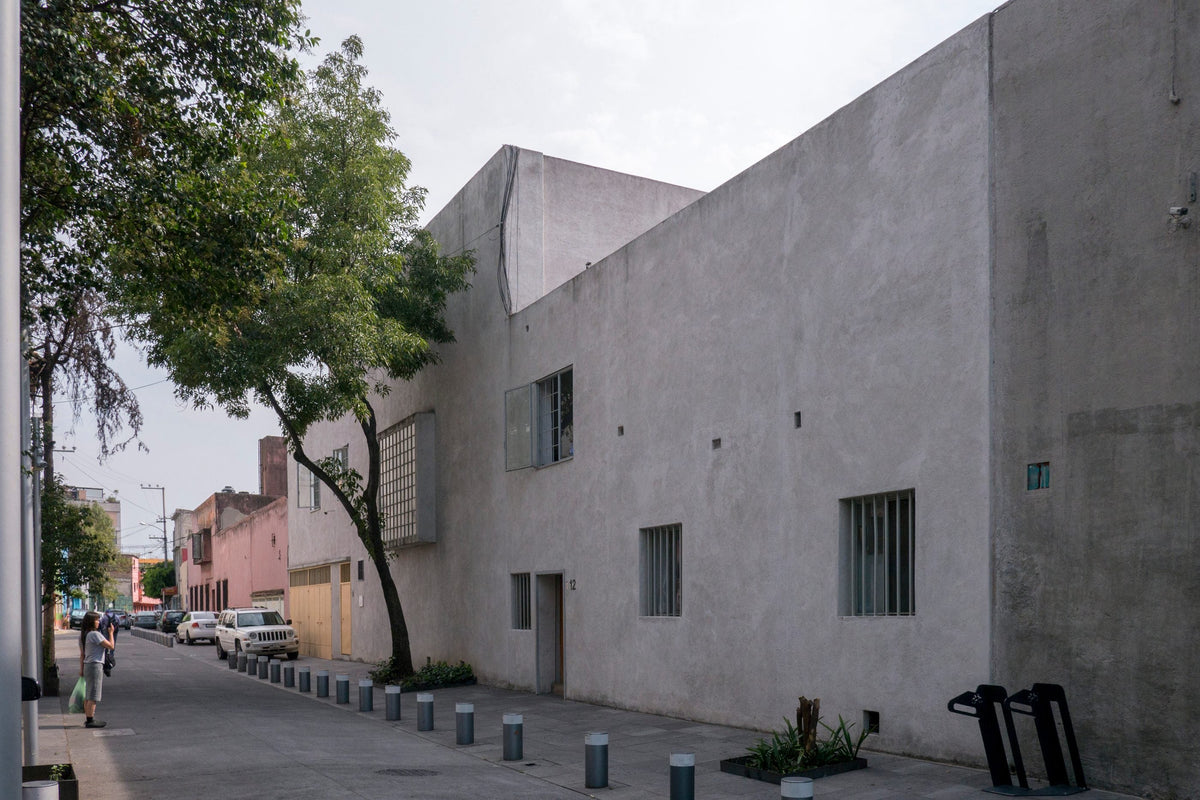
The plain street front of Casa Luis Barragán in Tacubaya, all the colour kept inside. Photo: Thomas Ledl, CC BY-SA 4.0, via Wikimedia Commons, licence
From the street in Tacubaya there is almost nothing to see. A plain two storey front, a few small windows, a wall the colour of dust. Step inside and the first room is yellow, a bright, unapologetic yellow that seems to give off its own heat. A little further, past a floor of volcanic stone, a wall turns pink. On the stair landing, gold leaf catches whatever light is left. And at the back, through a window that fills nearly a whole wall, a garden has been allowed to run wild.
This is Casa Luis Barragán, built in 1948 and lived in by its architect until his death in 1988. It is now a museum, jointly owned by the State Government of Jalisco and the Fundación de Arquitectura Tapatía Luis Barragán. In 2004 UNESCO inscribed it as a World Heritage Site, and it remains the only individual building in Latin America with that distinction. For a house with so little to say to the street, it has said a great deal to the century that followed it.

An engineer who taught himself to see
Barragán was born in Guadalajara in 1902 and trained as an engineer. As an architect he was largely self taught. He travelled in France and Spain in the 1920s and lived in Paris in 1931, where he attended the lectures of Le Corbusier. He could have come home a devoted modernist, all white walls and ribbon windows. Instead he built a house that keeps the modernist grid and then floods it with the colours of the Mexican street, the market and the convent.
When he received the Pritzker Architecture Prize in 1980, he used the occasion to speak about the things architects rarely mention in public: beauty, silence, solitude, the spirit. One line from that speech has followed his name ever since. "Any work of architecture which does not express serenity is a mistake." It is a strange sentence to read inside a house where one wall is pink and another is yellow. It only makes sense once you have stood in the rooms.
He also said something about looking that explains the house better than any plan. "It is essential to an architect to know how to see." The house is an argument for that kind of seeing, slow and unhurried, more interested in what light does to a wall at four in the afternoon than in what the wall is made of.
Colour doing the work of structure
In most houses colour is a finish, applied at the end when the real decisions have been made. At Casa Barragán colour is one of the real decisions. The yellow entry is small and filtered, a held breath before the larger rooms. The main living space rises two storeys, and its pink wall does more to define the room than any column could. The gold on the landing is not decoration so much as a lamp that never needs switching on.
Just as telling is the colour that is missing. There is no green anywhere inside the house. Barragán left that to the garden, which is nearly as large as the house itself and is visible through the great window in the living room, its cross shaped mullions framing tree branches, vines and wild grasses. The garden supplies the green, and so the house never has to compete with it. On the roof, orange and pink walls stand against the sky like a second, smaller garden made of planes.
The garden supplies the green, and so the house never has to compete with it.
Underfoot, everything is quiet. The floors are volcanic stone, dark stone and tropical wood. A floating staircase of plain wood climbs without a handrail. The furniture, designed by Barragán and by Clara Porset, is low and spare. Books on the Middle Ages, contemporary art, landscape and anthropology sit beside ceramics, religious figures and works by Josef Albers. The intensity is all on the walls. The ground is left to rest.
Serenity and intensity are the same thing
The tension at the heart of the house is the one Barragán seemed to enjoy most. How can a room with a hot pink wall be serene? The answer is in proportion and in restraint. There is one saturated plane, not five. It is large enough to hold the room together and calm enough, in its flatness, to be looked at for a long time. Pattern is almost absent. Ornament is almost absent. What remains is surface, light and the time it takes for one to change the other.
He wrote elsewhere of being moved by the peace of uninhabited cloisters and solitary courts, and the house carries that memory. The guest bedroom shutters form a cross when they are opened. A dressing room holds a large crucifix. Yet nothing about the place feels like a museum of faith. It feels like a house built by someone who knew exactly how much he needed, and was strict enough to stop there.
That strictness is the lesson worth carrying out of Tacubaya. A room does not become calm by being pale. It becomes calm when every element knows its place, when one surface is allowed to be loud and everything else agrees to be quiet. Barragán made a pink wall serene by making the floor, the wood and the stone patient enough to let it speak.
What the house asks of a floor
A visitor to the museum, which has received the public since 1994, notices something about the floors: they never argue with the walls. Stone and wood, matte and dark, they hold the room down while the colour lifts it up. It is a useful principle for anyone furnishing a home. If the wall is the event, the floor should be the ground. If the floor is the event, the walls should step back.
Barragán would probably have found the question of what to put on the floor a little beside the point. But the house answers it anyway. Whatever lies underfoot should share the earth tones of the stone and the warmth of the timber, should have texture rather than pattern, and should look as if it has always been there. In a room where colour does the work of structure, the floor's job is to be still.
Follow @casaluisbarragan on Instagram for their own work, in their own words.
Rugberry notes
From the Rugberry house
These Rugberry rugs share the palette Barragán built with: earth, rust, ochre and the warm side of pink. A solid rug with a deep, even pile behaves like one of his planes. It holds a single colour and lets the light move across it, so that the same rug reads as copper at noon and as something closer to brown at dusk.
If that way of using colour appeals, our textured solid rugs and rust and copper rugs work in a similar spirit, with the earthier terra rugs for rooms where the walls should do the talking.


In the Rugberry house
- Textured solid rugsOne colour, read through pile and light.
- Rust and copper rugsWarm earth tones that hold a room down.
- Terra rugsEarthy grounds for rooms with bold walls.
Rugberry has no affiliation with the studios featured. Images are from the Rugberry house unless credited.