Jantar Mantar, Jaipur: Geometry Built to Read the Sky
Images are credited where they are not from the Rugberry house.
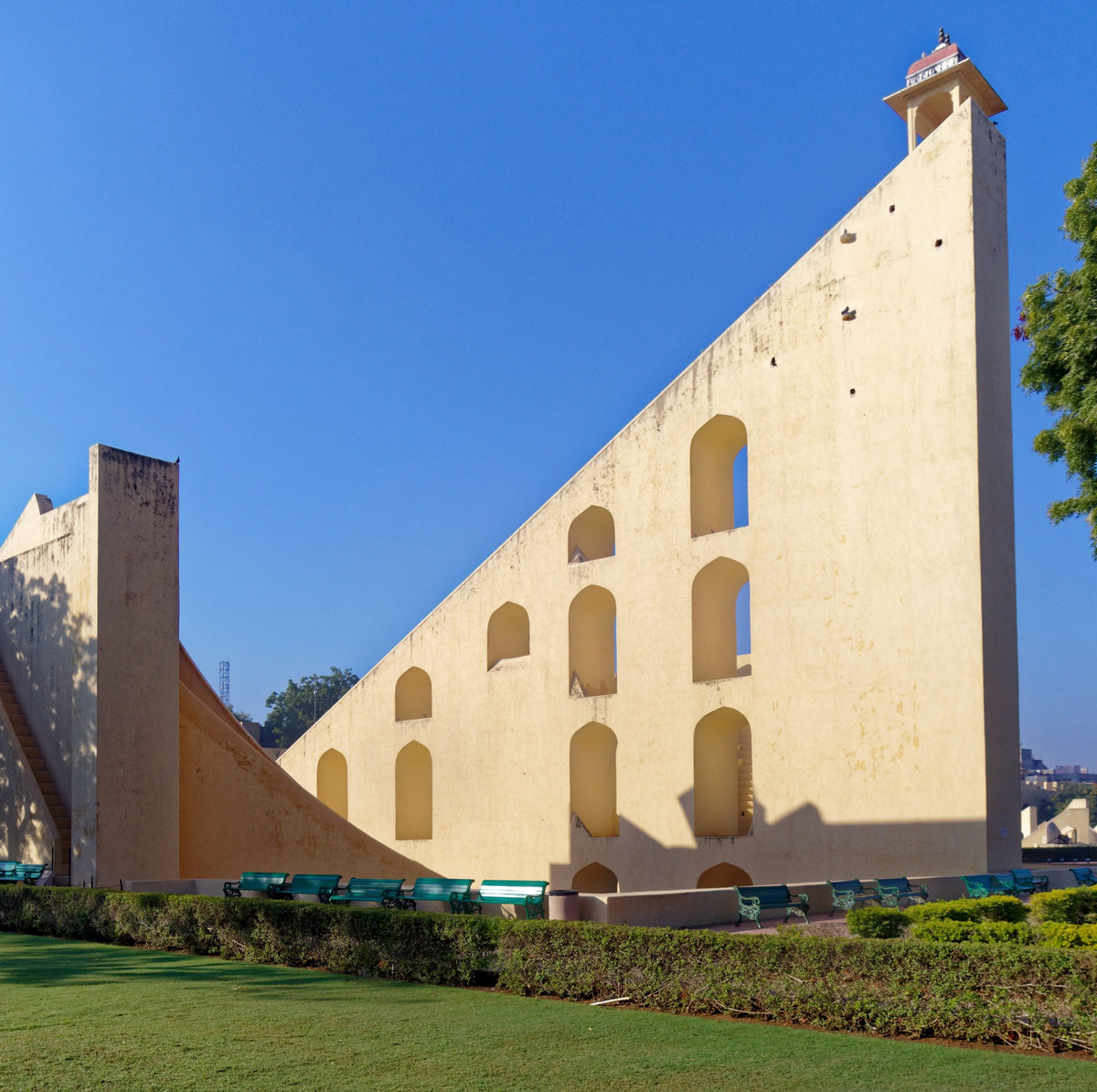
The Vrihat Samrat Yantra at Jantar Mantar in Jaipur, the great sundial, with its long stair running up the gnomon. Photo: Jakub Hałun, CC BY-SA 4.0, via Wikimedia Commons, licence
At noon in Jaipur the light comes down hard and white, and in one corner of the old city it does something unusual. It falls across a vast triangular wall of stone, and the shadow the wall throws slides along a curved scale so slowly that you have to stand still to see it move. Nothing about the place is decorated in the usual sense. There are no carved flowers, no painted borders. The geometry is the ornament, and the geometry is also a clock.
Jantar Mantar is an observatory, and one of the most surprising pieces of design in India. It was commissioned by Maharaja Sawai Jai Singh II and built between 1728 and 1734 in local stone and marble, the largest of five observatories he founded across the country. UNESCO inscribed it in 2010, describing an early 18th century site of some twenty main fixed masonry instruments, the most significant and best preserved of India's historic observatories.
Built big for a reason
The instruments are enormous, and the scale is not vanity. Jai Singh had found that the calendars available to him gave inaccurate positions for the planets, and he built his instruments far larger than earlier ones in order to read the sky more precisely. A small sundial has a small scale; a shadow moving across it moves by a hair. Make the dial the size of a building and the same moment of time is spread across a distance a person can see and measure.
UNESCO notes that the instruments were designed for observation with the naked eye, and that some are the largest ever built in their category. That is the key to their strange beauty. Each one is sized not to the human body, as most architecture is, but to the movement of the sun and stars, and then made readable to the human eye. The stairs, arcs and walls are what you get when an astronomer is given masonry instead of brass.

Each instrument is sized to the movement of the sun, then made readable to the human eye.
The great sundial
The largest of them, the Vrihat Samrat Yantra, stands 27.5 metres high and runs 45 metres long. Its long sloping edge, the hypotenuse of its great triangle, is set parallel to the axis of the Earth, so that it points at the celestial pole. Its shadow is read as time, and the instrument can give that time to an accuracy of about two seconds.
Climbing beside it, you feel the logic in your legs. The steps rise at the angle of the planet's axis; the wall ends where the geometry says it must; the curves are not chosen for grace but for truth. The grace arrives anyway. That is perhaps the most interesting lesson the place holds for anyone who works with pattern: when a form is completely determined by its purpose, it often ends up more beautiful than one designed to please.
Pattern without ornament
Rajasthan is famous for ornament. Its palaces are layered with mirror work, fresco and fretted stone; its textiles are dense with block printed and embroidered motif. Jantar Mantar sits in the middle of all this like a counter argument. Its patterns are stairs, scales, arcs and gridded floors, and every line has a job.
Yet the two traditions are not as far apart as they look. Much of the strongest Indian ornament is itself built on geometry: the grid beneath a jaali screen, the radial order of a lotus, the strict repeats of a woven border. Jantar Mantar simply strips the ornament away and leaves the geometry visible. Walking through it is like seeing the drawing beneath a finished design.

That is why the place speaks so directly to anyone who draws for the floor. A pattern on the ground is seen from above and from the side, at every angle, as people move across it. The patterns that last are usually the ones with an underlying structure strong enough to survive that movement: a clear line, an honest grid, an arc that resolves. Ornament can be added to that structure, but it cannot replace it.
There is a useful discipline in that idea for anyone choosing what goes on a floor. Before asking whether a pattern is pretty, ask what it is doing. Does it give a long room a direction? Does it hold a seating group together, or mark a threshold, or simply let the eye rest? The instruments in Jaipur answer a question about the sky with a form, and every form there can be explained. A rug that can explain itself in the same way, even in a sentence, will usually sit in a room more easily than one chosen only for its surface.
A claim on time
Another layer runs underneath, quieter and more political. UNESCO notes that the observatory was also a symbol of royal authority, because it gave its ruler control of time. Whoever could fix the calendar could fix the dates of festivals and rituals and the rhythm of the year. The great sundial is a scientific instrument, but it is also a statement, made in stone and at the scale of a palace, about who was in charge of the hours.

Seen that way, the restraint of the design becomes a kind of confidence. The instruments do not need decoration to impress, because what they claim is larger than any decoration could express. They claim the sky.
Reading the shadow
Visit early or late in the day if you can, when the sun is low and the shadows are long, and the forms are at their most legible. Stand beside the great wall and watch its shadow move along the scale. It is one of the few places where you can see time pass as a physical event, as definite as a line drawn on a page.

And notice the space between the instruments. Each form stands in open ground, with room enough around it to be read whole, and the calm of the place depends on that openness as much as on the geometry itself. A strong form needs room around it. The same is true indoors, where a good floor knows when to carry the geometry and when to say nothing.
Rugberry notes
From the Rugberry house
The lesson we take from those great stone instruments is that geometry carries a room best when it is clear and has a reason to be there: a line that runs true, a repeat that holds its rhythm, an edge cut to a deliberate shape.
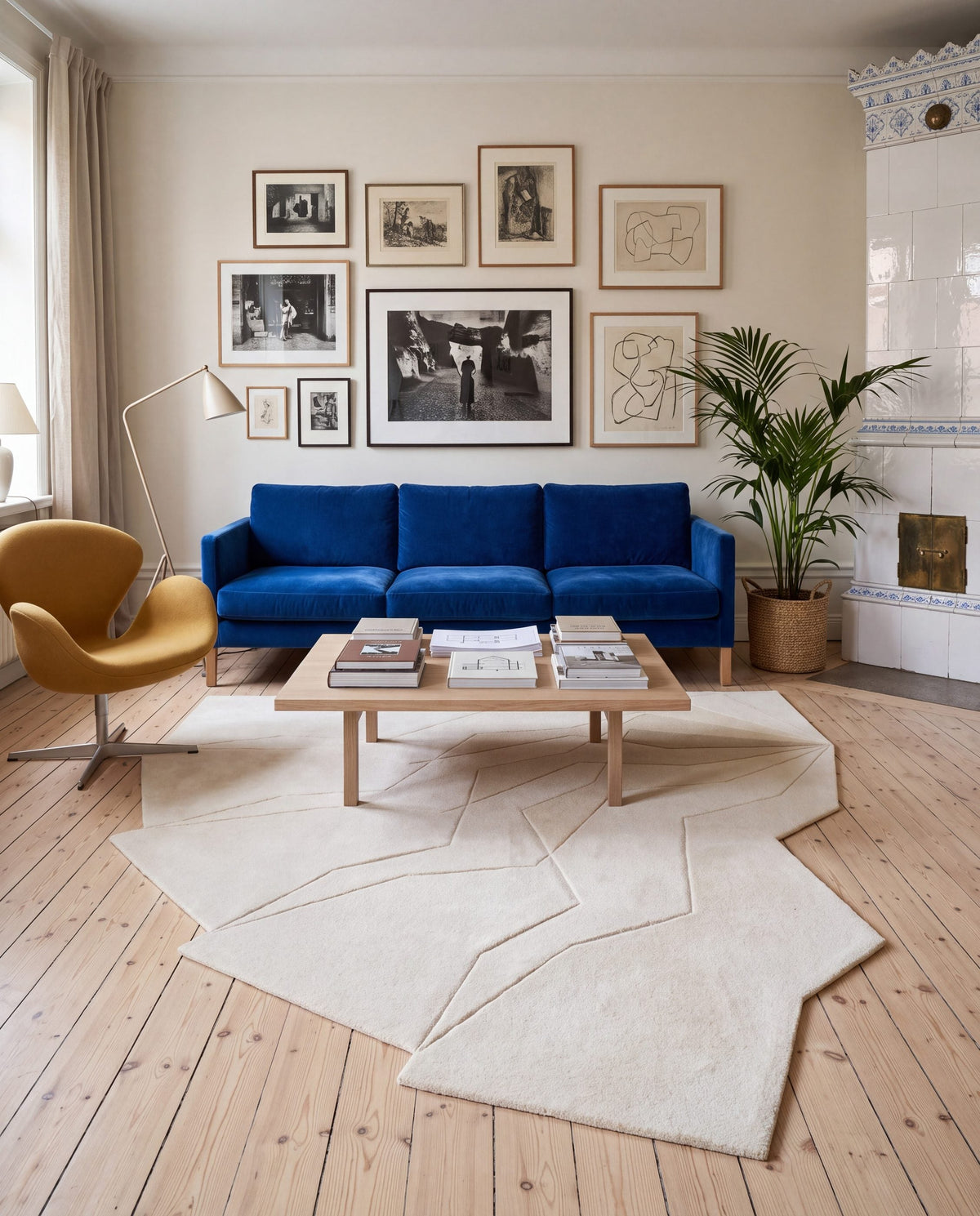
If that way of drawing appeals, our pattern rugs keep their lines clean, and our shaped rugs let the outline itself become the design.


In the Rugberry house
- Pattern rugsLines and repeats with a structure underneath.
- Modern rugsClear geometry for contemporary rooms.
- Shaped rugsThe outline as the design.
Rugberry has no affiliation with the studios featured. Images are from the Rugberry house unless credited.