Khadi: Spun by Hand, Worn as Protest
Images are credited where they are not from the Rugberry house.
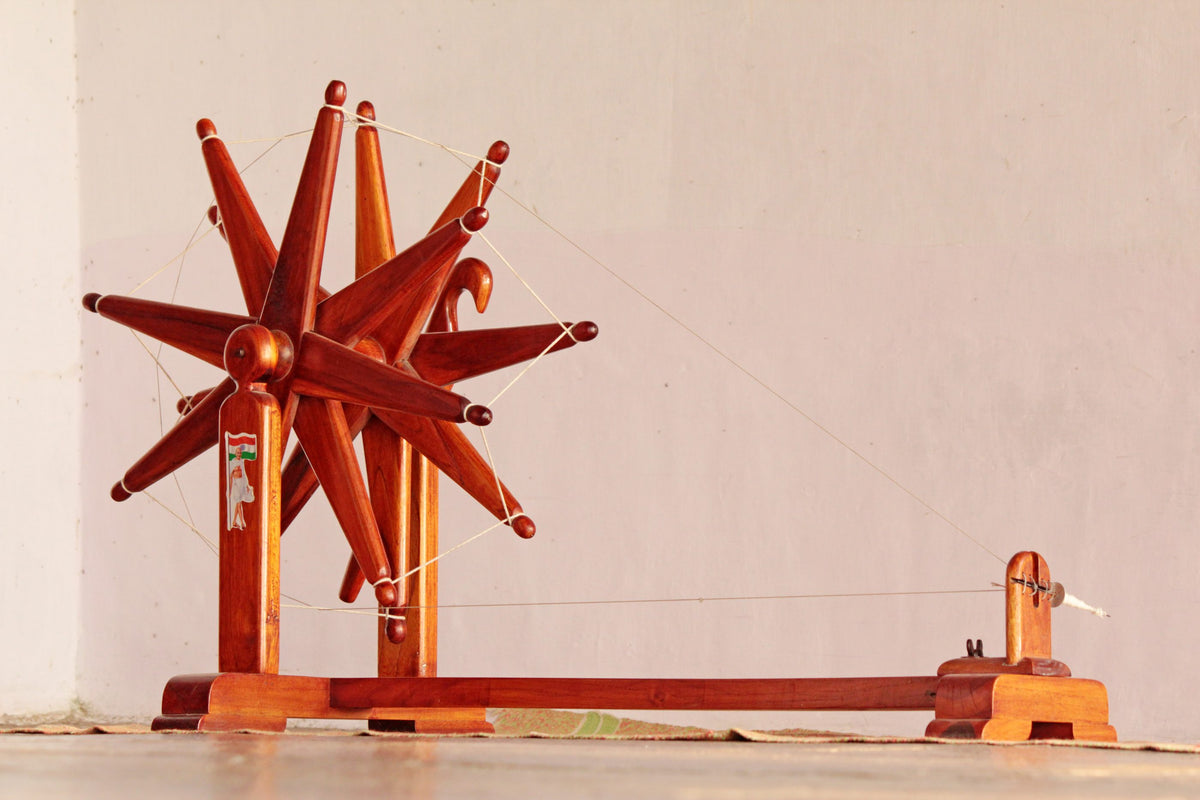
A charkha kept at the Gandhi Ashram, Sabarmati, Ahmedabad. Photo: Jigar Brahmbhatt, CC BY-SA 3.0, via Wikimedia Commons, licence
Hold a length of khadi up to the light and it is never quite even. The yarn thickens and thins as it runs across the cloth, a little slub here, a looser stretch there, each one a moment when the spinner's hand slowed or quickened on the wheel. In a machine made fabric those variations would count as faults. In khadi they are the signature, the visible record of a person spinning.
Khadi is, in the simplest terms, cloth that is spun by hand and woven by hand. It has traditionally been made in cotton, wool and silk. Because handspun yarn carries a low twist, the finished cloth is open and breathable, cool in summer and warm in winter, which is a rare combination in any fabric. That is the practical case for it. The other case, the one that made it famous, is political.
A wheel he had not yet seen
In 1908 Gandhi wrote Hind Swaraj, and in it he called the spinning wheel a panacea for the growing poverty of India. The confidence of the claim is striking, all the more so because of what he admitted later. In his autobiography he wrote that he could not remember having seen a handloom or a spinning wheel when he made it. The symbol came before the object.

Finding the object took time. Gandhi met Gangabehn Majmundar at the Broach Educational Conference in 1917, and after long wandering through Gujarat it was she who found the wheels, in Vijapur, in what was then Baroda State, stored away in lofts, the tools of a craft that had fallen out of use. Once the wheels came down and were put back to work, Vijapur khadi soon gained a name. There is a quiet lesson in that detail. The knowledge had not vanished. It had been put away, waiting for a reason to come back.
What followed is familiar from every history of the freedom movement: the charkha as an emblem, homespun as a uniform, the act of spinning as a daily discipline and a refusal of imported cloth. Few objects have carried as much meaning as that simple wheel. It turned a household task into a statement that anyone could make, with their own hands, every day.


What the hand puts into the yarn
Why does the hand matter so much in khadi? The answer is not sentimental. A spinner working by hand draws out the fibre and adds twist at a pace set by their own judgement, and the twist stays low. Low twist yarn is softer and fuller, with more air trapped between the fibres. Woven into cloth, that air is what makes khadi breathe in the heat and hold warmth in the cold. The irregularity that the eye notices is the same irregularity the skin feels as comfort.

This is why the textile scholar Rta Kapur Chishti is cautious about what happened next. To raise output, the later ambar charkha increased the number of spindles from two to eight, then to sixteen and twenty, and eventually needed electric motors to drive them. Production rose. In her argument, the qualities that made khadi distinctive were compromised along the way. A yarn spun faster and more evenly by a motorised wheel is closer to a mill yarn, and the cloth woven from it loses some of the softness and breath that justified the whole effort.
The irregularity the eye notices in khadi is the same irregularity the skin feels as comfort.
Every handmade craft lives with this tension. The pressure to make more, more evenly, at a lower price, is real, and it comes from good intentions as often as bad ones. More output can mean more work for more people. But past a certain point, the tool changes the thing it makes. The question is not whether to use better tools, but where the line falls between helping the hand and replacing it.
Wool makes the same point in a different way. A yarn spun slowly and loosely keeps its loft, the springiness that lets it recover after it has been pressed flat. Spun fast and tight, it becomes harder and leaner. Anyone who has handled both knows the difference at once, even without the words for it. The hand is not only a romantic idea in textiles. It is a measurable quality of the yarn.
Khadi today
Khadi remains a large undertaking. The Khadi and Village Industries Commission reported khadi cloth production worth Rs 3,783.36 crore and khadi garment sales of Rs 7,145.61 crore in 2024 to 2025. According to the same report, roughly five lakh artisans work in khadi, and about 80 percent of them are women. Those figures describe an industry, not a museum piece, and they describe it as overwhelmingly the work of women's hands.
The numbers also bring back Chishti's question. A craft at that scale has to decide, again and again, how much of the hand to keep. Every gain in speed is weighed against a loss in the quality that gave the cloth its name. There is no single right answer, but it should be asked aloud, because the people who buy khadi deserve to know what they are paying for, and the people who make it deserve to be paid for what only they can do.
What it means for a room
For anyone furnishing a home, khadi carries a lesson that goes beyond cloth. The slight unevenness of a hand made surface is not a flaw to be tolerated. It is the point. A handspun throw, a hand woven cushion cover, a rug made on a loom by a person, all of them carry small irregularities that a machine would iron out. Those irregularities catch the light differently across the day. They soften with use rather than wearing thin. They make a room feel lived in, because they show that people made the things in it.
The principle that Chishti defends is close to the one Rugberry works by. When a rug is woven on a handloom, the weaver sets the pace, beats in each row by hand and lets the yarn behave like yarn. The result is never perfectly uniform, and we would not want it to be.
Gandhi's wheel was a symbol long before it was a tool in his own hands. For the women who still spin and weave khadi today, it is the other way round. It is a tool first, and its meaning lives in the cloth it makes: open, breathable, a little uneven, and unmistakably human.

If the handloom side of this story interests you, our handloom rugs are woven on the loom in New Zealand wool, and the art of making follows a Rugberry rug from yarn to finished piece.


In the Rugberry house
- Handloom rugsWoven on the loom in New Zealand wool.
- The art of makingFrom yarn to finished rug.
- Sustainable rugsPlant and natural fibres.