


Designer Collaborations: How Rugberry Works with Designers
A Rugberry collaboration turns a designer's visual language into a small family of rugs, made in Rugberry's fibres and constructions and sold under both names. The three existing collections, with Marie Ducept, Khaled Hashem and Nina Brunn, show how different that language can be.
In short
- Rugberry has three designer collaborations on its India store: Marie Ducept x Rugberry, Khaled Hashem x Rugberry and Nina Brunn x Rugberry.
- The Ondulation Rug from the Marie Ducept collection is hand tufted New Zealand wool in 10x13 ft, from about ₹1.75 lakh.
- The Amal Rug from the Khaled Hashem collection is hand tufted wool and silk in 5x7 ft, from about ₹48,000.
- A strong rug collection starts from one consistent idea, such as a line, a surface or a mark, worked across a few sizes and colours.
This piece is for Indian designers thinking about a rug collection of their own. It looks at what the existing collections share, not at their commercial terms.
What is a Rugberry designer collaboration?
A Rugberry designer collaboration is a named collection of rugs drawn by an outside designer and made by Rugberry. The designer brings the visual idea, and Rugberry brings fibre, construction and making.

Each collection lives on its own page, such as Marie Ducept x Rugberry and Nina Brunn x Rugberry. The rugs carry the same product facts as the rest of the range: fibre, construction, sizes and price before GST.
Terms differ from designer to designer and are not published. What can be seen is the work itself, which says a great deal about how a collaboration is shaped.
What do the three collections have in common?
Each collection is built on one clear idea that repeats across its rugs. That consistency is what makes a group of rugs read as a collection rather than a list.


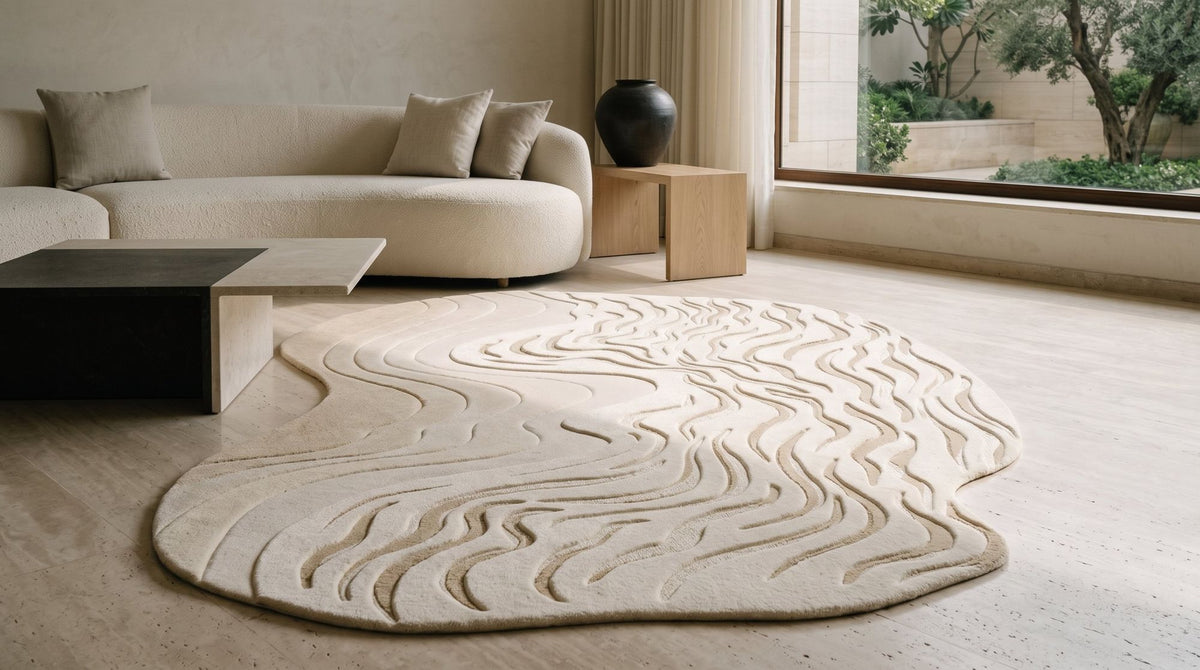
- Marie Ducept: surface and movement. The Ondulation Rug runs in long, even undulations across its pile.
- Khaled Hashem: the drawn line. The Amal Rug is an open field broken by a single drawn line.
- Nina Brunn: the quiet mark. The Bitte Wool Rug scatters small repeated marks across an otherwise quiet ground.
None of the three relies on colour to carry the idea. The concept survives a recolour, which matters when the same rug must sit in a Mumbai flat and a Bengaluru villa.
Each collection also keeps to a small number of rugs. A tight edit is easier for a client to understand and easier for a designer to specify, because every piece clearly belongs to the same family.
How does the Marie Ducept collection work?
The Marie Ducept collection works through texture and scale. The Ondulation Rug is hand tufted New Zealand wool in 10x13 ft, from about ₹1.75 lakh, its surface running in long, even undulations.
A rug like this is designed for a large room. Its pattern needs floor to unfold, so the stock size is generous, and it can also be made in any size and colour.
Undulations of this kind are carried by the pile itself, so they change with the light across a day. In a south facing Hyderabad living room the same rug reads soft in the morning and sculpted by late afternoon.
How does the Khaled Hashem collection work?
The Khaled Hashem collection works through restraint: one gesture on an open field. The Amal Rug is hand tufted in New Zealand wool and silk, 5x7 ft, from about ₹48,000, with a low sheen that shifts as you cross the room.
The smaller stock size suits a bedroom side, a study or a compact living room. The silk lifts the single line so that it catches light, which is why so little drawing can hold a whole rug.
A collection is one clear idea, worked across a few rugs, that survives a change of colour.
How does the Nina Brunn collection work?
The Nina Brunn collection works through calm grounds and small marks, and it is the broadest of the three. The Bitte Wool Rug is hand tufted New Zealand wool from about ₹40,000, with small repeated marks scattered across a quiet ivory ground.

The collection also includes wool, wool and silk and reversible rugs, which shows that one design language can travel across constructions. For a designer, that is a useful model: an idea that can live at more than one price.
What should a designer bring to a rug collaboration?
A designer should bring a body of work with one recognisable idea, a sense of the rooms the rugs are for, and drawings that can become yarn. A portfolio of unrelated patterns is harder to turn into a collection than three variations on one theme.


- Show two or three finished projects where the idea already appears.
- Draw in flat colour, at scale, with numbered colours.
- Name the rooms: Indian living rooms, bedrooms or hospitality spaces.
- Expect to work through swatches before the first rug is made.
Our pieces on the Marie Ducept collection and the rug design process go further into how a drawing becomes a rug.
Frequently asked questions
Can an Indian designer propose a collection to Rugberry?
Designers can approach Rugberry with a body of work and an idea for a collection. Rugberry does not publish its collaboration terms, which are discussed case by case.
Are collaboration rugs customisable?
Yes. The Ondulation, Amal and Bitte product pages each state any size to order and custom colours on request.
What constructions are used in Rugberry collaborations?
The current collections are mainly hand tufted New Zealand wool and wool and silk, and the Nina Brunn collection also includes reversible rugs. Construction is chosen to suit the drawing, not the other way round.
One idea, drawn clearly, made in good fibre. Material first.



Leave a comment
This site is protected by hCaptcha and the hCaptcha Privacy Policy and Terms of Service apply.