




Geometric Rugs for Modern Indian Homes
A geometric rug suits a modern Indian home when its scale is chosen against the room and the floor, not only against the sofa. Choose one large shape for a small room, a repeat that does not echo your tile grid, and a construction that keeps edges crisp, such as hand tufted New Zealand wool.
In short
- A geometric rug is defined by three choices: whether its edges are hard or soft, how large its repeat is, and how heavy its lines are.
- On a vitrified tile floor, a geometric repeat close in size to the tiles, such as 2x2 ft, can fight the joint lines, so choose a clearly larger or smaller scale or a curved geometry.
- Hand tufting can place curves and straight lines precisely, which is why most geometric rugs at Rugberry are hand tufted New Zealand wool at 14 to 16 mm.
- Rugberry geometric designs include Clique in Bone White and Pitch Black, Mosaic and the stepped Talus, priced from ₹27,195 inclusive of GST at the time of writing.
What makes a rug geometric?
A rug is geometric when its pattern is built from shapes that could be drawn with a ruler or a compass: lines, circles, squares, steps and the spaces between them. That separates it from a botanical, a painterly abstract or a traditional medallion, even when colours overlap.


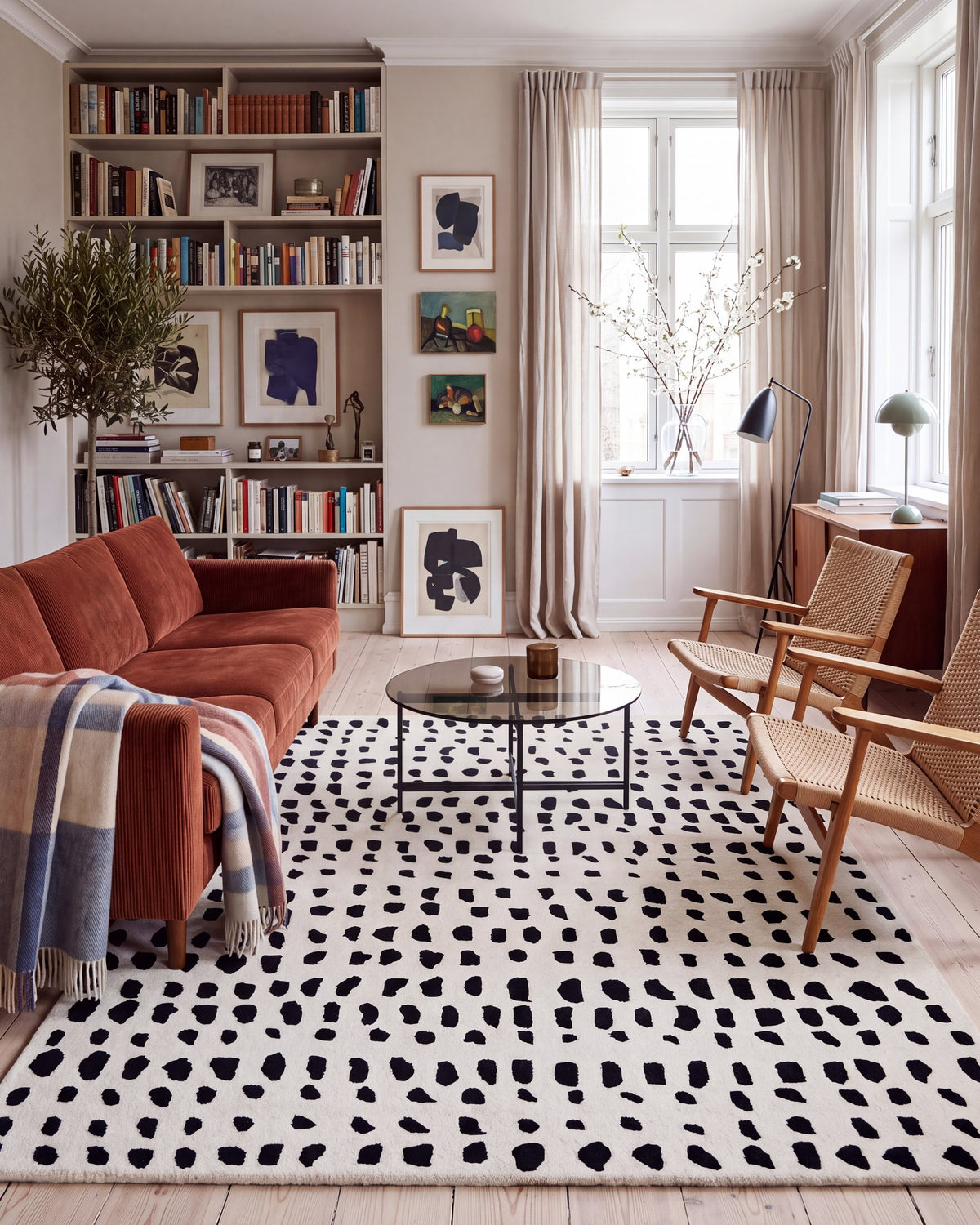
Geometric rugs in India have moved a long way from the busy all over grids of the 1990s. Today's modern Indian homes, with plain plaster walls, large format tiles and low, clean lined sofas, tend to suit fewer, larger shapes and two or three colours at most.
Within that family there are clear types. Hard edge geometry uses crisp blocks of flat colour, and line work builds shapes from many thin lines.
Soft geometry keeps the shapes but rounds the corners and lets the outline waver, so it reads as drawn by hand. A stepped or shaped rug carries the geometry into its outline as well as its field.
| Type of geometry | What you see | Rugberry example | Where it works best |
|---|---|---|---|
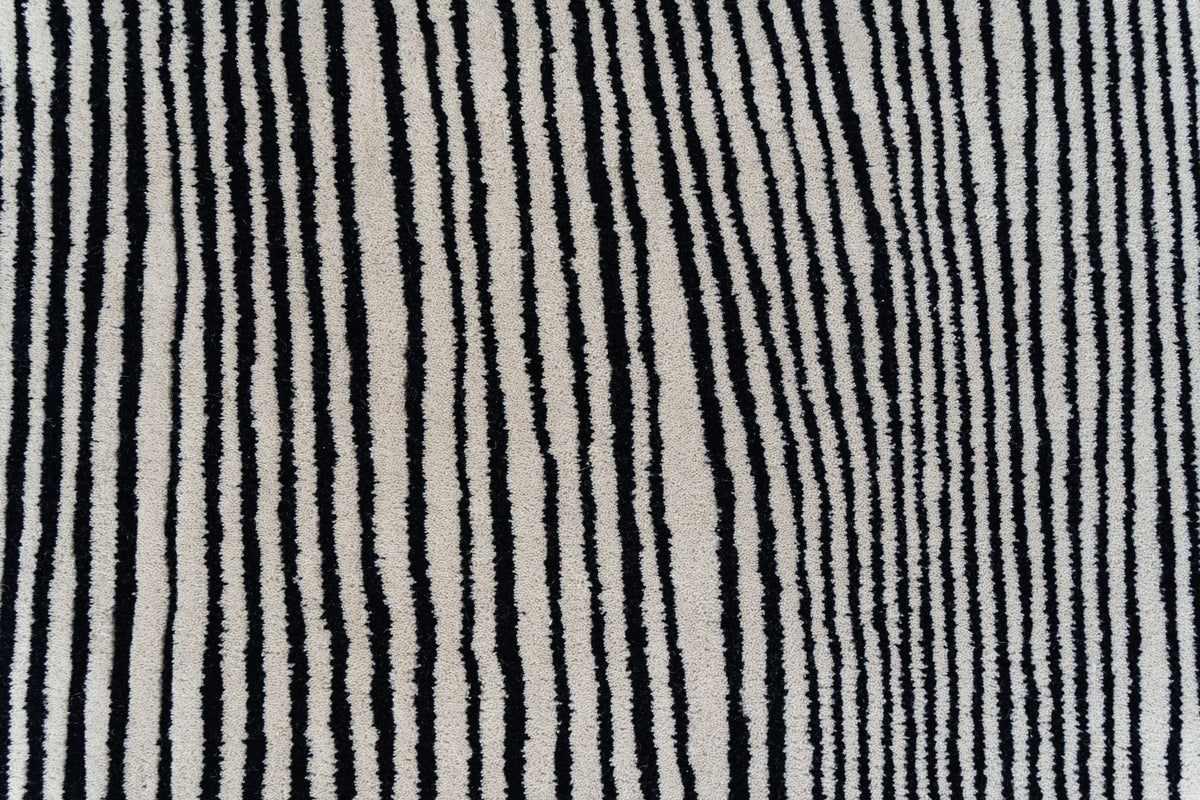
| Line work | Shapes filled with many fine parallel lines | Clique, two circles of lines on ivory or black | A bedroom or study where one strong motif gives focus |
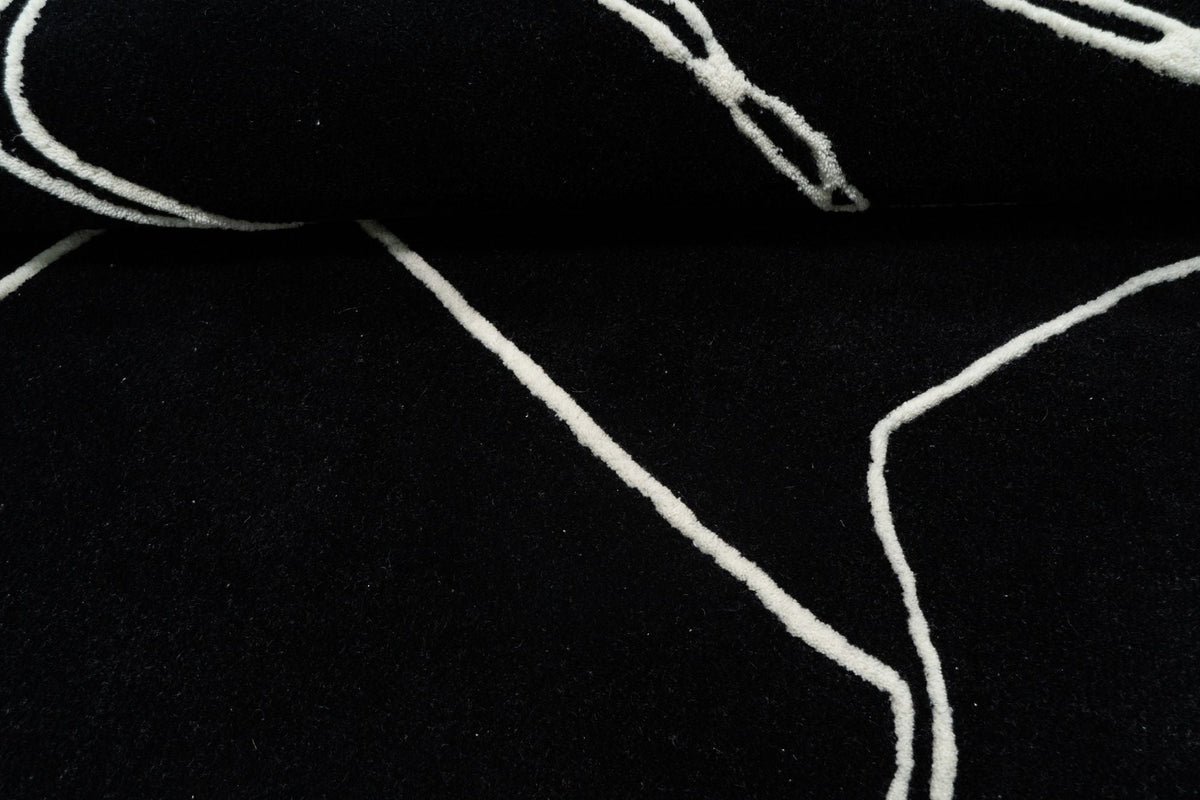
| Soft outline | Thin outlines of angular shapes with rounded corners | Mosaic, ivory outlines on black | A large living room with plain upholstery |
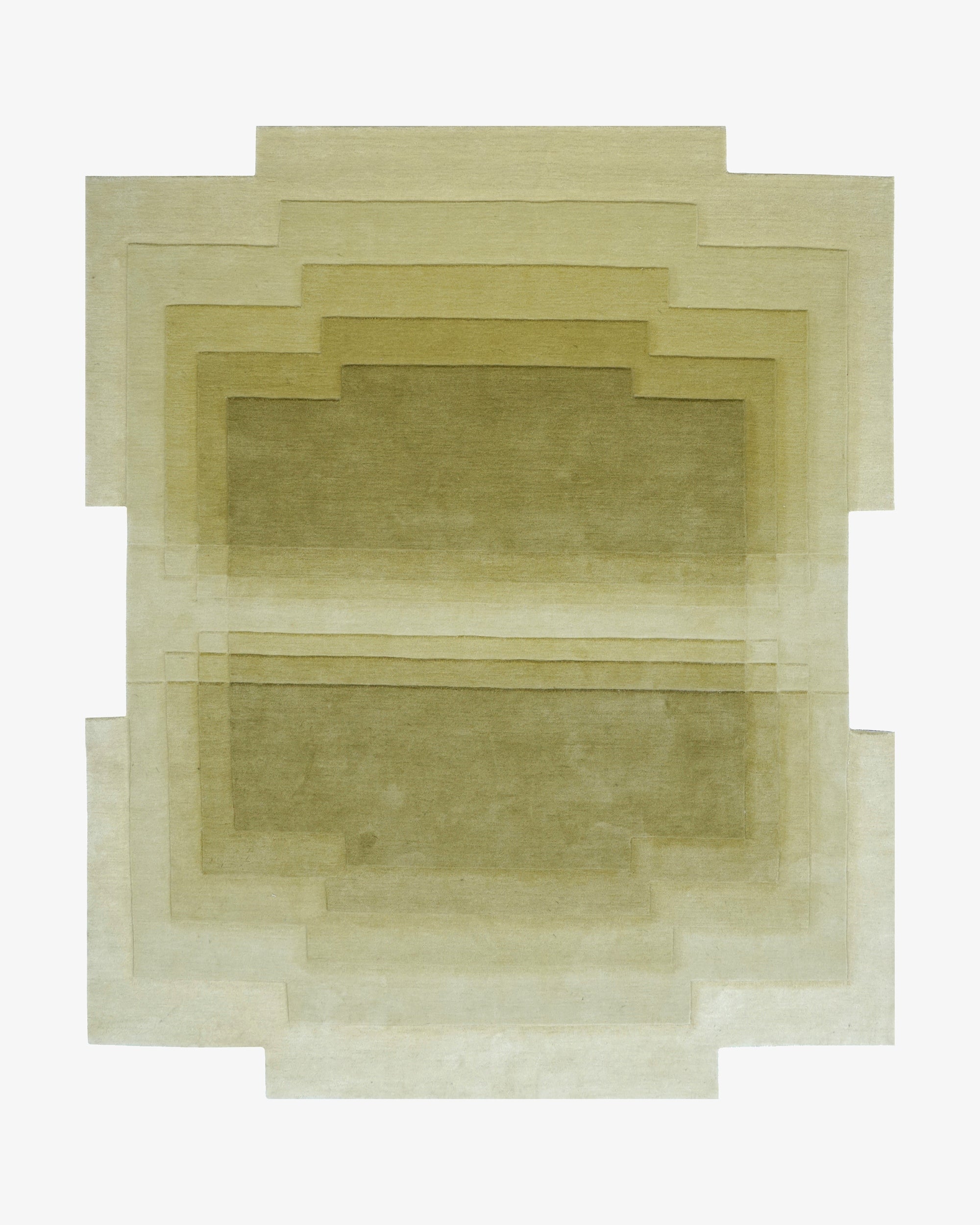
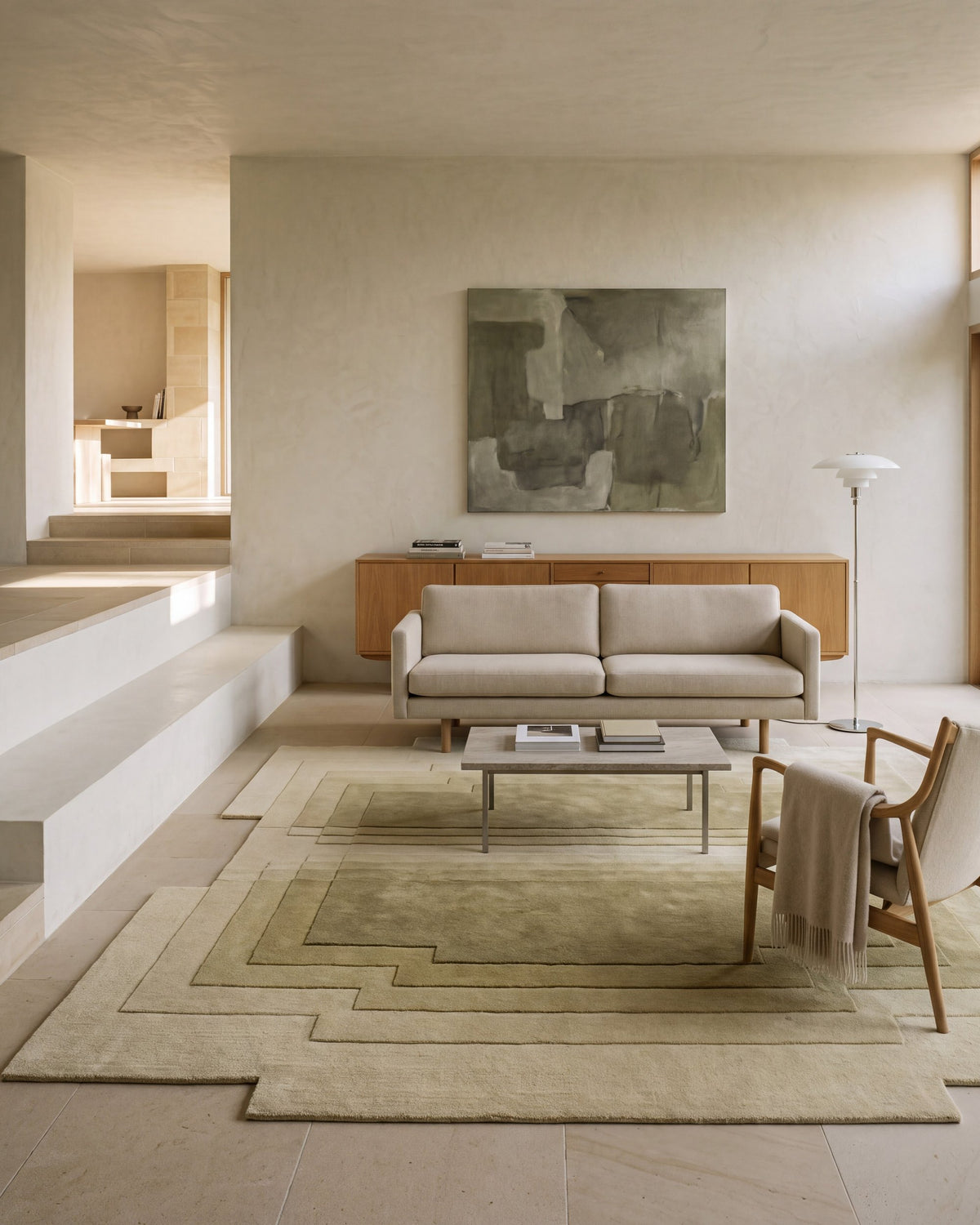
| Stepped and shaped | Tiers of tone and an outline that steps in and out | Talus, layered greens from the Lamina collection | An open plan room or a raised seating area |
| Woven grid | Squares set out on a regular grid | Kora, darker squares in natural jute | A dining room or passage on a dry floor |
Verdict: for a first geometric rug in a calm modern home, choose line work or soft outlines over hard edge blocks, because they add pattern without turning the floor into the loudest surface in the room.
How do you read the scale of a geometric pattern against your room?
Read scale by asking how far away the rug will usually be seen from and how much of it furniture will cover. Fine lines merge into a tone when you stand a few metres away, while one large shape stays legible across a big room.

In a 10x12 ft bedroom, a rug with one central motif gives the room a centre. Clique works this way: two circles of fine lines meet near the middle of the rug, and in a bedroom they sit at the foot of the bed where the whole motif stays visible.
In a living room the coffee table often stands right on the centre of the rug. A central motif can then disappear, so lay a sheet of newspaper where the table will go on the product photo, scaled roughly to your room, and see what remains. An all over pattern such as Mosaic keeps its character even with a table in the middle.
In a geometric rug living room scheme, also check the sight line from the sofa. People seated look at the rug at a low angle, which compresses the pattern, so a circle seen from a seat reads as an oval and fine lines close up into a darker band. Shapes that are a little bolder than you think you need often look right once you sit down.
Line weight matters too. A rug with thin lines needs to be seen up close to read as pattern, which suits a bedroom or a reading corner. Heavier lines and bigger shapes are what carry in a 15x20 ft drawing room or a double height space.
How should a geometric rug sit on a vitrified tile grid?
A geometric rug sits best on a vitrified tile grid when its repeat is clearly different in size from the tiles and its edges run parallel to the joints. Most Indian apartments use tiles of 600x600 mm, 800x800 mm or 600x1200 mm, and those joint lines form a grid of their own.

When a rug's squares or lines are close to the same size as the tiles, the two grids compete and the eye cannot settle. A pattern with a much larger scale, a much smaller one or a curved geometry avoids that clash. Circles and soft outlines, such as Clique and Mosaic, sit happily on any tile grid because they share no straight module with it.
Alignment matters as much as scale. An 8x10 ft rug covers roughly four by five tiles of 600 mm, so set its edges on or parallel to a joint line and the room looks planned.
A rug a few degrees off the tile grid looks careless, and on a geometric design the error is doubled. Our guide to rugs for marble and tile floors covers grip and underlay on these surfaces.
Two grids in one room will argue. Give the rug a scale the floor does not already have.
Which Rugberry rugs are geometric, and what do they cost?
Rugberry's geometric rugs range from line work and soft outlines to stepped, shaped designs, most of them hand tufted in New Zealand wool at 14 to 16 mm. The prices below are the lowest listed prices, for the smallest size, inclusive of GST at the time of writing.


The Clique Wool Rug in Bone White sets two circles of fine black lines on an ivory ground, and the Clique Wool Rug in Pitch Black reverses it with ivory lines on black. Both come in all six standard sizes from 5x8 to 12x15 ft and are listed from ₹27,195.
The Mosaic Wool Rug draws thin ivory outlines of angular, round cornered shapes across a black field, from ₹31,080 in sizes from 5x8 to 12x15 ft. The Talus Wool Rug, part of the Lamina collection, steps its tones and its outline in tiers of green, from ₹33,600. For a rug built on circles in softer colourways, see our guide to the Round Square rug.
Which constructions keep geometric edges crisp?
Hand tufting keeps geometric edges crisp because the yarn is placed along a drawn outline, so curves and fine lines follow the design closely. Other constructions can carry geometry too, but each has its own limits on what shapes look right.


In a hand tufted rug, the edge between two colours can be sharpened further by carving, where the pile is cut slightly lower along the boundary. In a hand knotted rug, smooth curves depend on knot density: finer knotting draws rounder circles, while coarser knotting turns a curve into small steps.
Flat woven rugs favour straight lines. On a loom, squares, stripes and steps come naturally and circles become stepped approximations, which is why the handwoven Kora Jute Rug uses a grid of squares. If your heart is set on a perfect circle, choose tufted wool; if you want a woven grid, a flat weave is the honest choice.
Can you mix a geometric rug with patterned upholstery?
You can mix a geometric rug with patterned upholstery if the two patterns differ clearly in scale and share at least one colour. A small check on cushions beside large circles on the floor looks considered; two medium checks look like a clash.

Keep one of the two patterns quiet in colour. Clique in Bone White, mostly ivory with black lines, sits well beside a sofa in a printed fabric, because it adds structure without adding new colours. Mosaic on black is bolder and wants plain upholstery around it.
Ikat, block print and bandhani cushions are geometric in their own way, but their edges are soft and slightly irregular. Pair them with a rug whose geometry is also drawn rather than ruled, such as Mosaic's wavering outlines, and the two will feel related. Our guide to a rug with a patterned sofa goes further into prints on the sofa itself.
Is a geometric rug a good choice for an Indian family home?
A geometric rug is a good choice for a family home when the pattern spreads across most of the field, because it breaks up the marks of daily life. A single motif on a large plain ground shows every footprint around it.
Black and ivory designs show different things. Ivory grounds show dust and spills; black grounds show lint, pet hair and the pale dust that settles in Indian cities in winter. A pattern with both colours in fine lines, like Clique's circles, disguises a little of each.
Think about where people walk. A geometric rug in a passage or at a doorway is crossed constantly, so a dense all over pattern holds up better visually than a central circle that everyone steps on. For more on how pattern ages over the years, see texture or pattern for a rug that ages well.
Frequently asked questions
What size geometric rug should I buy for a living room in India?
For a three seater sofa with two chairs, 8x10 ft is the usual starting point, and 9x12 ft suits larger drawing rooms. With a geometric design, check that the main shapes are not hidden under the coffee table at that size.
Do geometric rugs make a small room look smaller?
Not if the scale is right. One large motif or a few bold lines can make a small room feel calmer and more spacious than a busy small repeat, which tends to look cluttered at close range.
Is a black geometric rug hard to keep clean?
A black ground shows lint, pale dust and pet hair more than it shows spills. Regular vacuuming keeps it sharp, and a design with ivory lines through the black, such as Mosaic or Clique in Pitch Black, hides some of that dust.
Can I order a Rugberry geometric rug in my own colours?
Yes. Rugberry geometric rugs are listed as customisable, so the colours can be changed and the rug made to any size. Rugberry Me, the free recolouring tool on rugberry.in, lets you try colourways on a design first.
Which is better for geometric patterns, hand tufted or hand knotted?
Hand tufted wool gives the cleanest circles and fine lines for the price, which is why most geometric rugs are made that way. Hand knotted rugs can match that crispness only at a high knot density, which raises the cost considerably.
Start with the room and the floor, then let the shapes follow. The full range is in pattern rugs and modern rugs at Rugberry. Material first.



Leave a comment
This site is protected by hCaptcha and the hCaptcha Privacy Policy and Terms of Service apply.