


Article: Hallway Runners for Indian Apartments
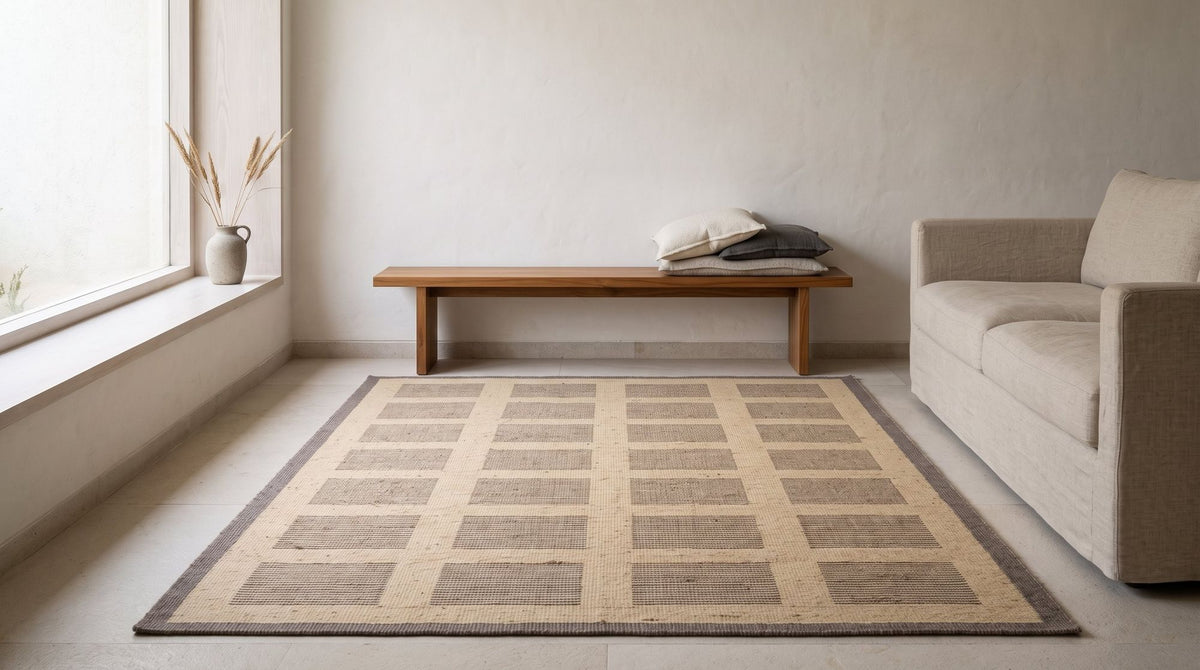
Hallway Runners for Indian Apartments
A hallway runner should leave 10 to 15 cm of bare floor on each side and stop 15 to 30 cm short of each end of the passage. In a typical Indian flat with a 3.5 ft passage, that means a runner about 2.5 to 3 ft wide.
In short
- A hallway runner should be 20 to 30 cm narrower than the passage, so a strip of floor shows on both sides.
- In a 3.5 ft wide passage, a runner about 2.5 to 3 ft wide looks right; in a 4 ft passage, about 3 to 3.5 ft.
- The Rugberry Nahda Rug is a stock runner in 3.5x8 ft (100x250 cm), hand tufted in New Zealand wool and silk, from about ₹45,000.
- Other Rugberry runners, such as the Kora Jute Rug or the Grain Wool Rug, are made to the width and length you give, through the customisable route.
The passage that links bedrooms in most Indian 2BHK and 3BHK flats is long, narrow and full of doors. A runner sized to it changes how the whole flat feels to walk through.
What size runner suits an Indian apartment hallway?
Choose a runner about 20 to 30 cm narrower than the passage and 30 to 60 cm shorter than its length. The floor that shows around it is what makes it look intended.

| Passage width | Runner width | Floor showing each side |
|---|---|---|
| 3 ft (90 cm) | 2 to 2.5 ft (60 to 75 cm) | 8 to 15 cm |
| 3.5 ft (105 cm) | 2.5 to 3 ft (75 to 90 cm) | 8 to 15 cm |
| 4 ft (120 cm) | 3 to 3.5 ft (90 to 105 cm) | 8 to 15 cm |
| 5 ft (150 cm) and wider | 3.5 to 4 ft (105 to 120 cm) | 15 cm or more |
For general runner proportions in kitchens and beside beds, see our runner size guide. A passage has its own extra rule: the doors.
How do you measure a passage for a runner?
Measure the width at its narrowest point and the length between the two places where the runner must stop. Then walk the passage and open every door.


- Measure the width in three places. Indian passages often narrow where a wardrobe or a pillar juts out.
- Measure the length from the living room threshold to the far wall or the last door.
- Note every door that opens into the passage, and measure the gap under it.
- Note any threshold strip or level change, often at a bathroom door.
A bedroom door with less than about 1.5 cm of clearance will catch a pile runner. In that case, either end the runner before that door or choose a low, flat weave.
Which stock runner does Rugberry carry?
The Nahda Rug is the Rugberry runner held in stock, in 3.5x8 ft (100x250 cm). It is hand tufted in New Zealand wool and silk, rising in a single arc across the field, from about ₹45,000.
At 3.5 ft wide it suits a passage of about 4 to 4.5 ft. Its low sheen shifts as you walk past, which is why it works in a passage, where it is always seen in motion.
How do custom width runners work?
For any width or length other than 3.5x8 ft, a runner is made to order to your measurements. Most Rugberry designs, including the Kora Jute Rug and the Grain Wool Rug, can be made to any size and colour.


Give the finished width and length you want, not the passage size. A long passage of 14 to 18 ft often needs one continuous runner, which is only possible as a custom piece.
The route is the same as for any customisable rug. The price follows the area, so a 2.5x14 ft runner of 35 sq ft costs less than a 5x8 ft rug of 40 sq ft in the same design.
A passage is always seen in motion, so the runner should reward a glance from both ends.
Should a hallway runner be jute or wool?
For a passage that sees outdoor shoes, choose jute; for one walked barefoot between bedrooms, choose wool. Most Indian homes take shoes off at the door, so wool is often the more comfortable answer.

- Kora Jute Rug: handwoven jute, firm and textured, from about ₹28,000 in 5x8 ft. It is hard-wearing in dry traffic but should be kept away from a bathroom door.
- Grain Wool Rug in umber: handloom New Zealand wool with a low, closely worked surface, from about ₹37,000 in 5x8 ft. The deep brown hides the dust that collects in a passage.
- Nahda Rug: wool and silk with a sheen, best in a passage that sees bare feet and lighter traffic.
Our jute rugs range shows the other jute weaves that can be made as runners.
How do you stop a hallway runner from moving?
Lay a thin underlay cut 2 to 3 cm inside the runner's edges. On polished marble or vitrified tiles, a runner without one will creep towards the end of the passage within days.

Choose an underlay thin enough that the doors still clear. Vacuum the runner along its length, never across the ends, so the binding stays flat.
Frequently asked questions
Can one runner cover an L shaped passage?
One straight runner cannot turn a corner neatly. Use two runners that meet at the corner, with the shorter one butting against the side of the longer one, or leave a square of bare floor at the turn.
How long should a hallway runner be?
A hallway runner should stop 15 to 30 cm short of each end of the passage. In a 12 ft passage that means a runner of about 10 to 11 ft, usually as a custom size.
Can I use two short runners instead of one long one?
Yes, two runners of the same design laid end to end with a 30 to 45 cm gap work well in a passage broken by doors. Align them on the same centre line so the gap looks deliberate.
Measure the narrowest point, then open every door. Material first.




Leave a comment
This site is protected by hCaptcha and the hCaptcha Privacy Policy and Terms of Service apply.