Article: Arne Jacobsen's Copenhagen, from the Museum to the Sea
Arne Jacobsen's Copenhagen, from the Museum to the Sea
Images are credited where they are not from the Rugberry house.
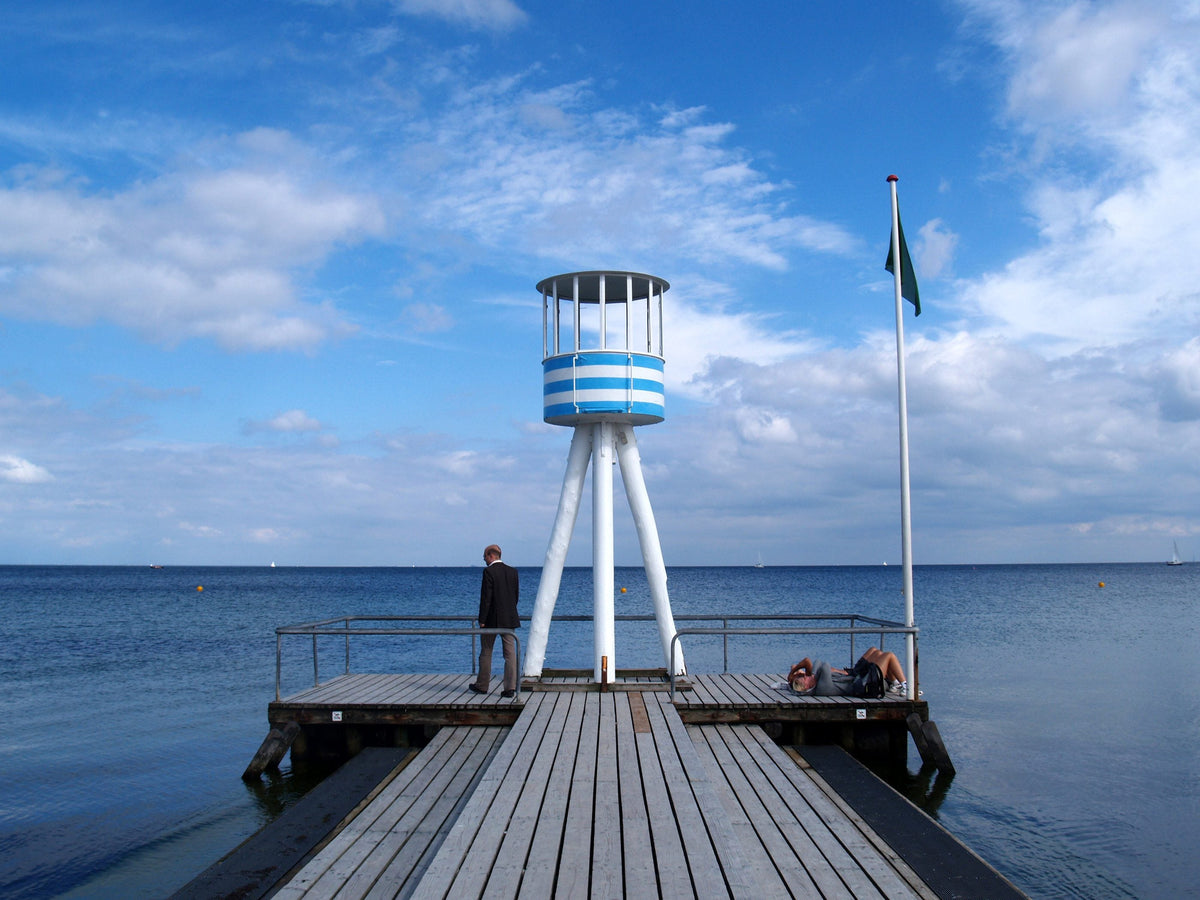
A blue and white striped lifeguard tower by Arne Jacobsen at the end of the pier at Bellevue, Klampenborg. Photo: seier+seier, CC BY 2.0, via Wikimedia Commons, licence
On a bright morning in Klampenborg, the water off Bellevue is pale and very still, and at the end of the pier a lifeguard tower stands in blue and white stripes like a piece of punctuation. It looks almost too cheerful to be serious architecture. It is, in fact, where one of the most disciplined designers of the twentieth century began, and following his work from the city centre up this stretch of coast is one of the best lessons in total design that any city can offer.
Arne Jacobsen designed at every scale. Buildings, yes, but also the kiosks beside them and the furniture inside them. Copenhagen still carries the evidence, scattered between a museum on Bredgade, an architecture centre on the harbour and a run of modest buildings along the road north. The trip is short, and it rewards slowness.
Begin with the context
It helps to start indoors. Designmuseum Danmark, at Bredgade 68 in Frederiksstaden, holds the national design collection, and its exhibition Danish Modern covers the decades from the 1920s to the 1970s, the period in which Jacobsen worked and the one that made Danish furniture famous far beyond Denmark. Seeing his pieces among those of his contemporaries makes one thing clear very quickly: he was not alone. The whole country was working out how a modern room should feel, and the answers shared a vocabulary of light wood, plain surfaces and careful proportion.
Down at the harbour, the Danish Architecture Centre in the BLOX building on Bryghuspladsen runs an exhibition called So Danish, which moves through a thousand years of Danish architecture and design. It is the wider frame. Jacobsen did not invent the Danish taste for restraint; he inherited it, sharpened it and pushed it into places where nobody expected to find it, such as a petrol station.

He did not invent the Danish taste for restraint. He inherited it, sharpened it and took it to the beach.
North along the water
From the centre, the coast road runs north towards Klampenborg. Bellevue Strand lies about 10 km from the centre, a 700 metre beach where the city goes to swim. When Bellevue Strandbad opened in the summer of 1932, it was Jacobsen's first building. The commission was a public bathing establishment rather than a monument, which may be exactly why it remains so lovable.
The blue striped lifeguard towers still stand at the end of the pier, and the geometric kiosks are still in place. They are small things. A kiosk is a box for selling ice cream; a tower is a raised seat for someone who watches the water. Jacobsen treated both as worth designing properly, giving them crisp outlines and a colour that reads from far down the sand. The lesson is not about stripes. It is that no part of a place is too minor to be thought about, and that a beach can be given a character as clear as a civic hall.
A few minutes away stands Bellevue Teatret, Jacobsen's theatre of 1937, which still programmes concerts and plays and presents itself, plainly, as his theatre. It offers guided tours of the building and its history, which is the best way to see how the same mind that designed the kiosks handled a room meant for an audience. The scale changes; the attitude does not.


A canopy on the road
Further along, at Skovshoved, is the strangest and perhaps the most perfect of the set. In the mid 1930s Jacobsen designed a petrol station prototype for Texaco. It was meant to be the first of many. It turned out to be the only one built, and it is now listed, preserved to its original form with its mushroom shaped canopy floating over the forecourt. The official Jacobsen site counts it among his most iconic works.
Stand there for a while. A filling station is pure function: a roof against the rain, a place for a car to pause. Jacobsen gave it a single gesture, the canopy, and then refused to add anything else. The building is generous because it is simple, and simple because every decision was made once and then left alone. Few buildings anywhere show so clearly that restraint is a design act, not an absence of one.
How far can consistency go
The appeal of Jacobsen's Copenhagen is consistency, and so is the risk. Total design, in which one hand shapes everything from the walls to the cutlery, can produce rooms of rare coherence. It can also produce rooms that feel finished in the wrong sense, where nothing can be moved or added without spoiling the composition. A museum can afford that kind of perfection. A home usually cannot, because a home has to absorb the books, the post, the inherited chair and the child's drawings.
What survives best from the coastal buildings is not their completeness but their method. Each one sets a clear structure, then lets the surroundings do the rest. The beach is busy and loud; the towers stay calm. The road is full of traffic; the canopy holds its line. The theatre fills with people; the room stays legible. The design gives the place a spine, and life is allowed to hang from it.
That is the useful idea to bring home. In a room built around sculptural furniture, the floor matters more than it seems to. A busy pattern underfoot competes with the outline of a chair; a quiet, even surface lets the chair stand out as an object in space, the way the lifeguard tower stands out against the sand. The coastal buildings make the same point outdoors, with sand and water as the quiet ground.
The walk back
The best way to end the trip is to return to Bellevue in the late afternoon, when the light lowers over the water and the stripes on the towers turn soft. By then the buildings have begun to feel less like works of architecture and more like parts of the coast, as natural as the pier and the dunes. That was always the ambition of the best Danish design: not to impress, but to become ordinary in the most demanding sense of the word, so well made that nobody notices it until they look closely.
Rugberry notes
From the Rugberry house
What the coast north of the city teaches is the value of a quiet ground. A sculptural chair, a round table, a run of bookshelves all read more clearly over a floor that holds still.
That is the work of texture rather than pattern. A solid wool rug with a hand finished surface catches the light without asking for attention, and a firm handloom weave keeps its line under daily use. If that way of furnishing appeals, our textured and solid rugs are made in a similar spirit, and the beige edit keeps to the pale end of the scale.


In the Rugberry house
- Textures and solidsQuiet grounds for sculptural furniture.
- Handloom rugsFirm woven wool that keeps its line.
- Beige rugsThe pale end of the scale.
Rugberry has no affiliation with the studios featured. Images are from the Rugberry house unless credited.