Dinner Under Jaali Light at Indian Accent
Images are credited where they are not from the Rugberry house.
Late in the afternoon on Lodhi Road, the sun comes through a wall of concrete lattice and breaks into a thousand small pieces. They fall across stone and timber, shift as the light lowers, and by evening they are gone. It is one of the oldest effects in Indian architecture, the jaali, rebuilt in a modern material for a modern hotel. Inside, in a dining room of marble floors and white linen, one of the country's most celebrated restaurants carries on its own quiet experiment in taking something old and stripping it to its essentials.
Indian Accent opened in 2009 at The Manor in New Delhi, and is now at The Lodhi on Lodhi Road. It ranked No. 46 on Asia's 50 Best Restaurants in 2025, and the list describes its room in a few spare phrases: marble floors, white tablecloths, garden views through floor to ceiling windows. Nothing in that description is ornamental. That restraint deserves a closer look, because the room does with materials what the kitchen does with food.
A hotel wrapped in stone
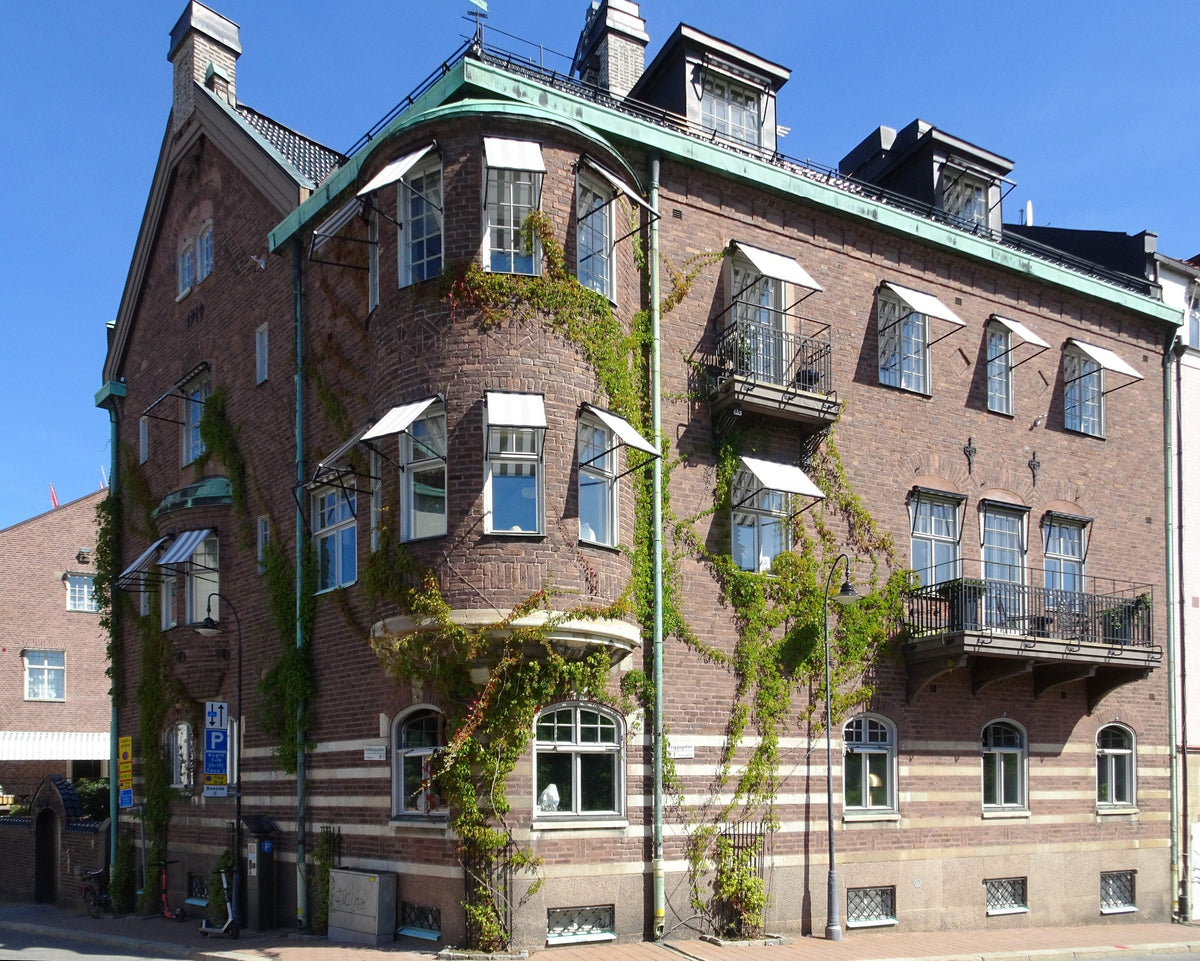
The building was first created as Aman New Delhi by Kerry Hill Architects, and its language is deliberately sober. The architects used an olive Rajasthani stone called khareda, dark timber panelling, handmade floor coverings and, above all, concrete jaali screens that filter sunlight, privacy and views. The screens do three jobs at once. They shade the rooms from the Delhi sun. They let guests look out without being looked at. And they turn the view itself into something partial and mysterious, glimpsed rather than displayed.
This is a Mughal idea in its bones. The pierced stone screens of the old tombs and palaces in Delhi were never just decoration; they were climate control, social architecture and a way of handling light as a material. What Kerry Hill Architects did was strip the idea of its carving and keep its logic. The pattern became a grid, the marble became concrete, and the effect survived intact.
The pattern became a grid, the marble became concrete, and the effect survived intact.
The room and the plate
That same logic runs through the food. A tasting menu introduced in April 2025 reworked regional dishes, among them a khakra tart with dhokla from Gujarat and kothimbir vadi from Maharashtra, under the line of traditional flavours with modern techniques. The dishes are familiar to anyone who grew up with them and new in their form, the way a concrete jaali is both a modern screen and an old memory.
Restaurants often try to tell this kind of story through their decoration, with heritage motifs on the walls and artefacts on the shelves. Indian Accent does the opposite. Its room is almost silent, and that silence is what lets the plate speak. A guest who sits at a white tablecloth on a marble floor, with the garden beyond the glass, is not being told what to feel about India. The room simply gets out of the way.
For anyone furnishing a formal room, at home or in hospitality, that is the lesson. A room can carry great richness without a single ornamental flourish, provided its materials are good and its light is handled with care. Stone, timber and linen do the work. The richness is in the quality of each surface and in the way they meet.
It is also a lesson in sequence. Diners at Indian Accent at The Lodhi in Delhi sit inside a building whose stone and screened light have already set the mood, so that by the time they sit down the atmosphere belongs to the architecture rather than to anything placed on a table. The architecture prepares the guest; the room receives them; the food does the rest. Each layer is quieter than it might be, and the whole is stronger for it. Few interiors in the city show as clearly that calm is something designed in stages, not switched on at the door.
A kitchen in continuity
There is a harder question beneath the calm, and it belongs to every restaurant built around one chef's name. In July 2024 the founding chef, Manish Mehrotra, left after about 24 years with the company. The kitchen passed to Shantanu Mehrotra, who had been with the Delhi restaurant since its start and is now its executive chef.
Transitions like this often prompt a reinvention, a new menu and a new identity designed to announce a new era. The evidence so far suggests something else here: continuity. The menu has kept its method of reworking regional food with modern technique, and the restaurant has kept its place on the list. It is not a story of disruption but of a team that had absorbed a way of cooking well enough to carry it forward.
That is, in its way, the same thing the building does. A jaali in concrete is not a rupture with the past. It is a continuation of an idea by other means, by people who understood it deeply enough to change its material without losing its meaning. Good institutions, like good rooms, are built on that kind of understanding.
What restraint asks of a floor
A room this pared back places unusual demands on every surface in it, and the floor most of all. When there is no ornament to distract the eye, every material is seen plainly. Marble shows its veining and its polish. Timber shows its grain. Anything laid on the floor in such a room must be just as honest, or it will look like an apology.
That is why quiet rooms are often the hardest to furnish. The temptation is to fill them, to add pattern because the space feels bare. The better instinct is to add texture instead: a surface that rewards close attention, that changes as the light from those jaali screens moves across it in the afternoon, and that otherwise keeps still.
By evening on Lodhi Road the scattered light through the screens has faded, and a room built on stone and linen takes on its night character. Nothing has been added; the room has simply changed with the hour. That ability to change without being rearranged is the mark of a well made space, and it is a quality worth bringing home.
Follow @indianaccent on Instagram for their own work, in their own words.
Rugberry notes
From the Rugberry house
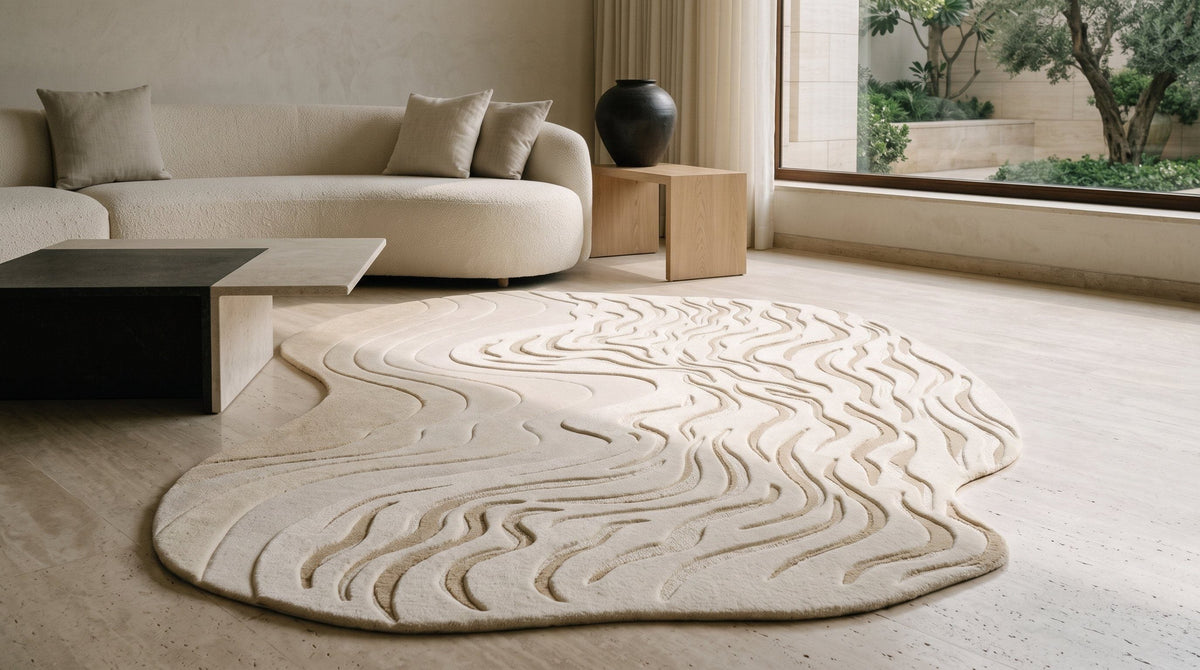
What that dining room teaches us is that a formal room can be rich without pattern, if the floor offers texture and the light is allowed to move across it.
Solid wool in a quiet colour does exactly that. If that way of furnishing appeals, our textured and solid rugs work in that register, and the Rugberry trade programme supports architects and designers specifying rugs for hospitality and residential projects.


In the Rugberry house
- Fine wool rugsClose, quiet wool for formal rooms.
- Trade programmeFor architects and designers specifying rugs.
- Textures and solidsTexture in place of pattern.
Rugberry has no affiliation with the studios featured. Images are from the Rugberry house unless credited.