The Golden Fibre and the Line Drawn Through It
Images are credited where they are not from the Rugberry house.
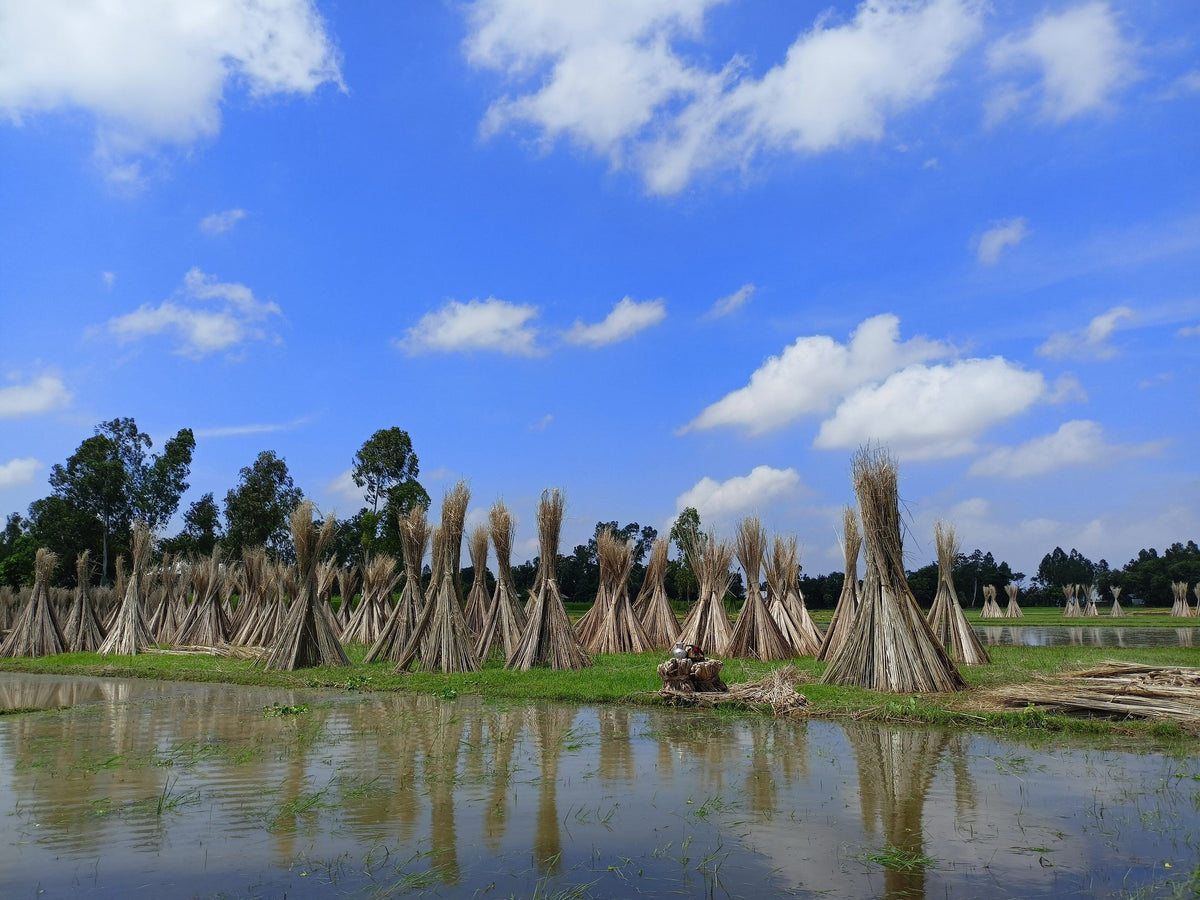
Bundles of jute stalks stood up to dry beside a flooded field. Photo: Frameofashik, CC BY-SA 4.0, via Wikimedia Commons, licence
In the wet months, in the low green country of Bengal, the jute is cut once it has flowered and before it goes to seed. The stalks are tied in bundles and laid in water, and there they stay for days while the water does its slow work. When they come out, the bundles are struck with a long wooden hammer until the fibre loosens and can be pulled free of the stem, washed, and hung over bamboo poles to dry in pale gold lengths. Drying in the sun, it shines. That shine is why jute has a nickname.
India calls it the Golden Fibre, for its golden colour and silky lustre. The country is the world's largest producer of raw jute, and according to the government it accounts for about 75 percent of estimated world production of jute goods. Most of that begins in West Bengal, which leads the country in cultivation, ahead of Bihar, Assam, Odisha and Jharkhand. Behind every pale jute rug on a sunlit floor, there is a field like this one, and a person in the water.
A crop of heat and rain
Jute is generally sown in March and April and harvested within 100 to 110 days. It wants heat and humidity, with rainfall of 700 to 1,500 mm while it grows, and it is mostly rainfed. That is why it belongs so completely to the east of India, to the floodplains and wet fields where the monsoon is generous. The plants are usually harvested after they flower and before the flowers go to seed, when the fibre in the stem is at its best.
None of this can be hurried. The crop sets its own calendar, the monsoon decides how good the year will be, and the retting takes as long as it takes. A jute rug is, among other things, a record of one season in one field.
It is a crop of small holdings. The government describes jute as grown mainly by small and marginal farmers, and says it sustains nearly 40 lakh farm families. Those families are the beginning of a long chain that runs through mills, spinners and weavers to the floor of a room they will never see.


What retting asks of a person
Between the field and the fibre comes retting, the step that makes jute what it is, and the hardest to see from a finished rug. The cut stalks are submerged in water, often for around twenty days, while water and microbes break down the material that binds the fibre to the woody stem. Retting in water is a practice centuries old.

Then the work turns physical. After the hammer comes the stripping, the washing and the drying, on bamboo poles or spread across thatched roofs. After two or three days in the sun, it is tied into bundles and sold. Every stage is wet, heavy and done by hand.

The beauty of jute is usually described from the finished end. We talk about its warmth, its irregularity, the way it softens with use. All of that is true. But the irregularity was made in a pond. The warmth comes from a fibre that someone stood in water to free. The government now runs a scheme called JUTE ICARE, launched in the 2015 and 2016 financial year, to improve cultivation and retting, including support for building retting ponds. It is a quiet acknowledgement that the hardest part of the craft happens before any weaver touches it.
The irregularity we love in a jute rug was made in a pond, by someone standing in the water.
The line drawn through the fields
Jute's history in India goes back, the government notes, to the third century BC. It became a great commercial crop under colonial rule, when the East India Company built mills across Bengal and made the region a centre of jute cultivation and processing. For generations the fields and the mills belonged to one economy.

Then came 1947. Independence and Partition cut through the jute economy of Bengal like a blade. Nearly 80 percent of the jute growing land went to East Pakistan, now Bangladesh. Most of the mills stayed in India. Almost at once, the factories found themselves on one side of a border and most of their raw material on the other.


What followed was one of the less told stories of the new nation. In September 1949 the government launched a Grow More Jute campaign, encouraging farmers to move from paddy to jute. It worked. India's raw jute production more than doubled, from 6.7 lakh tonnes in 1951 and 1952 to 14.56 lakh tonnes ten years later. Bengal's farmers, many of them on small plots, rebuilt a crop that the border had taken away.
1947 carries a private weight for us. Rugberry comes from a weaving family since 1947, and it is tempting to draw a line between the two stories. It would be the wrong line to draw. The jute story belongs to Bengal's farmers, to the people who changed their fields and learned to grow a crop at scale in the years when the country most needed it. We share a date with them, not their labour.
From pond to floor
Today India has 120 composite jute mills, and West Bengal alone holds 89 of them. The Jute Packaging Act of 1987 requires jute sacks for packing essential commodities, which gives the farmers a steady market. The fibre goes into sacks, cloth and, at the smallest end of the trade, into rugs. A natural jute rug is a modest use of a fibre that has carried grain and built industries, but it is a revealing one. Laid on a floor, jute shows its character more honestly than in a sack: the slight variation of colour from one fibre to the next, the firmness underfoot, the way it settles into a room over years.

Weaving jute well means respecting those qualities rather than correcting them. Jute is firm, so it suits flat and close constructions. It varies, so it rewards patterns that use its variation rather than hiding it. It is a plant fibre, so it carries a little of the field into the room. And it lasts, provided it is kept dry, which is a gentle irony for a fibre that begins its life in water.
The next time you see a jute rug in a sunlit room, remember the pond. The gold in the fibre was pulled from a stem by hand, dried on a bamboo pole, and carried out of a field in the country that grows more of it than any other. The rug is the last and quietest step in a very long story, and most of that story happened in the water.
In the Rugberry house
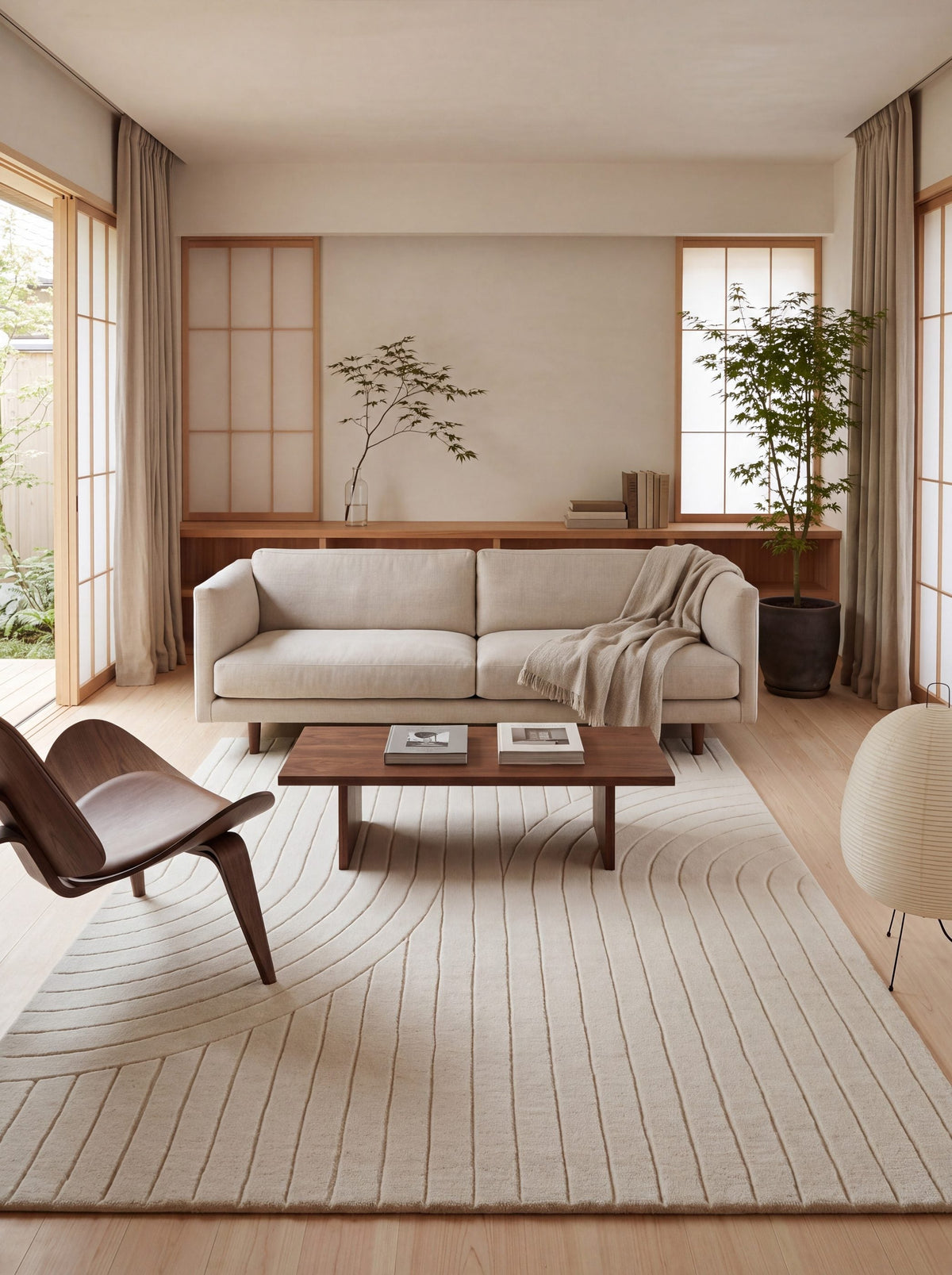
- Natural jute rugsPlant fibre woven to show its own variation.
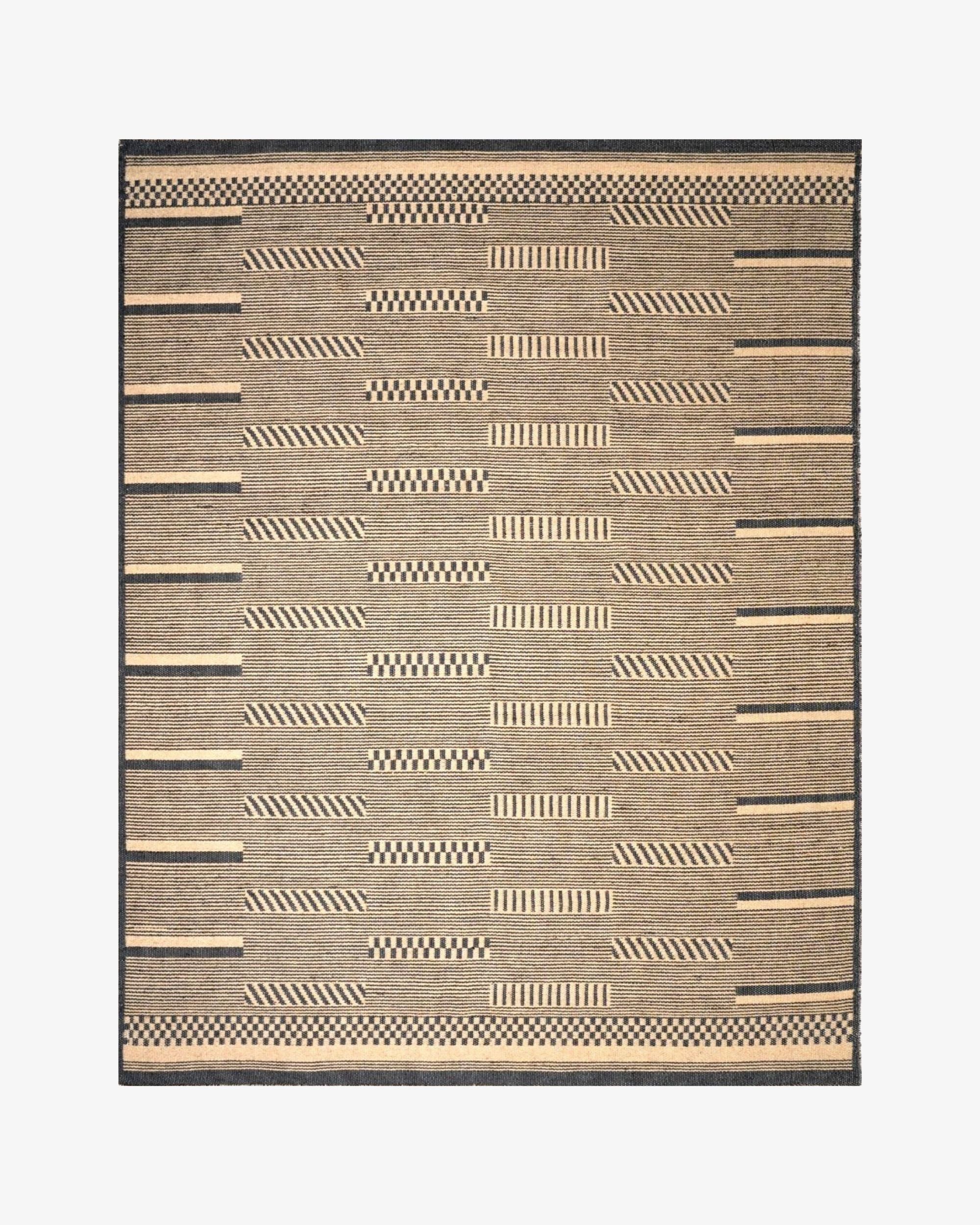
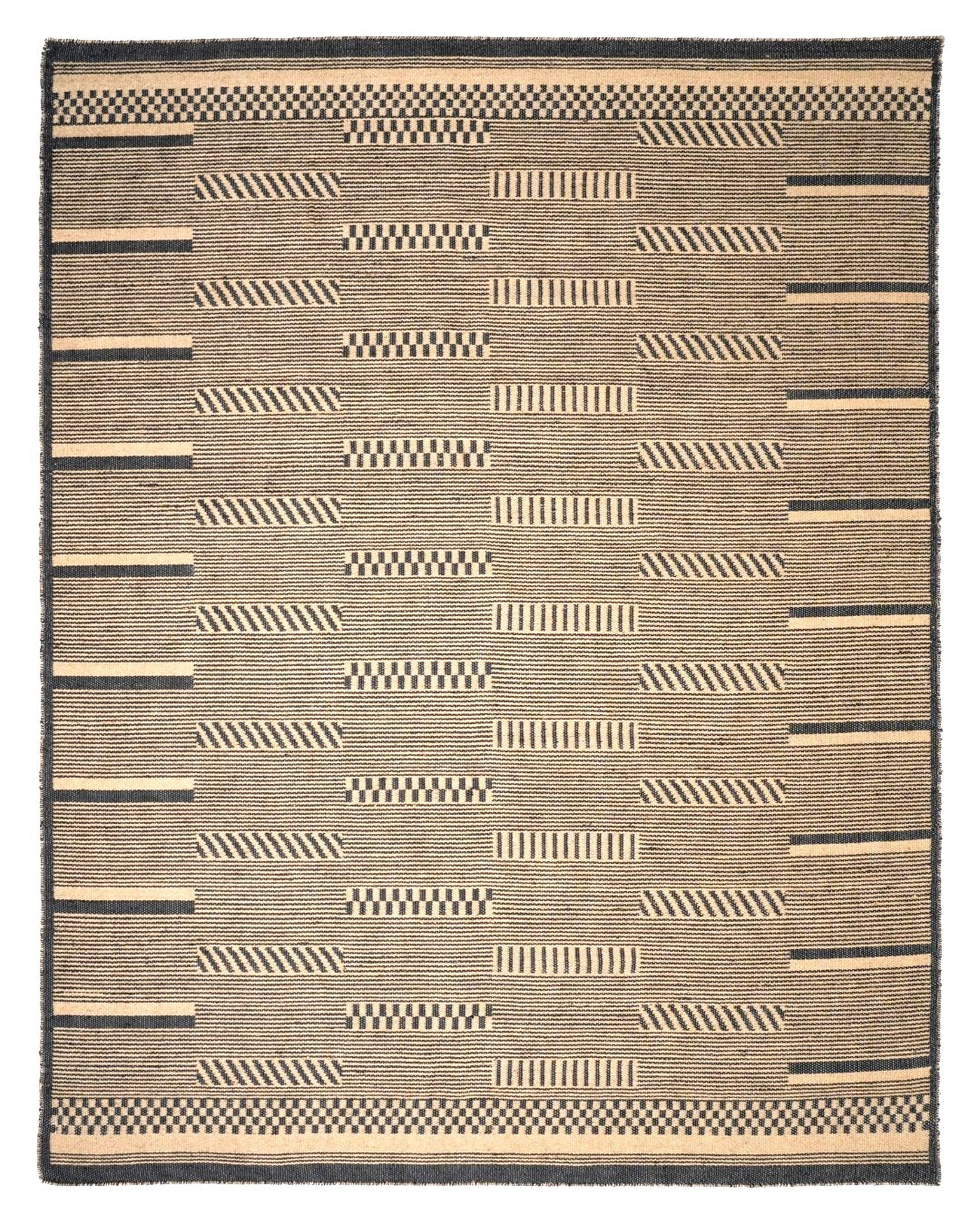
- Pampas Jute RugHandwoven in jute, made to your measure.
- Sustainable rugsPlant and natural fibres.