Keiji Ashizawa, Steel and Honest Wood
Images are credited where they are not from the Rugberry house.
After the earthquake of 2011, a group of people in the city of Ishinomaki set out to build benches for outdoor film screenings. They were local high school students, working with an architect who had been commuting to the city to help a friend rebuild a restaurant and home. The benches were plain, practical things, meant to be used rather than admired. They made more than forty of them. Somewhere in that work, between the saw and the screwdriver, a furniture brand began.
The architect was Keiji Ashizawa, and the workshop became Ishinomaki Laboratory. Today his name is often used as shorthand for a certain look, the pale oak, low furniture and quiet rooms that the design press calls Japandi. The label is understandable. It is also a little unfair, because it describes a style, and Ashizawa's work is really about a method.
Ten years with steel
Ashizawa graduated from the Yokohama School of Architecture in 1995. He then spent ten years working as an architect and as a steel fabricator, before founding Keiji Ashizawa Design in 2005. That decade with steel is the key to almost everything that followed.
A fabricator thinks in joints. Steel does not forgive a careless connection, and anyone who has welded or bolted a frame learns quickly that the strength of a structure lives in the places where its parts meet. You also learn the honesty of a material that shows exactly how it was made. A weld is visible. A bend has a radius. There is nowhere to hide a bad decision.
You can see that training in a piece like Sutoa, a storage unit he designed for FRAMA in 2011. Oak drawers are stacked on a slim steel frame, growing in size from top to bottom. The idea is simple enough to describe in one sentence. Its quality is entirely in the proportions and the joints, the way the wood sits in the steel, the way the drawers step down.
Most designers come to furniture from drawing. Ashizawa came to it from making, and the difference shows. A drawn chair can be anything. A made chair has to stand up, take weight, survive being moved, and be put together by someone in a reasonable amount of time. Those constraints are not obstacles to design. For a maker, they are the design.
Simple cuts and screws
Ishinomaki Laboratory was set up in 2011 as a place for local manufacturing that could support the city's recovery after the earthquake. Its defining idea is the use of ready made materials, designed to be assembled with simple cuts and screws. The point was not to make the finest furniture possible. It was to make good furniture that people could make themselves, in a place that had lost so much.
Early on, through the Disaster Area Support Programme, Herman Miller provided furniture and co-hosted a furniture making workshop with people affected by the disaster. The laboratory kept that spirit. It still holds design workshops for sharing ideas and skills, and it describes itself as a furniture brand that expands the possibilities of DIY through the power of design. It now works with made in local partners in more than ten countries.
This is the part of Ashizawa's story that the Japandi label leaves out. The calm, honest look of his furniture is not a styling choice laid over it afterwards. It comes directly from the constraints: plain material, simple joints, nothing that a careful person with ordinary tools could not understand.
The calm look is not laid over the furniture afterwards. It comes directly from the constraints.
Kinuta and the natural room
The same discipline runs through his work at the other end of the scale. With Norm Architects and the furniture maker Karimoku, Ashizawa created the Karimoku Case Study Kinuta collection, shown at the Kinfolk Gallery in Copenhagen during 3 Days of Design in 2019. It was drawn from the Kinuta Terrace apartments in Tokyo, a building arranged around a large outdoor courtyard, and it was made only in natural materials: oak, stained oak, stone and textiles by Kvadrat.
The pieces Dezeen described from that show include a gridded timber bookshelf, a stained oak desk with a black tinted glass top, and a stone topped coffee table, along with a pale grey sofa set on a cream rug. Nothing in that list is decorative. Every piece is a structure, made of something real, doing a clear job. It is the Sutoa principle at the scale of a whole home.
It is also telling that the collection was conceived for one particular building. Furniture designed for a real set of rooms, with their own light and proportions, tends to be calmer than furniture designed for a catalogue, because it is answering a question rather than trying to attract attention.
What a joint teaches a weaver
A weaver would recognise this way of working. A woven rug is also a structure of joints. Every place where a weft crosses a warp is a connection, and the character of the rug lives in how those connections are made: how tight, how even, with what fibre. A handwoven rug shows its construction as openly as a steel frame shows its welds. You can see, and feel, how it was made.
A weaver also learns the fabricator's lesson about forgiveness. A loom does not hide a mistake for long. A loose row shows. A tension that drifts across the width shows. The quality of a woven rug, like the quality of a welded frame, is decided by many small connections made consistently, one after another.
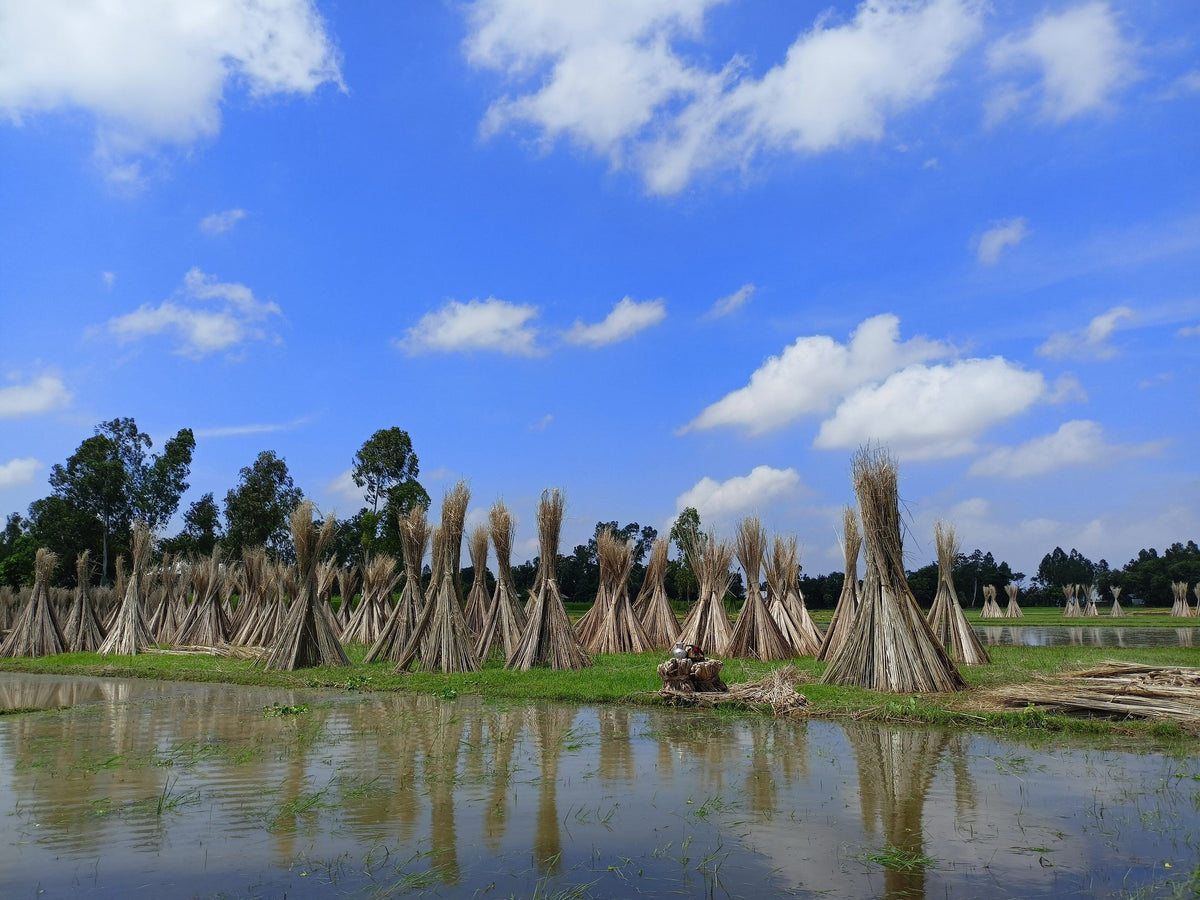
Plain materials make that honesty easier to see. Jute, a plant fibre, brings its own irregular texture to every row. A low, closely woven wool shows its structure on the surface. Neither depends on pattern to be interesting. Like oak and steel in Ashizawa's furniture, they are interesting because of what they are and how they are put together.
The deeper lesson of Ishinomaki is about who gets to make things. The laboratory was built on the belief that good design should be within reach of ordinary hands, not reserved for specialists. That is a humbling idea for any craft. It suggests that the value of handwork lies not in mystery but in clarity: in making something so well, and so plainly, that anyone can see why it is good.
Japandi will eventually pass, as every style label does. The benches in Ishinomaki, the drawers on their steel frame and the oak shelves of Kinuta will outlast it, because they were never really about a look. They were about joints, plain materials and use. That is a method, and methods do not go out of fashion.
Follow @keijiashizawadesign on Instagram for their own work, in their own words.
Rugberry notes
From the Rugberry house
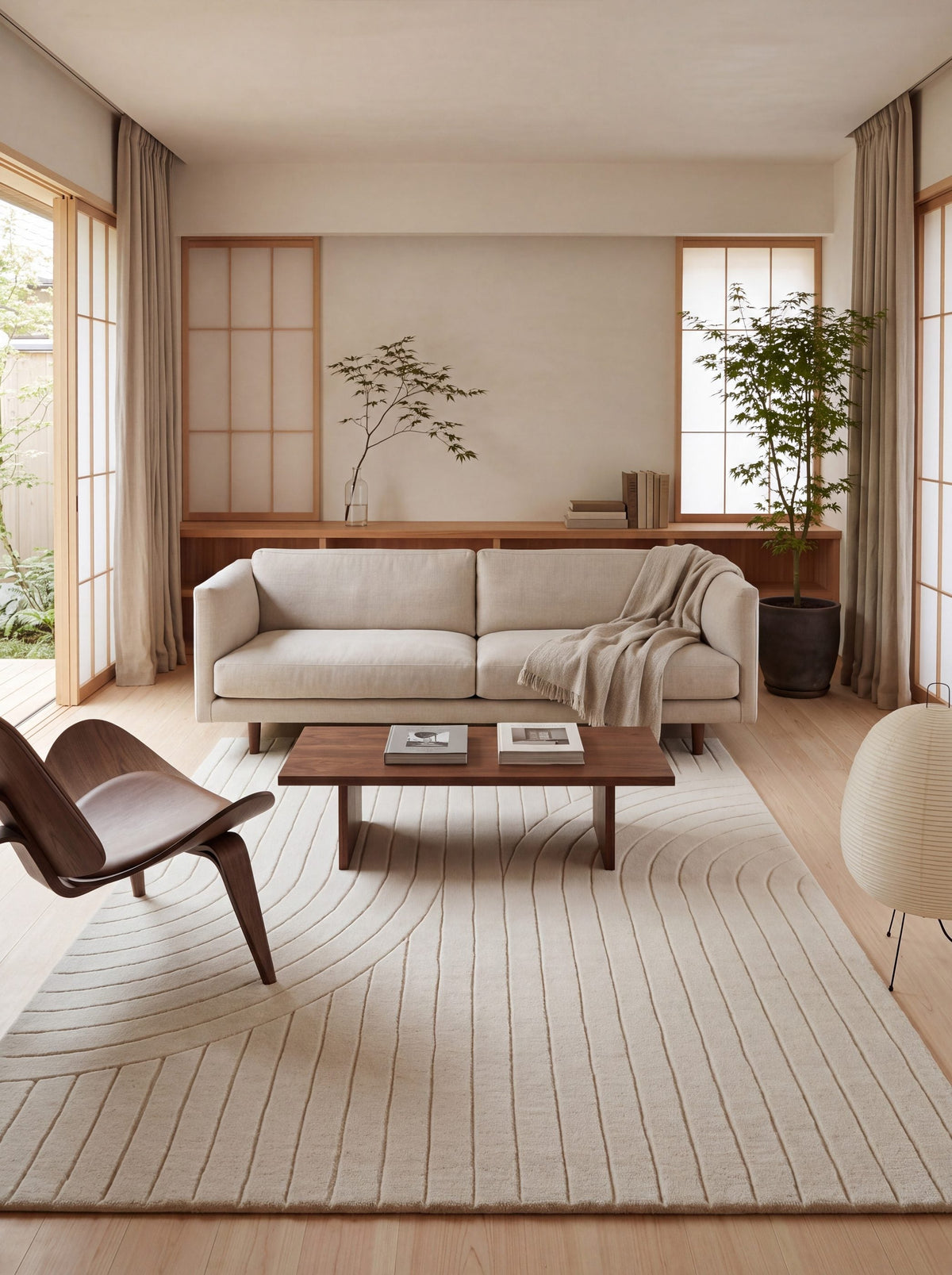
Plain materials and visible construction decided the rugs in these rooms.
If that way of making appeals, our Grain collection is handloom wool with the weave left visible underfoot, and the Bitte Wool Rug works in a similar register, hand tufted in New Zealand wool with small repeated marks scattered across an otherwise quiet ground.


In the Rugberry house
- The Grain collectionHandloom wool with the weave visible underfoot.
- Bitte Wool RugHand tufted in New Zealand wool, small marks on a quiet ground.
- Handwoven rugsConstructions that show how they were made.
Rugberry has no affiliation with the studios featured. Images are from the Rugberry house unless credited.