Kanchipuram's Korvai, the Join You Are Not Meant to See
Images are credited where they are not from the Rugberry house.
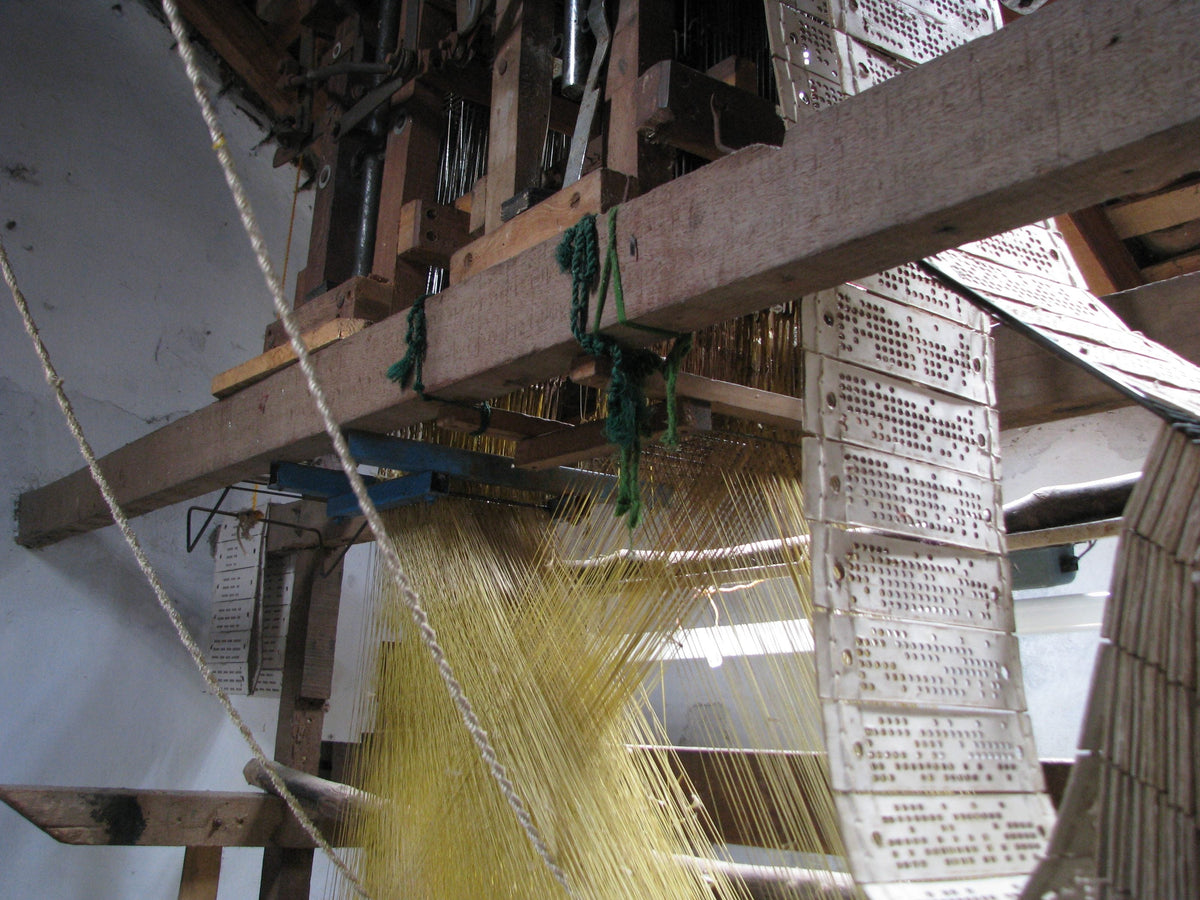
A hand loom for silk weaving in Kanchipuram, with the punched cards that carry the pattern. Photo: McKay Savage, CC BY 2.0, via Wikimedia Commons, licence
Two people sit at one loom, on opposite sides, and they work as if they were one person with four hands. The shuttle crosses, and at the edge of the cloth, where the deep green body of the sari will meet a border of magenta and gold, one weaver passes the thread to the other. They lock it. The shuttle crosses again. Pick by pick, hour after hour, the border is joined into the body so firmly that, it is said, the sari can tear before the border will come away.
This is the heart of Kanchipuram silk, the sari of the temple town in Tamil Nadu that has become, for many families in south India, the cloth of weddings, festivals and inheritance. It is admired for its colour, its weight and its gold. But its real distinction is structural. A Kanchipuram sari is built as much as it is woven, and the most important part of it is a join that most people never notice.
A protected cloth
Kanchipuram silk saris won Geographical Indication status in the 2005 to 2006 cycle, after the state government applied for it. The materials travel to the town from elsewhere: the mulberry silk comes from Karnataka, and the gold zari, the metal wrapped thread of the borders and end pieces, from Surat. What happens in Kanchipuram is the weaving, and that is what the protection recognises.
The district reports about 50,000 weavers working through cooperatives. A survey from around 2008 counted some 5,000 families engaged in sari production, supported by 25 yarn units and 60 dyeing units in the region. Those numbers describe an ecosystem rather than a workshop: spinners, dyers, designers and weavers, each dependent on the others, all centred on a single kind of cloth.
The motifs come from the same place. Rudraksham, the bead of the rudraksha seed. Gopuram, the tower of a temple gateway. Mayilkan, the peacock's eye, and kuyilkan, the nightingale's eye. They are drawn from the temples and the natural world around the town, and they appear again and again in borders and bodies, a shared vocabulary passed down through generations of weavers.


The korvai join
The technique at the centre of all this is called korvai. A Kanchipuram sari is woven with three shuttles, and with a weaver and an aide on opposite sides of the loom. One works the body of the cloth. The other works the border colours. Body and border are woven as separate parts and interlocked as the cloth grows, so that the boundary between them is not a seam added afterwards but a structure made in the act of weaving.

The result is a border that will not detach, even if the sari itself tears. That is a large promise for a piece of cloth, and it explains why these saris are kept, worn and handed down for decades. The colour may fade. The zari may soften. The join holds.
Watch it being done and the first impression is of slowness. Every pass of the shuttle at the border becomes a small negotiation between two people, a thread handed over, a turn made, a lock tightened. It cannot be rushed without weakening the join, and it cannot be done alone. The loom becomes a place of conversation, conducted almost entirely through the hands. Weavers who have worked together for years develop a rhythm that an outsider can hear before they can see it, the shuttles answering each other across the warp.
Korvai also explains one of the most striking features of the sari: its contrasts. Because the border is woven as its own field of colour, it can differ completely from the body, deep green against magenta, mustard against maroon, and still meet it cleanly. The contrast is a visible sign of an invisible skill.

The colour may fade. The zari may soften. The join holds.
Kalakshetra and the design inheritance
The craft has had its champions. At the Kalakshetra Foundation, the arts institution shaped by Rukmini Devi, a weaving centre runs 14 looms using Kanchipuram methods. Rukmini Devi chose motifs for Kalakshetra from heirloom saris and temple textiles, returning to old sources rather than inventing new ones. Today 50 of those designs are licensed to the Tamil Nadu Handlooms Directorate and woven as Kalakshetra Saris.
Returning to heirlooms was a choice with consequences. It meant that the patterns on a new sari could be traced back to cloth that had already survived generations of wear, and to the temple textiles that had first given the region its motifs. The design inheritance and the structural inheritance were kept together, which is rarer than it sounds. In many crafts the technique survives while the old patterns are replaced by whatever sells, or the patterns survive as prints while the technique is lost.
That work is a reminder that a tradition is not only a technique but also a library. The joins, the shuttles and the two weavers at one loom preserve how the cloth is made. The motifs preserve what it says. Both have to be kept alive for the sari to remain itself.


What a rug can learn from a sari
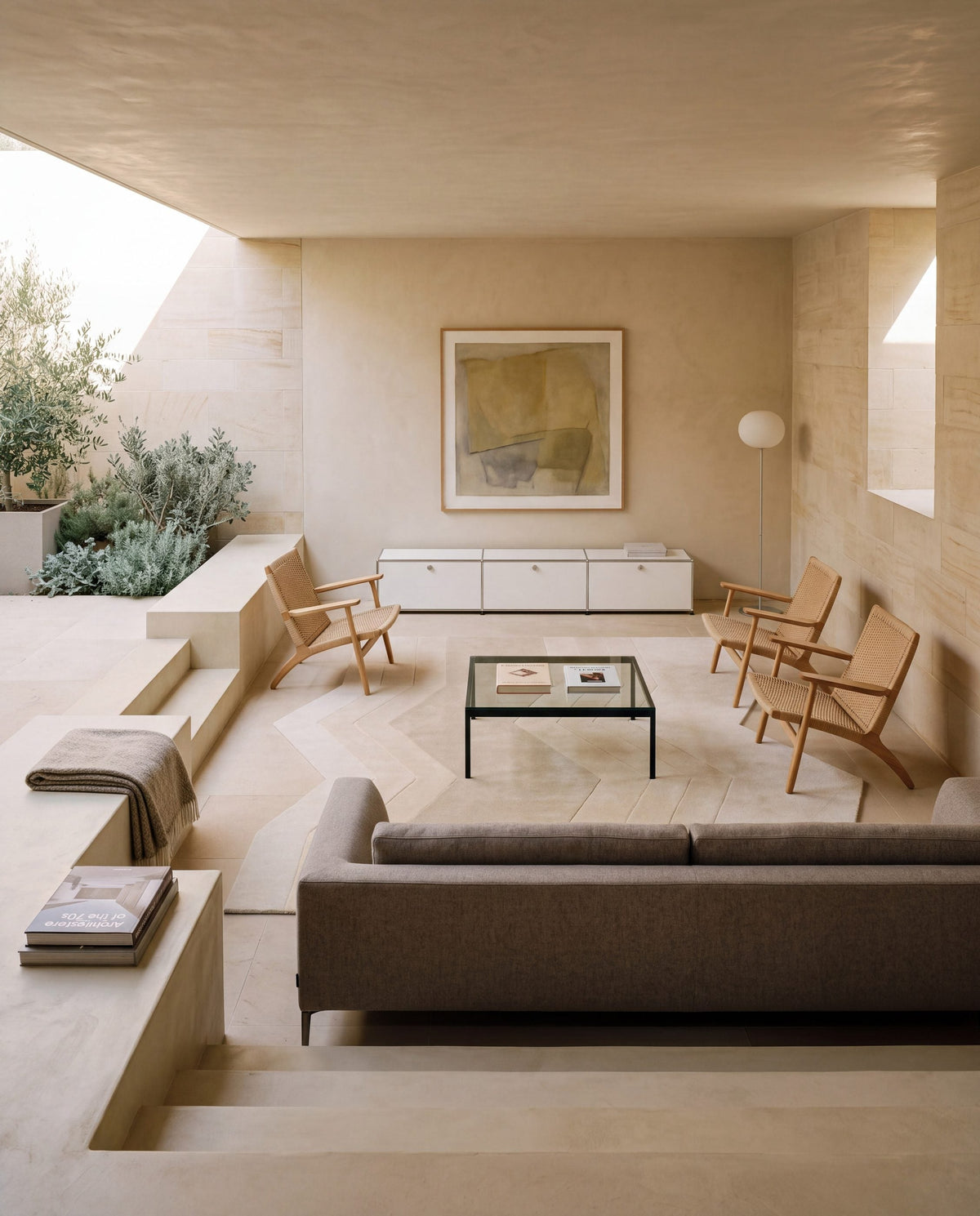
It might seem a long way from a silk sari to a rug on a floor. The connection is closer than it looks. In both, the real luxury is structure. A rug, like a sari, is judged at first by its colour, its pattern and the way it catches the light. It is judged over the years by how it holds together: whether the edges stay straight, whether the pile stays put, whether the border and the field remain one piece after a decade of feet.
The joins you cannot see decide how long a piece lasts. In a sari it is the korvai. In a woven rug it is the density of the weave, the tension of the warp, the way the edges are bound and finished. None of these things shows in a photograph. All of them show in ten years of use.
There is also a lesson about fibre. Real mulberry silk is an extraordinary material, strong for its weight, with a lustre that comes from the structure of the fibre itself. It rewards slow, careful weaving and punishes haste. The rarest fibres in any craft ask the same thing of a maker: time, attention and a structure good enough to deserve them. That is the spirit of the Rugberry Reserve, made to measure in the rarest fibres, and of the handloom rugs woven on our looms.


Two weavers, one cloth
Go back to the loom in Kanchipuram. Two people, opposite each other, passing a thread across a boundary and locking it, again and again. It is an image of cooperation as much as of craft. Neither weaver could make the sari alone. Together, they make something that will outlast them both, and very likely be worn by someone not yet born. As the work of a weaving family since 1947, Rugberry knows of no better description of what a loom is for.
In the Rugberry house
- Rugberry ReserveMade to measure in the rarest fibres.
- Handloom rugsWoven by hand on the loom.
- The art of makingHow a Rugberry rug is made.