What Vincent Van Duysen Leaves Out
Images are credited where they are not from the Rugberry house.
On a wooded lot in Melides, in Portugal, a house of concrete sits among tall pines on sandy ground. The concrete was left unsealed and tinted to a sandy hue, so that from a little distance the walls seem to rise out of the soil they stand on. Inside, the floors are soft tile, the walls are poured concrete and pale wood, and a fireplace of cubic volumes stands between the living and dining rooms. Over a deep mahogany dining table hangs a Noguchi lantern. There is not much else. What there is, one writer called few yet impeccable.
The house is Casa M, and it belongs to the Antwerp architect Vincent Van Duysen. It is often filed, like most of his work, under minimalism. But stand in it, even in photographs, and the word starts to feel wrong. This is not an empty house. It is a house so full of material that it does not need objects.
Antwerp and Milan
Van Duysen studied architecture at Sint-Lucas in Ghent, graduating in 1985, and then went to Milan, where he spent two years as the first assistant to the designer Aldo Cibic. He worked for decorators in Brussels and Antwerp before opening his own studio in Antwerp around 1990. In 2016 he was appointed creative director of Molteni&C, overseeing architecture, interiors, product and communication. For B&B Italia he has designed pieces including the Oskar table and the Pablo armchair. His honours include the Henry van de Velde Lifetime Achievement Award and a place on the AD100.
That is a long and serious career, and it has produced a recognisable language: pale stone, dark wood, linen, generous proportion, very little ornament. It is easy to look at that language and see only what is absent. It is more useful to look at what is present.
A house outside the walls
Van Duysen's own house in Antwerp dates to the seventeenth century. It was first built outside the city walls, as a leisure house where men met to talk. Its floors are Belgian blue limestone and poplar planks. The kitchen has Delft tiles. The walls are the colour of bone. And his love of natural materials, stone, wood and linen above all, has been noted by nearly everyone who has written about him.
Put that house beside Casa M and a pattern appears. Both are restrained. Neither is cold. In both, the quietness comes not from removing things but from choosing a small number of materials and letting each one be fully itself: the grain of the poplar, the blue cast of the limestone, the sand in the Portuguese concrete. One writer described Casa M as warm brutalism, which is a good phrase for it, and arguably for most of his work.
He has his own way of putting it. His work, he once told 1stdibs, is about subtle variations on the same theme, like classical music. He wants to make spaces, interiors and furniture that are loaded with emotion, that people want to embrace and live with. And he credits an old principle of the designer Jean-Michel Frank as one that applies to his own work: elegance means elimination.
Elegance means elimination. But what remains has to be good enough to carry the room alone.
Elimination is not emptiness
Elimination is the part of that principle everyone remembers. The part they forget is what it demands of whatever survives. When you take away the ornament, the pattern, the extra chair, the object on the table, the things that remain have nowhere to hide. A plain wall has to be a beautiful plain wall. A single table has to be a remarkable table. Restraint is not a way of spending less effort. It concentrates all the effort into fewer things.
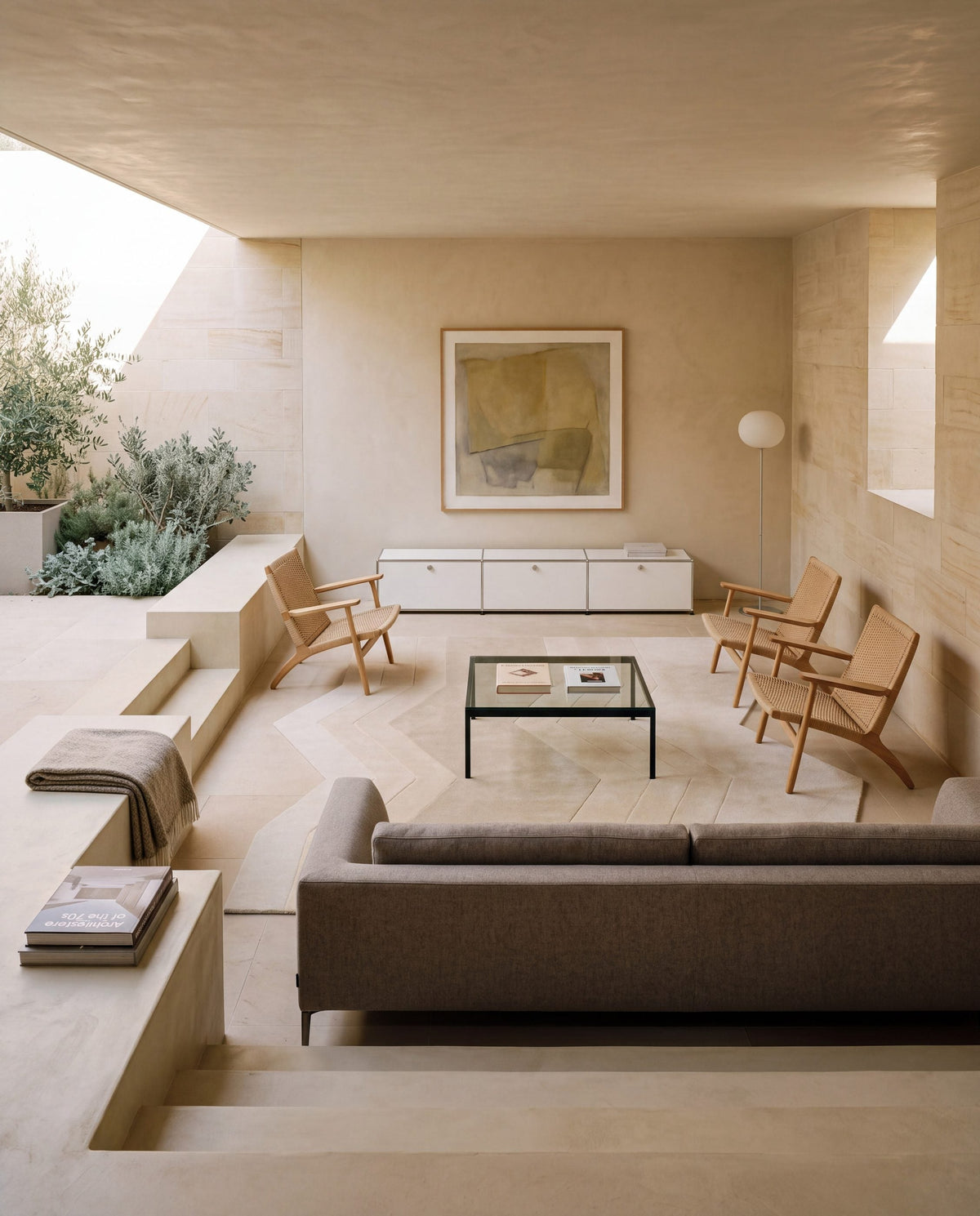
This is why Van Duysen's rooms feel warm rather than sparse. The surfaces that remain are tactile: stone you want to put your hand on, wood with visible grain, linen that creases. They invite touch, and touch is what makes a room feel inhabited. A minimal room made of cheap or smooth materials is just an empty room. A minimal room made of stone, wood and linen is a sensory one.
It is also why his rooms photograph so differently from how they feel. In a picture, restraint reads as absence. In person, it reads as texture: the cool of the stone, the slight give of a linen cushion, the dry warmth of unvarnished wood. Minimalism at this level is a tactile discipline that the camera can only partly record.
The one surface everyone touches
In a room like this, the floor matters more than almost anything. It is the largest surface after the walls, and it is the only one everyone touches, every day, usually without shoes. Van Duysen's own floors are stone, tile and wood: materials with temperature and texture, that change under the foot.
A rug in such a room has the same job. It should be material first, pattern a distant second. Undyed or softly coloured wool, a close weave, a handloom texture that shows how it was made: these do in textile what limestone and poplar do in stone and wood. They give the room something to touch. A loud pattern would argue with the architecture. A good plain rug finishes it.
Colour should follow the same logic. The palette in Van Duysen's houses is largely the palette of the materials themselves: sand, bone, the blue of limestone, the brown of mahogany. A rug in undyed or naturally toned wool joins that palette without effort. It belongs to the room because it is made of the same kind of thing.
Much of his furniture works on the same idea. A table, an armchair, a sofa: forms simple enough to be drawn in a few lines, but made in materials that reward a closer look. The simplicity is in the outline. The richness is in the surface.
Leaving things out
There is a difference between a room where nothing has been chosen and a room where almost everything has been refused. The first is empty. The second is full of decisions, most of them invisible. Van Duysen's houses are the second kind. Their calm is the result of a long series of refusals, each one made so that the things that remain can be felt more fully.
That is the real art of leaving things out. Not the absence, but the attention it makes possible. In a house among pines in Melides, a concrete wall the colour of sand, a mahogany table and a paper lantern are enough. They are enough because each one was chosen, and because nothing else was allowed to get in the way of them.
Rugberry notes
From the Rugberry house
The rugs in these rooms were chosen for material before pattern, the order Van Duysen's houses follow.
That balance, a simple outline and a rich surface, is the one a plain rug has to strike. If that palette of sand, bone and warm brown appeals, our fine wool rugs and the Grain Wool Rug in mochaccino work in a similar register. The Grain is handloom woven in New Zealand wool with a low, closely worked surface, a plain outline with the weave left visible underfoot.


In the Rugberry house
- Fine wool rugsMaterial first, pattern a distant second.
- Grain Wool Rug, MochaccinoHandloom woven in New Zealand wool, low and closely worked.
- Textures and solidsPlain grounds that give a room something to touch.
Rugberry has no affiliation with the studios featured. Images are from the Rugberry house unless credited.