Lunuganga, Geoffrey Bawa's Fifty Year Garden
Images are credited where they are not from the Rugberry house.
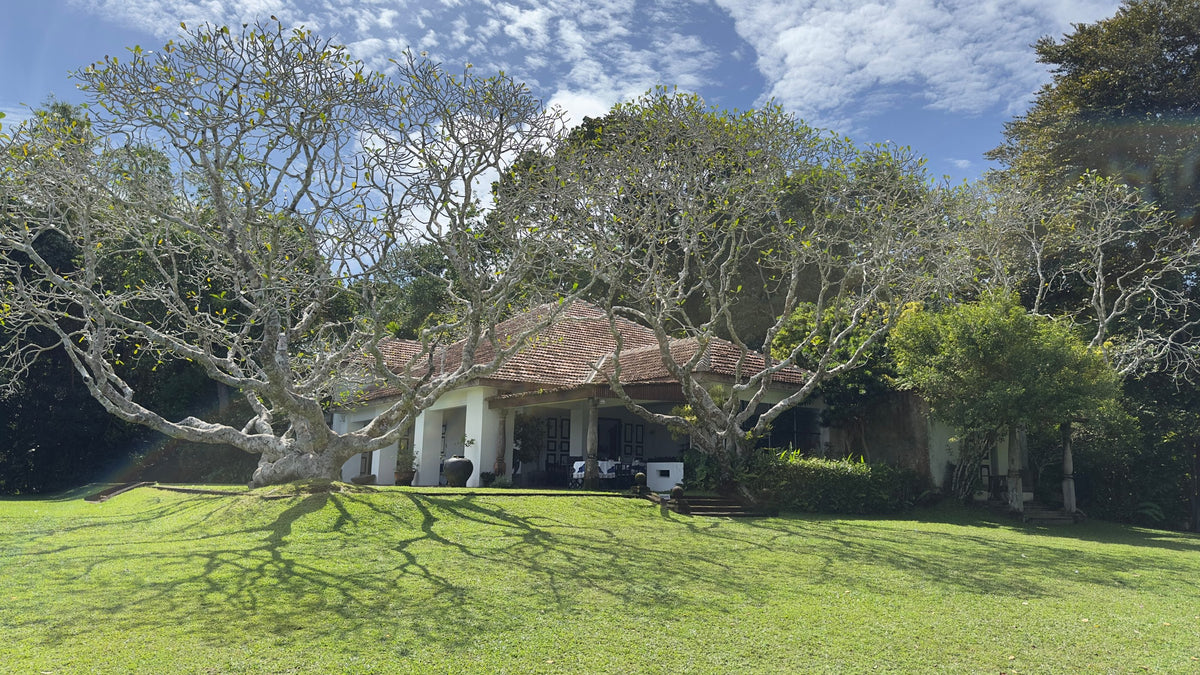
The bungalow at Lunuganga under its spreading frangipani trees, seen across the lawn. Photo: Eco2004, CC BY-SA 4.0, via Wikimedia Commons, licence
The road to Lunuganga climbs steeply off the coast at Bentota, a rough track that gives no hint of what is waiting at the top. Then the trees open. A lawn falls away towards water. A frangipani spreads its branches wider than seems possible. A bell hangs from a tree, and somewhere beyond a hedge another one answers. The house is there too, low and white, but it takes a while to notice it. At Lunuganga the house was never the main event.
Geoffrey Bawa bought the estate in 1948, the year Sri Lanka became independent. It was a former rubber and cinnamon plantation of about 25 acres, a working landscape made for extraction. He spent the rest of his life turning it into something else: a garden of lawns, water, shade and long views, edited a little at a time over half a century. The name means Salt River in Sinhala. Today the place is cared for by the Geoffrey Bawa Trust, a non profit charity that runs garden tours and overnight stays.
A garden made of rooms
What makes Lunuganga work is that it treats a landscape the way an architect treats a plan. There are outdoor rooms here, each with its own mood and its own view. A terrace looks across to the lake. A path drops into green shade and comes out at a pond. A bench is placed exactly where the land opens towards the water, and it is only when you sit on it that you understand why it is there.

Bawa furnished those rooms like a collector. Works by the Sri Lankan artist Laki Senanayake stand in the garden, alongside Burmese gongs and Chinese ritual vessels set out along the lawn. A bust of Pan watches over a lotus pond. Bells hung in the trees once summoned lunch, tea and drinks, each with its own voice, so that the whole estate became a kind of instrument for an afternoon. It is playful, theatrical and entirely serious about pleasure.
Nothing about it is hurried. A garden cannot be designed in a season, and this one was not. Bawa cut, planted, waited and cut again. Views were opened and closed. Trees were trained, and the vast frangipani is the result of two trees grafted together. Lunuganga is less a design than a long conversation between one man and one piece of ground.

Lunuganga is less a design than a long conversation between one man and one piece of ground.
The house as one part of the view
The house began modestly, as a plantation bungalow with two bedrooms and a verandah, and a car porch because a planter of the 1930s was assumed to own a car. Bawa reworked it over the years without ever letting it dominate. He moved the approach, relocated the entrance and created a formal hall with a black and white floor, where two doors face each other in perfect symmetry.
Elsewhere the estate grew a small family of buildings. There is the Glass Room, set over the old car parking space, and a gatehouse. Cinnamon Hill House was added in the mid 1990s as a two bedroom weekend cottage. A garden room was built entirely from the recycled timber of an eighteenth century shop house, with a single plank table of raintree wood at its heart. Each building is a pause in the walk rather than a destination.
Inside, Bawa moved steadily towards less. Built in furniture of brick and plaster, white platforms to sit or lie on, dark polished cement floors that stay cool underfoot. Against that plain ground he set a few chosen things: an Art Deco dining table, a Georgian chandelier, colonial Roorkee chairs, canvas director's chairs carried out to the garden. He liked to set the new against the old, the smooth against the rough, the pristine against the weathered. The rooms feel collected rather than decorated, and never precious.
Before the label
The style now loosely called tropical modernism owes a great deal to this place, and the label has travelled a long way from it. It is now applied to almost anything with a palm, a timber screen and a terrazzo floor. Lunuganga is a useful corrective, because its lessons are not about any of those objects. They are about climate and time.
The rooms are open because the air needs to move. The floors are cement because cement stays cool. The furniture is built in because damp and insects are hard on loose pieces, and because a plaster bench can be swept and never wobbles. The garden comes right up to the walls because, in a place this green, the most beautiful thing in any room is usually the view out of it. None of that is a look. It is a set of answers to a particular place.
Even the collecting follows that logic. The old pieces at Lunuganga are few, and each is given room. A Venetian gilded mirror or an old Indo-Portuguese settee reads clearly against white plaster and a dark floor, the way a single figure reads against a lawn. Crowd the same room and the climate would win: more surfaces to dust, more corners for damp, more things competing with the garden. Bawa's restraint was partly taste and partly maintenance, and in a hot, wet country the two are hard to separate.
The lesson for a tropical room, wherever it is, follows from those answers. Keep the floor cool and the surfaces honest. Use fewer, better things. Let the furniture be heavy enough to stay put and simple enough to sweep around. And leave room for the view, because the view will outlast any object you put in front of it.
A hill above the river
Bawa's ashes rest beneath a simple grey stone on a hillside overlooking the river. There is no plaque or formal marker. It is entirely in keeping with the place, which never needed to explain itself. The garden goes on growing, the bells still hang in the trees, and visitors still climb the rough track up from the coast to find a house that knows it is only one part of the view.
Follow @geoffreybawatrust on Instagram for their own work, in their own words.
Rugberry notes
From the Rugberry house
Bawa's floors are cool, flat and calm, and that makes a useful brief. On a polished cement floor in a warm climate, a heavy pile rug is often the wrong answer. A flat or low rug in plant fibre or firm wool lets the air move, takes bare feet well and can be lifted and shaken out when the monsoon brings the garden indoors.
If that way of living appeals, our natural jute rugs and handwoven rugs work in a similar spirit, with green rugs for rooms that want to carry the garden inside.


In the Rugberry house
- Natural jute rugsCool, flat plant fibre for warm rooms.
- Handwoven rugsLow and light, easy to lift and move.
- Green rugsFor rooms that carry the garden inside.
Rugberry has no affiliation with the studios featured. Images are from the Rugberry house unless credited.