Merci Behaves Like a House, Not a Shop
Images are credited where they are not from the Rugberry house.
The first thing most people photograph at Merci is not inside the shop at all. It is a small red Fiat 500 parked in the courtyard off the Boulevard Beaumarchais, where it has stood for sixteen years and become one of the most photographed sights in the Marais. It is a fitting welcome. A car that never leaves, in front of a shop that has never quite behaved like a shop.
Merci opened in the spring of 2009 at 111 Boulevard Beaumarchais, in a 19th century building that once housed a company specialising in upholstery fabrics and wallpaper. It does not occupy a floor or a corner of that building. It fills the whole thing, the way a family fills a large house, with cafes set into the shop windows where a more conventional store would put its displays.
A house, not a boutique
The idea of the shop as a house is more than a manner of speaking. Merci describes itself as filling the building like a large house, and the experience of walking through it bears that out. Rooms open into other rooms. A staircase leads somewhere unexpected. There is food on the ground floor and linen upstairs and, in between, the odd sensation of being a guest in a home whose owners have very good taste and very little interest in arranging things by price.
That last point is the heart of it. The store pairs vintage with contemporary and handmade with industrial, and it does so deliberately and without apology. A Duralex glass, the plain toughened tumbler familiar from school canteens, sits beside a plate from Jars Ceramistes. A plastic crate stands next to a vintage trolley by Mathieu Matégot. The cheap thing is not hidden in a corner and the costly thing is not placed on a plinth. They are put together because that is how real homes are furnished.
The cheap thing is not hidden in a corner and the costly thing is not set on a plinth. They are simply put together.
Shopping that gives something back
Merci was founded by Bernard and Marie France Cohen, who had earlier founded Bonpoint. They set it up as France's first magasin solidaire, a shop that directs part of its profits to good causes, in this case educational projects in Madagascar. The name itself, a simple thank you, makes the intention plain.
In 2013 the Cohens sold Merci to the Gerbi family, and the shop has carried on in the same spirit. In March 2025 it opened a second address in Paris, in a former post office at 19 rue de Richelieu. The new store has a copper counter by Piet Hein Eek and an urushi lacquer table by Jo Nagasaka, two pieces that sit naturally in the Merci habit of putting the crafted and the everyday side by side.
The choice of a post office is telling. Like the fabric and wallpaper house on the Boulevard Beaumarchais, it is a building with a working past, one that ordinary people once used every day. Merci tends to move into places with a life already in them and then add to that life rather than erase it.
The lesson of the mixed room
What Merci offers a visitor, beyond the things on its shelves, is permission. It shows, room after room, that a beautiful interior does not need to be made of matching things bought at the same time from the same source. It can be made of a found chair and a new lamp, a good glass and a plain one, an heirloom and a bargain. The mix is not a compromise. It is the point.
This is a harder lesson to act on than it sounds. Most furnishing advice still pushes toward sets: the matching dining chairs, the coordinated sofa and armchair, the room that looks finished on the day it is delivered. Merci argues the opposite. A room that looks finished on the first day has nowhere to go. A room assembled slowly, from things with different ages and origins, keeps changing and keeps its interest.
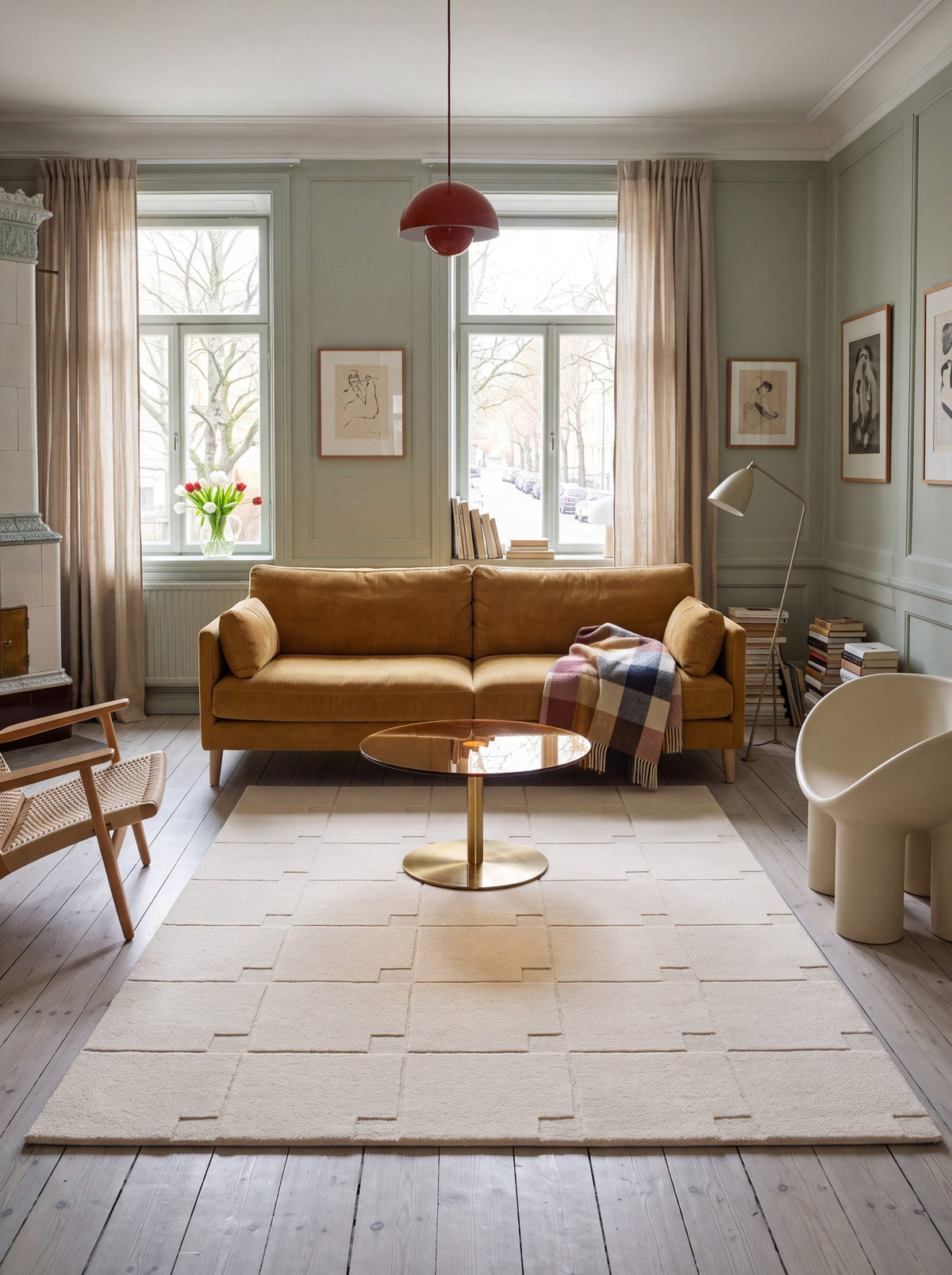
In such a room, the most useful pieces are often the quietest. A plain linen throw. A white plate that goes with everything. A floor covering in a soft, textured solid that does not compete with the vintage trolley or the inherited armchair but holds them together, the way a good tablecloth makes a set of odd plates look intentional. These are the pieces that let the louder things speak.
There is also something democratic in the approach. If a Duralex glass can sit comfortably beside a hand thrown plate, then good taste is not a matter of budget. It is a matter of attention: choosing each thing for what it does well, whatever it cost, and trusting that things chosen with care will get along.
The building on the Boulevard Beaumarchais adds its own layer to the argument. It was once a house of upholstery fabrics and wallpaper, the two materials that most directly shape how a room feels to sit in. Today it holds linen, glass, furniture and food. In a sense it has never stopped being in the business of rooms, only widened the brief. A shop that occupies such a building with care, rather than gutting it, is making the same case in brick and plaster that it makes on its shelves: that what is already there is often worth keeping, and that new things look better beside old ones than they do alone.
Why it still feels new
Concept stores have come and gone in the years since 2009, many of them built on the same promise of a lifestyle edited into a single shop. Merci has outlasted most of them, and the reason may be that it never really sold a lifestyle at all. It sold a way of looking, one that can be taken home and applied to things you already own.
The red car in the courtyard is the best summary of that idea. It is not new, not rare, not especially valuable. It has simply been there long enough, cared for and looked at, to become part of the place. Most of the best things in a home earn their place in the same way.
Follow @merciparis on Instagram for their own work, in their own words.
Rugberry notes
From the Rugberry house
A quiet, textured rug is so often the piece that lets a mixed room hang together. The Avalanche Wool Rug and the Bitte Wool Rug are both hand tufted in New Zealand wool, one with a carved geometry in a single pale tone, the other with small repeated marks scattered over a quiet ground. Our textures and solids gather the pieces that sit beneath other things rather than in front of them.


In the Rugberry house
- Textures and solidsQuiet grounds that hold a mixed room together.
- Handwoven rugsFlat and close, easy to move and live with.
- Ivory rugsPale wool rugs for layered, collected rooms.
Rugberry has no affiliation with the studios featured. Images are from the Rugberry house unless credited.