Namda: Kashmir's Felted Rug and Its Second Life
Images are credited where they are not from the Rugberry house.
Most rugs are built thread by thread, on a frame, in rows. A namda is not. It begins as a loose cloud of sheep's wool spread across the floor, wetted, soaped and pressed until the fibres grip one another and will not let go. No warp, no weft, no loom. Just wool, water, soap and pressure, and the patience to keep pressing until a heap of fleece has become a single, solid cloth.
The namda is Kashmir's felted rug, and the technique behind it is one of the oldest ways of making textiles anywhere. Then, once the felt is made, comes the second skill: embroidery in aari chain stitch, or designs laid in dyed felt on felt, worked across the surface in coloured wool. Two crafts in one object, one structural and one decorative, and both done by hand.
How wool becomes cloth without a loom
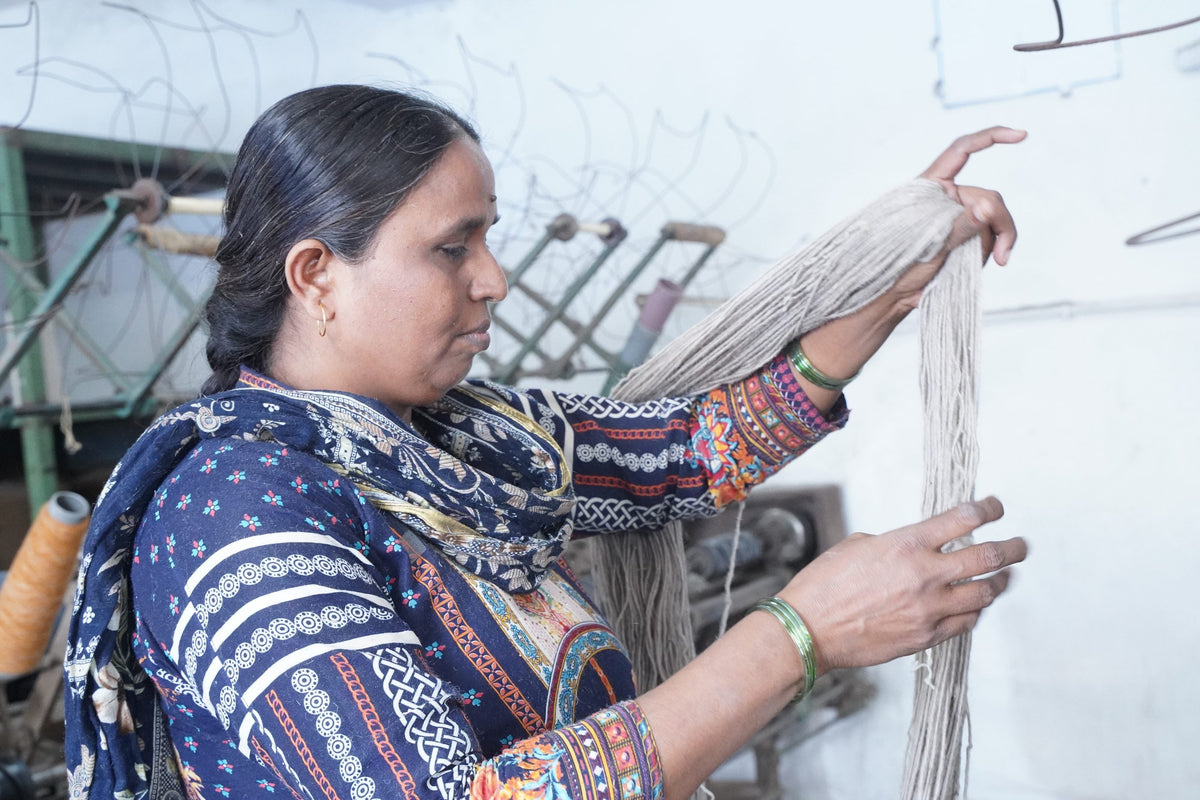
The making is simple to describe and hard to do well. The wool is washed with water and soap, then spread in even layers. It is soaked, and then pressed, traditionally with a tool called a pinjra, until the scales on each fibre catch on their neighbours and the mass begins to hold together. The more it is worked, the tighter and stronger the felt becomes.
Everything depends on evenness. A patch where the wool is spread too thin becomes a weak spot. A patch too thick stays lumpy. A good felt maker reads the wool with their hands and eyes as they lay it out, long before any pressing begins, much as a weaver reads a warp. The result, done well, is a rug that is soft and dense at once, with no grain and no direction, warm underfoot in the cold months.
Then the embroiderer takes over. Aari work uses a hooked needle to draw a continuous chain of loops across the felt, building up lines and fields of colour. Where a woven rug carries its pattern inside its structure, a namda carries it on top, like ink on paper. It is a different way of thinking about a floor covering, and a reminder that softness and pattern can come from felting as much as from the loom.


There is a freedom in that approach that a loom does not allow. A woven design has to be planned row by row before the first thread is laid, and it is bound by the grid of warp and weft. Embroidery on felt can curve, swell and wander wherever the hand wants to take it. The felt supplies the body. The needle supplies the drawing. Each can be judged on its own, and a fine namda is one where both are good.
A gift for a horse
The namda gained prominence in India under the emperor Akbar, and a legend explains how. A craftsman named Nubi is said to have gifted Akbar a namda to keep his horse warm, and the emperor, pleased, granted him land. Whether or not the story is literally true, it captures something real about the namda: it began as a practical object, valued for warmth, before it became a decorative one. The government describes the craft as going back to the 11th century.
For centuries it remained a craft of the valley, made in homes and small workshops, sold locally and, in time, abroad. By the 1970s, namda exports were reported to be worth Rs 300 to 400 crore a year. That is a large figure for a felted rug, and a sign of how much demand there was for a soft, colourful, affordable piece made by hand.
A namda carries its pattern on top, like ink on paper, rather than inside its structure.
The collapse
Then the trade fell away. From 1998, exports dropped by almost 100 percent, according to reporting on the craft. The reasons given are practical ones: raw material became scarce, skilled labour grew harder to find, and the marketing that had carried namdas abroad faded. The government itself later described the craft as moribund, for lack of raw material, trained manpower and market.
Those three reasons have to be read together, because each depends on the others. Without orders, there is no reason to train young people. Without trained people, there is no one to make the orders. Without a reliable supply of wool, neither the training nor the orders matter. A craft does not usually die from a single cause. It unravels when all three threads are pulled at once.
A second life
The revival, when it came, was organised. A pilot project under the Pradhan Mantri Kaushal Vikas Yojana began in November 2021 and certified 2,212 artisans, most of them young women, across clusters in Srinagar, Baramulla, Ganderbal, Bandipora, Budgam and Anantnag. The government presents it as a public private partnership model under Skill India. Soon afterwards, the first export consignment in about 25 years, worth around 1.5 lakh dollars, went to buyers in the UK, Japan, the Netherlands and Germany.
Those are hopeful numbers, and they are reported numbers, so they deserve both welcome and a little care. Training thousands of people is a real achievement. But it raises the question every craft revival has to face sooner or later: is a craft revived by the number of people who can make it, or by the number of people who keep buying it?
The honest answer is that it needs both, and that the second is harder. A certificate gives someone a skill. Only steady orders give them a living. One export consignment is a start, not a market. The namda's future depends less on how many artisans are trained this year than on whether buyers, at home and abroad, keep choosing felted rugs year after year, so that a young woman who learns the craft today can expect to be practising it in a decade.
What felt teaches
The namda says something about wool that every rug maker understands. Wool wants to hold together. Its fibres are built to grip, which is why a felt can form from nothing but pressure and water, and why a well made wool rug of any construction recovers and lasts. The namda simply takes that property to its logical end and does without the loom altogether. A felt has no warp to break and no weft to unravel, so all of its strength lives in how well the fibres were worked together.

It also shows that a soft, dense, warm floor does not have to come from a long pile. Some of the most comfortable rugs we make are handloom woven, like the deep Plush Wool Rug, and the art of making explains the constructions we use. The next time you see a namda, embroidered in chain stitch on a soft felt ground, remember that not a single thread in it was woven.


In the Rugberry house
- The art of makingThe constructions behind a Rugberry rug.
- Fine wool rugsNew Zealand wool, soft and resilient.
- Textures and solidsWool led surfaces with quiet pattern.