Ajrakh: Indigo, Madder and a Village Rebuilt
Images are credited where they are not from the Rugberry house.
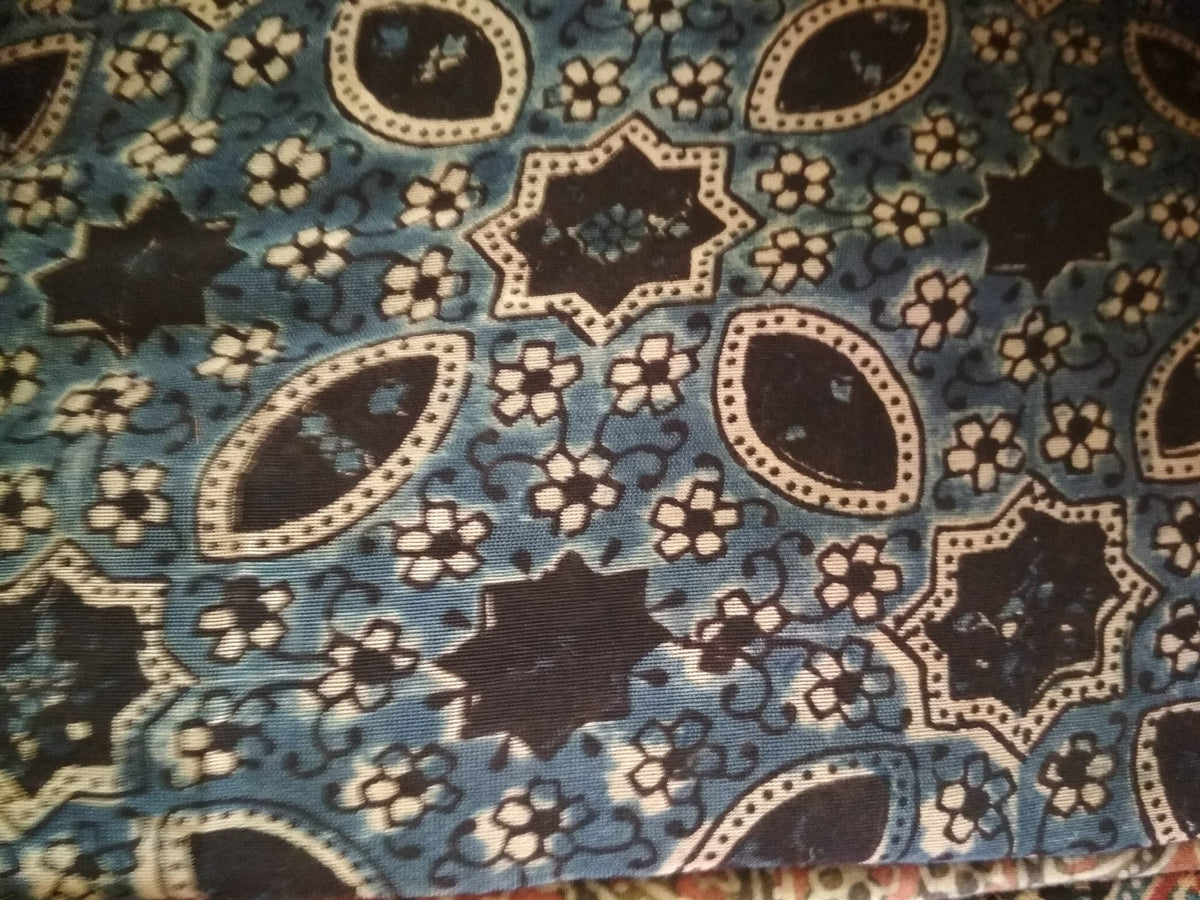
Ajrakh printed cotton, stars and lozenges resisted out of indigo. Photo: SMarndi, CC BY-SA 4.0, via Wikimedia Commons, licence
An Ajrakh cloth does not reveal itself all at once. It begins as plain cotton, and for days it looks like very little: stamped with mud and lime, dipped, rinsed, dried in the sun, stamped again. The pattern emerges slowly, in reverse, from what the printer chose to protect rather than what they chose to colour. By the end, after many baths and many days, the cloth carries a deep crimson and an indigo so dense it reads almost as black, laid out in symmetrical patterns that seem to have been there all along.
So what is Ajrakh print? In the simplest terms it is a resist printed textile from Kutch, in Gujarat, made with hand carved wooden blocks and natural dyes. In practice it is one of the most patient forms of colour in India, and one of the clearest lessons anywhere in how natural colour is built in layers.
The people who change colours
Ajrakh belongs to the Khatri community, whose name is said to mean one who fills or changes colours. The Khatris migrated from Sindh to Kutch in the 16th century and settled into printing villages, among them Dhamadka and Ajrakhpur. The craft is much older than any of those dates, and its exact antiquity is debated, but its life in Kutch has been bound up with these families for centuries.
The name of the craft and the name of the community tell the same story. This is work defined by colour, and by the long knowledge of how to make it, fix it and protect it, passed down within families rather than written in manuals.

Printed in reverse
The making of Ajrakh is a sequence of protections and reveals. Artisans print the cloth with hand carved wooden blocks, using resists of mud and lime to shield the areas that must stay pale. Then the cloth goes into the dye. Then it is washed. Then it is printed again, and dyed again, and washed again, in repeated cycles with natural dyes and mordants that include indigo, madder, harda and lime.

Each cycle adds a layer, and each layer depends on the ones before it. A single piece can take up to three weeks and as many as 20 washes, using vegetable and mineral dyes. Nothing can be hurried, because every bath has to finish its work before the next can begin, and every resist has to be applied with the same precision as the first, or the pattern will blur.

The pattern emerges in reverse, from what the printer chose to protect rather than what they chose to colour.
That logic explains why Ajrakh looks the way it does. The colour is not laid on top of the cloth like paint. It is built into it, bath by bath, so that the red is never one red and the blue is never one blue. Each shade carries a faint memory of the steps that made it. Under raking light the surface shows depth rather than flatness, a quality no single application of colour can produce.
Why natural colour never looks flat
This is the lesson Ajrakh holds for anyone who loves rugs, even though Ajrakh is cotton and a rug is usually wool. Natural colour, built slowly, has a liveliness that uniform colour lacks. Fibres take dye slightly differently. Baths vary by a degree or two. The result is a surface that shifts as you move around it, warmer in one light and cooler in another.
Rug makers know this effect well, because it happens in wool too. Yarn dyed in batches carries small differences of tone, and when it is woven or knotted, those differences become a gentle movement across the field of the rug. In the language of the trade it is sometimes called abrash, and it is the reason a well made rug in a single colour never looks like a sheet of plastic. It looks alive.


Indigo and madder, the two great colours of Ajrakh, are also among the oldest colours of the textile world, and both behave this way. Indigo builds through repeated dips, each one deepening the blue. Madder gives a range of reds that depends on what it is paired with. Neither offers a single flat tone. Both reward patience.

A village named after a cloth
In 2001 a devastating earthquake struck Kutch. The printing families of Dhamadka were already struggling with drought, and the disaster made it harder still to carry on. Rather than scatter, Khatri artisans from Dhamadka bought land together about 50 km away and began again. They named their new village Ajrakhpur, after the cloth itself.
It is a rare thing for a craft to give a place its name. Most crafts are named after the places where they began. Here the order was reversed, a statement that the work was the community's identity, the thing worth rebuilding around. Today Ajrakhpur has around 200 houses and 90 workshops.
What sets the village apart is its commitment to natural dyes. Chemical dyes crept into Ajrakh from the 1940s onward and held it for decades, and many printers elsewhere still use them because they are cheaper, faster and more predictable. Almost all of Ajrakhpur's printers have gone back to the old materials and the old pace, and that choice is now part of what makes their work recognisable. The Controller General of Patents, Designs and Trademarks has granted a Geographical Indication certificate to the artisans of Kutch Ajrakh, a legal recognition that the cloth belongs to its place and its people.
What the cloth teaches a weaver
Ajrakh is a good teacher for anyone who works with colour and fibre, because it makes visible something that is usually hidden: that depth comes from process, and process takes time. A colour built in layers reads differently in morning light and in lamplight, and it keeps rewarding a second look.


A rug in deep blue or rust has the same choice to make as a printer in Kutch. It can be flat and uniform, quick and easy to repeat. Or it can carry the small variations of a slower making, so that the colour moves and changes as the light does. The second kind is harder to produce and harder to describe. It is also the kind that people keep for decades.
The next time you see an Ajrakh cloth, look closely at the edges of its shapes, where the resist met the dye. You will see that each line is very slightly alive, the trace of a hand and a block and a bath of colour. That small imperfection is the signature of the craft. It is what weeks of printing, dyeing and washing look like.
In the Rugberry house
- The art of makingHow colour and fibre become a Rugberry rug.
- Blue rugsFrom pale mist to deep indigo.
- Rust and copper rugsThe warm reds of the earth.