





Biophilic Design and Your Rug
In a biophilic room the rug is the largest natural surface you touch every day, so it carries the idea further than any plant. Choose a natural fibre you can feel barefoot, colours lifted from a real landscape and lines that move like grain or water, then plan for the plants and watering around it.
In short
- Biophilic design brings people into contact with nature indoors through daylight, views, plants, water, natural materials and forms that echo the living world.
- A rug supports biophilic design mainly through touch: a wool, jute or wool and Botanical Silk pile gives bare feet the varied, slightly irregular surface that synthetic floors lack.
- A biophilic rug does not need a leaf print; flowing lines, gradations of colour and carved relief read as nature more convincingly than literal motifs.
- Pots, saucers and watering are the main practical risk to a rug in a plant filled room, so planters should stand on raised stands or sit just off the rug.
What is biophilic design, and where does a rug fit?
Biophilic design is the practice of building our instinctive bond with nature into the rooms we live in. The idea was developed by the late Stephen Kellert and others, and a widely cited 2014 framework groups it into fourteen patterns, from a view of greenery to the play of changing light and the use of natural materials.

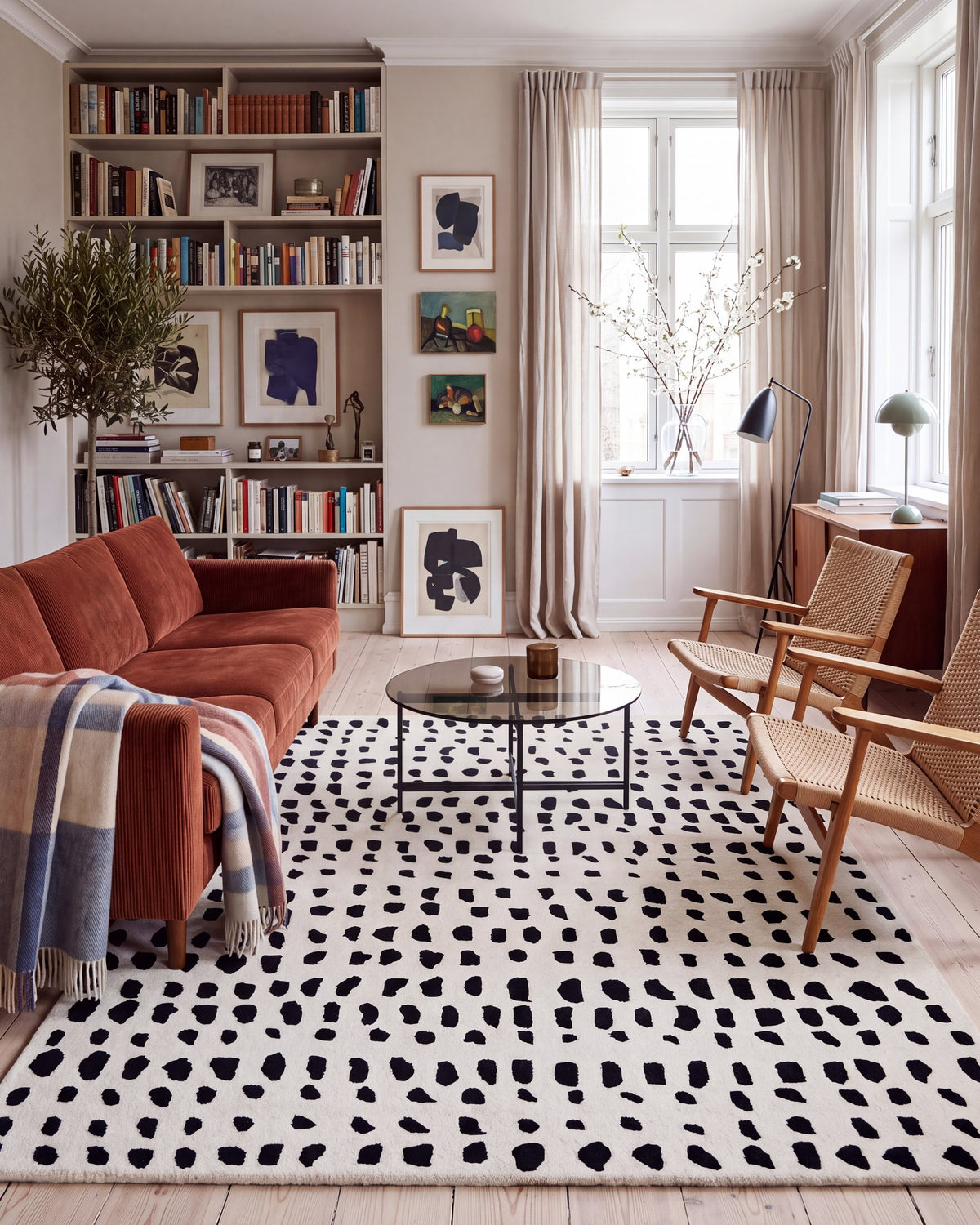
Most people start with plants, which is sensible but incomplete. A home with twenty pots on a vitrified floor, under flat white light, with a polyester rug in a printed leaf design, has the props of nature without much of the experience. Biophilic rooms work through the senses, and touch is the sense most often forgotten.
That is where the rug comes in. It is usually the biggest soft surface in a room, the one your feet meet first in the morning and the one children and pets lie on. If the walls, the furniture and the floor are all hard and smooth, a natural fibre rug is often the only place in the room where the body meets something grown rather than manufactured.
Which biophilic patterns can a rug actually carry?
A rug can carry four of the patterns well: a material connection with nature, a non visual connection through touch, biomorphic forms, and complexity in the way natural surfaces are complex. It can support the others, such as daylight and views, through where it is placed. The table sets out what each one asks of a rug.


| Biophilic pattern | What it means in a home | How a rug delivers it | What undermines it |
|---|---|---|---|
| Material connection with nature | Surfaces made from things that grew | Wool, jute, wool and jute, wool and Botanical Silk | Plastic fibres printed to look natural |
| Non visual connection (touch) | Textures you feel with hands and feet | A pile or weave with some variation, firm in one place and soft in another | A perfectly uniform, slippery face |
| Biomorphic forms | Shapes that recall living or geological forms | Lines that bend like wood grain, water or contour lines; carved relief like terraces | Literal leaves and birds repeated on a grid |
| Complexity and order | Detail that rewards a closer look, held in a calm structure | Tonal shifts, two colour yarns, a gradation across the field | Busy pattern with no resting place for the eye |
| Light and view (supporting role) | Daylight that changes; a line of sight to green | A rug placed to lead the eye to a window, with a fibre that changes as the light moves | A dark rug that swallows a room's only daylight |
Verdict: for a biophilic room, choose a plain or softly patterned natural fibre rug over a printed leaf design, because the feeling of nature comes from the material and its irregularity, not from a picture of a plant.
Why does the fibre matter more than the motif?
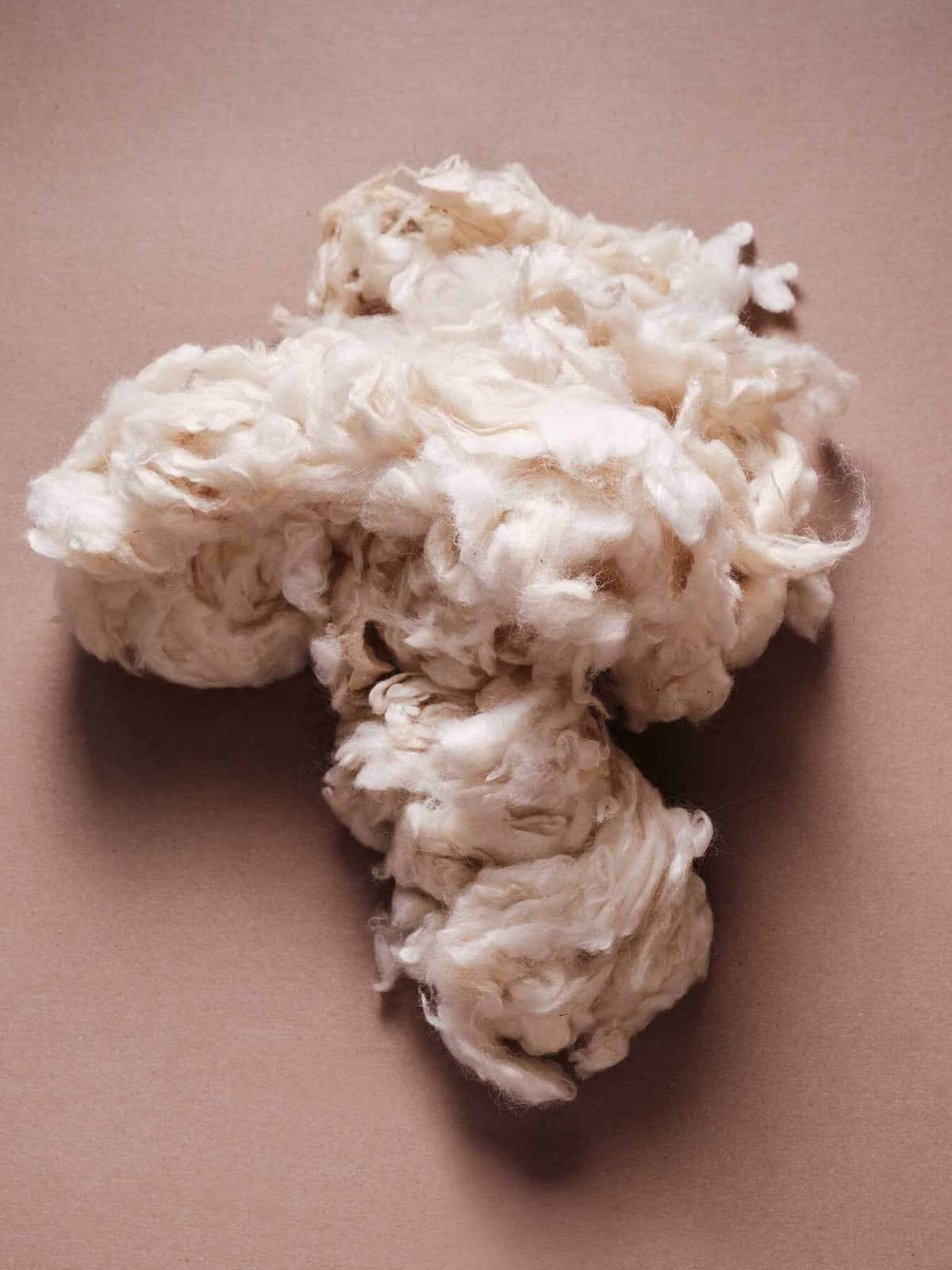
The fibre matters more because biophilic design is about real contact, and contact is felt before a pattern is seen. Wool carries a slight springiness and warmth, jute is firm and dry with a visible twist, and Botanical Silk, a plant based fibre, adds a low sheen that shifts as you move. Each behaves the way natural things behave, slightly differently in every square foot.

Wool is the most forgiving starting point. Its fibre holds natural lanolin, it takes up some moisture from humid air without feeling damp, and it softens with use rather than flattening for good. For a family room in Pune or a bedroom in Bengaluru, a handloom New Zealand wool rug is the closest thing to walking on a meadow that a city flat allows.
Jute brings the drier, more fibrous end of nature: think of a woven basket or a coir mat in a verandah. It suits rooms that are already rich in wood and stone and want a rougher counterpoint, though it dislikes water, which matters in a room full of plants. Our comparison of wool and jute rugs sets out the trade offs.
The Rugberry Grain Wool Rug in Sage shows the principle well. Its colour sits between dry grass and the underside of a neem leaf, and its low handloom surface shows a faint, uneven texture where the yarn has been worked by hand. It is from about ₹31,080, inclusive of GST at the time of writing.
How do you take a rug colour from a landscape rather than a paint chart?
Take the colour from a specific place you love, not from a swatch fan. Real landscapes are never one flat green or one flat brown; they move from dark to light, warm to cool, across a single view. A rug that does the same feels natural even in a plain room.


Start with the view you actually have. A Mumbai flat that looks into a rain tree in the monsoon sees deep, wet greens, while a farmhouse near Hyderabad looks out on red earth, dry grass and grey granite. A rug that answers the view outside the window ties the room to it, which is one of the quiet aims of biophilic design.
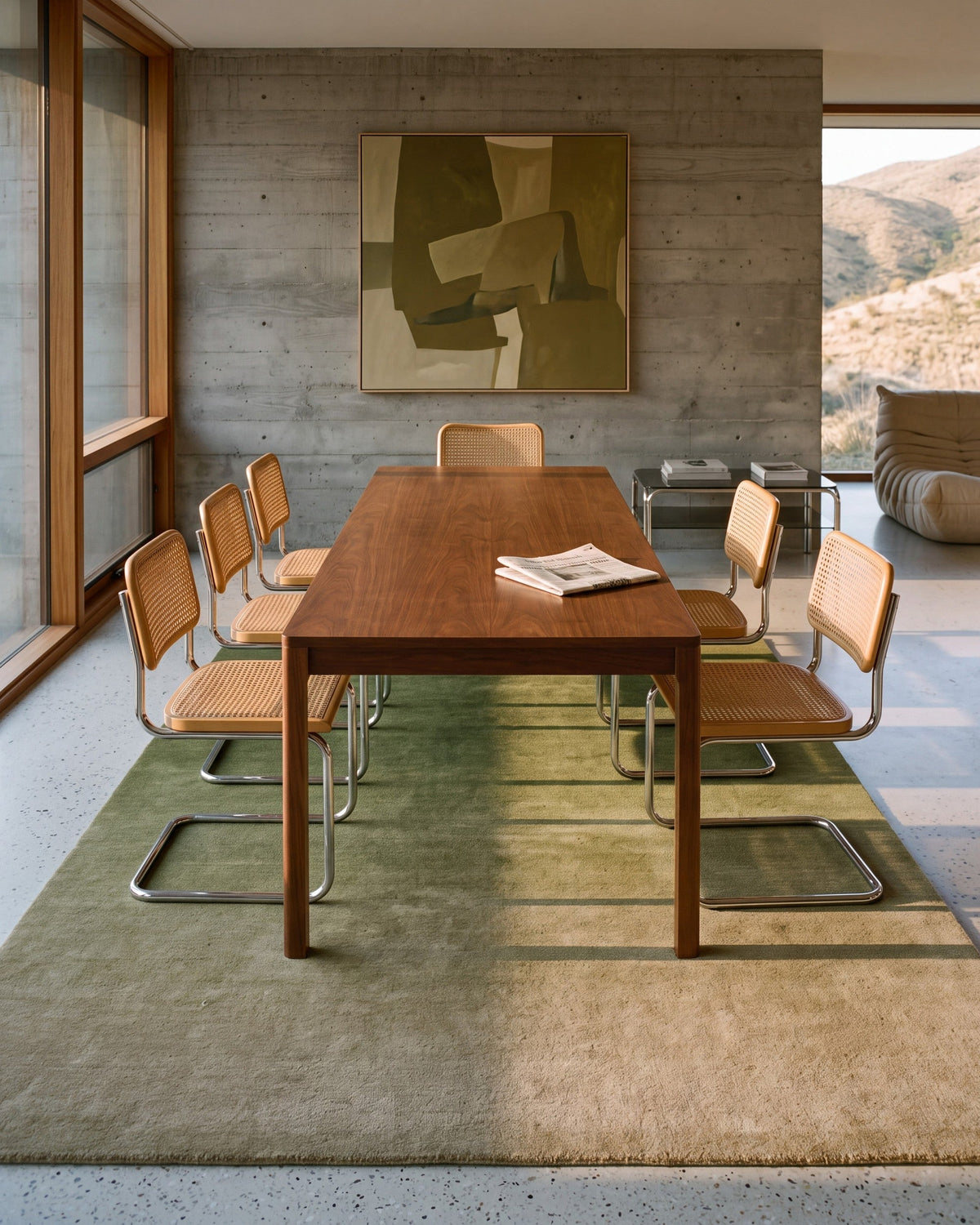
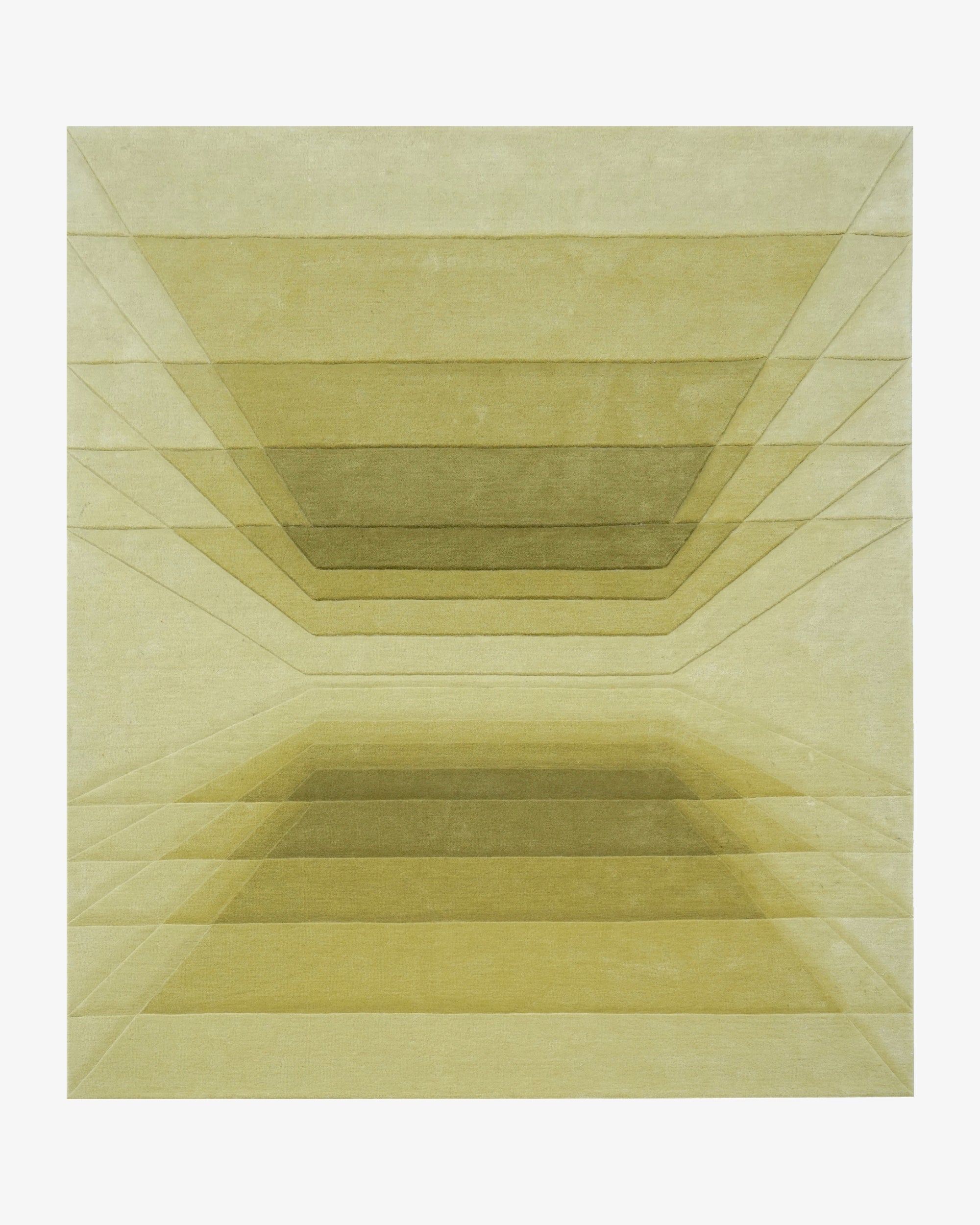
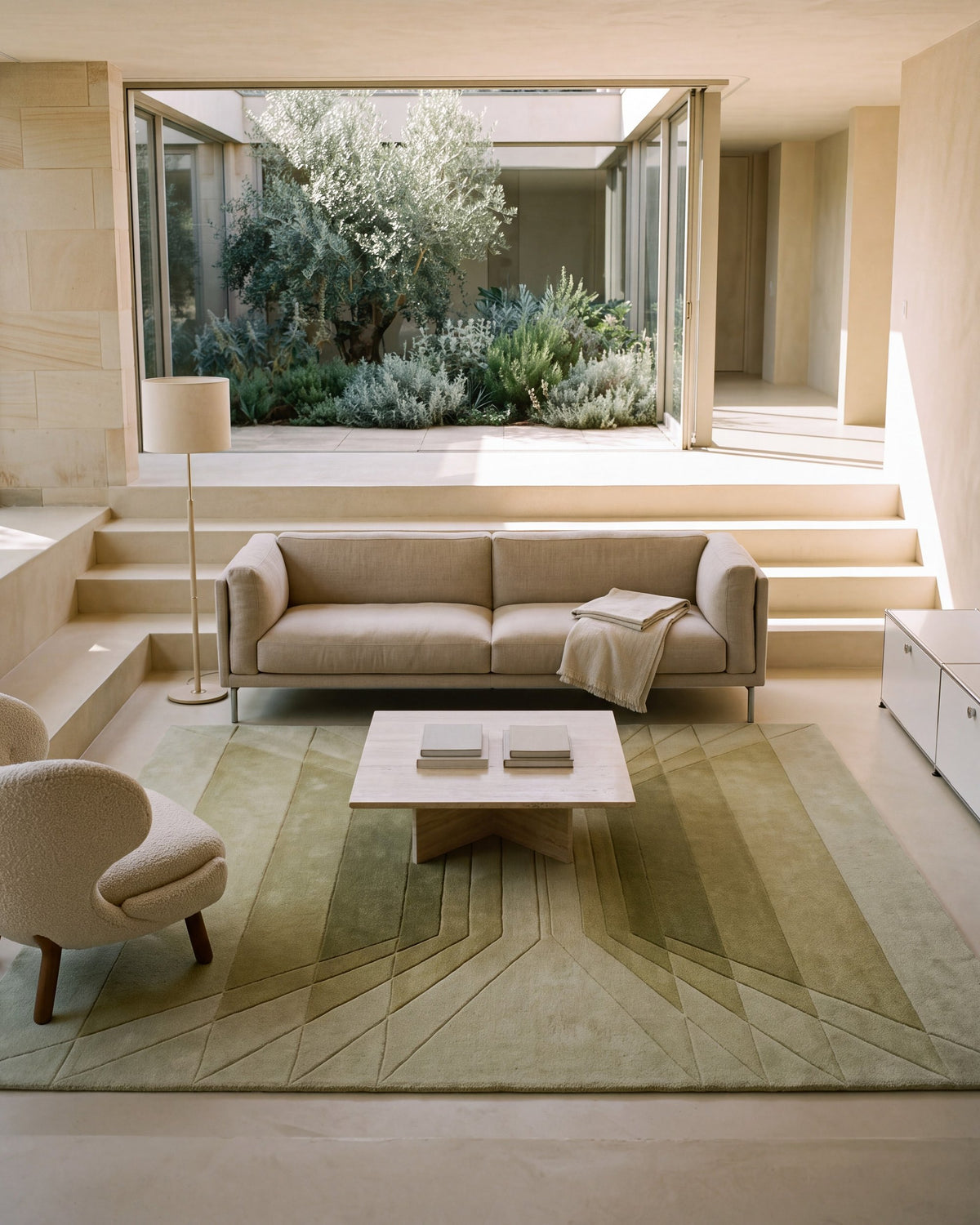
Gradation is the most convincing way to do this. The Ombré Meadow Rug, hand-tufted in New Zealand wool, moves slowly through soft greens and warm neutrals across its length, the way a field changes from shade to sun. It is from about ₹36,960, inclusive of GST at the time of writing, and its deeper sibling, the Ombré Forest Rug, is darkest at one end, like the floor of a wood.
Keep proportions natural too. In most landscapes the strong colour is small and the quiet colour is large, so let the rug carry the large, quiet tone and save the bright greens for living plants. Our guides to sage green rugs and earth tone rugs go further into individual shades.
Can a rug be biomorphic without a leaf print?
Yes, and it usually works better without one. Biomorphic design borrows the logic of nature, its curves, branching and layering, rather than copying a leaf or a bird. A rug that does this reads as natural from across the room and still rewards a close look.
Nature indoors is not a picture of a leaf. It is a surface that behaves the way living things behave.
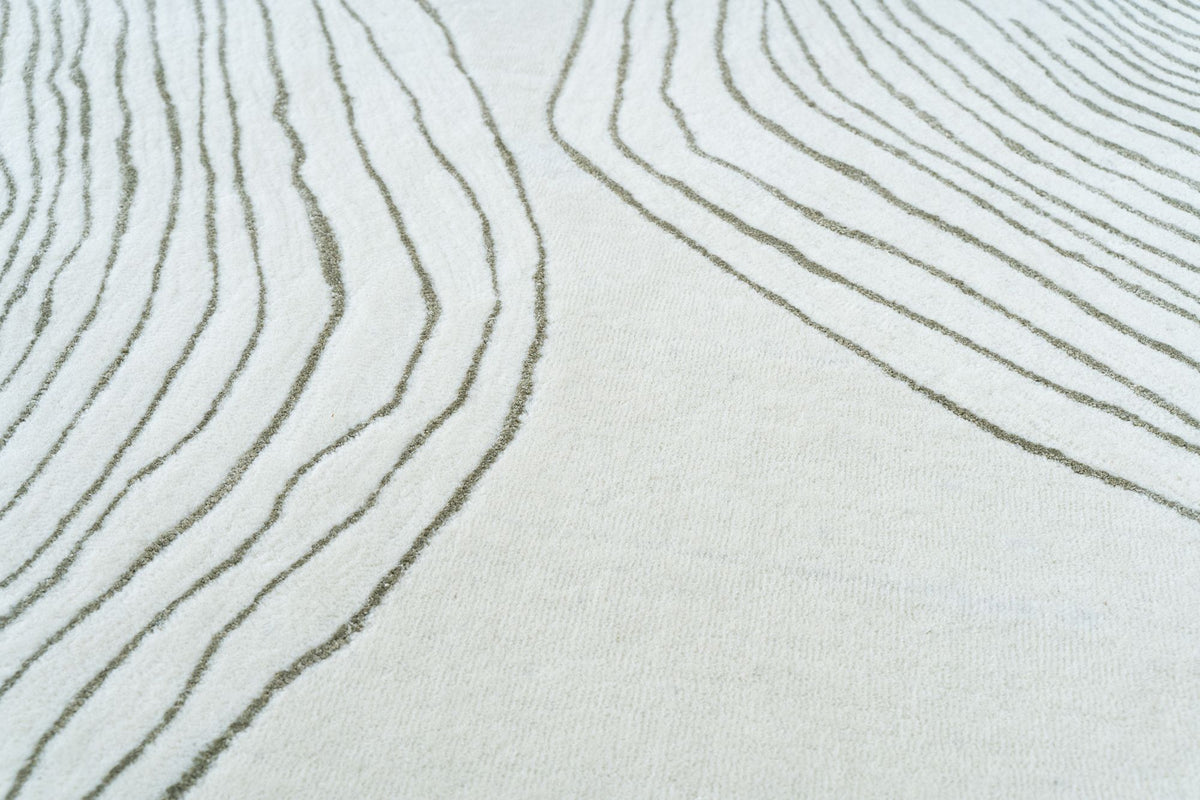
The Livid Wool & Silk Rug is a good example. Its lines bend and bunch like the grain in a cut log or the contours on a hill map, in New Zealand wool and Botanical Silk, hand-tufted with a 14 to 16 mm pile. It is from about ₹33,600, inclusive of GST at the time of writing.
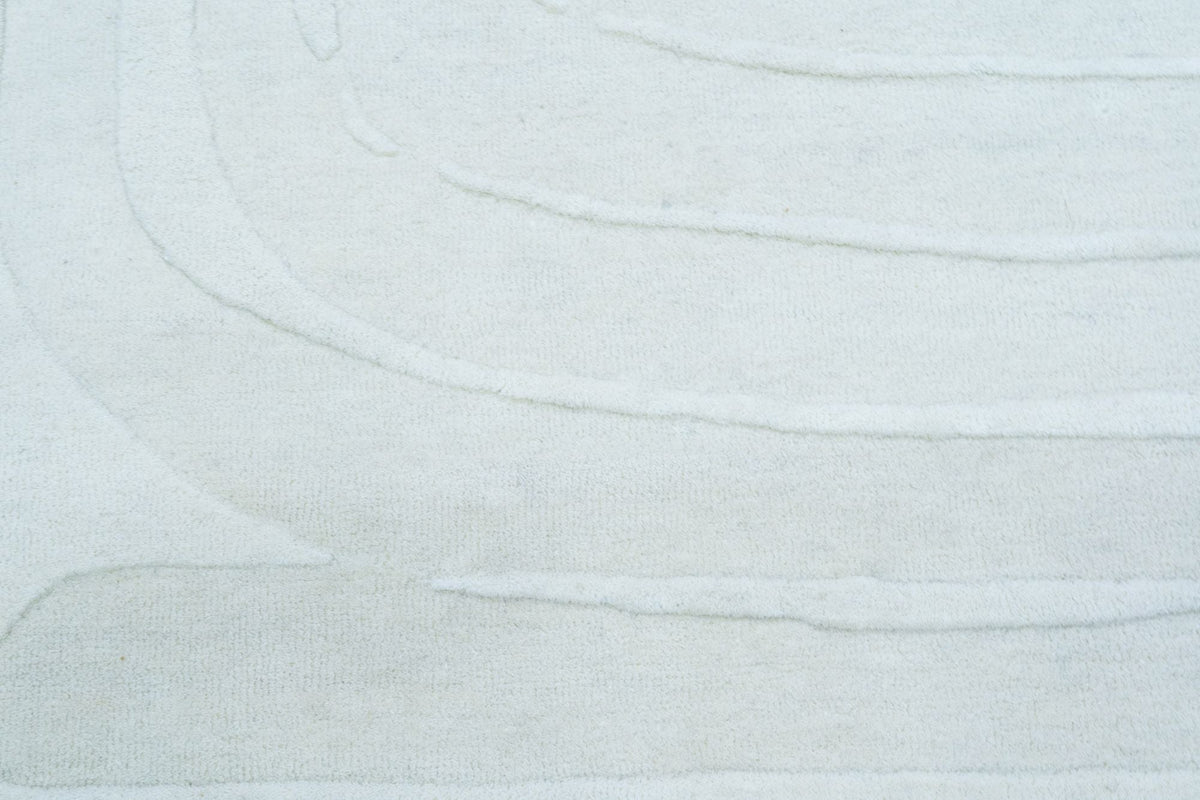
Carving is another route. The Cavea Wool Rug from the Lamina collection is hand-tufted in New Zealand wool and cut into stepped layers of one colour family, which catch light the way terraced fields or eroded rock do. Our article on carved wool rugs explains how that depth is made.
How do you keep plants and a rug in the same room?
Keep the soil and the water off the rug. Pots should stand on raised stands with deep saucers, or sit on the bare floor just beyond the rug's edge, because a saucer that overflows once a week will mark wool and stain jute long before anyone notices.

Water is the hidden risk in a biophilic room. A terracotta pot sweats moisture through its sides, a plastic saucer can trap a ring of condensation beneath it, and a watering can drips on the way from the tap. Each of these leaves a damp patch that dries slowly under a rug and can leave a tide mark or a musty smell, especially in the monsoon.
- Raise every pot. A stand of 5 to 10 cm lets air move under the saucer and makes any spill visible.
- Use deep, glazed saucers. They hold run off and do not sweat the way unglazed clay does.
- Water off the rug. Carry small pots to the sink or balcony, or lay a folded towel under the can for large ones.
- Check underneath monthly. Lift the rug corner nearest the plants and feel the floor and the rug's back for damp.
- Brush, do not wipe, spilled soil. Let it dry, then vacuum; wet soil rubbed into pile is far harder to remove.
Balcony gardens need the same thought at the threshold, where wet feet and hose spray meet the first indoor rug. Our guide to a covered balcony or sit out rug covers the outdoor side.
How should daylight and the view shape where the rug goes?
Place the rug so it leads the eye toward the window, the courtyard or the balcony, and accept that strong daylight will slowly soften its colour. Biophilic rooms want sun and a view, and a rug is part of the path that draws people toward them.

Changing light is one of the patterns rugs handle well. Light through a jaali or a wooden shutter falls in moving bars across a textured pile, and a fibre with a little sheen, such as wool with Botanical Silk, changes tone as the sun moves through the day. A flat, synthetic face shows the same light all day long.
Design researchers also describe the comfort of prospect and refuge: a sheltered place from which you can see out. A rug is a simple way to mark that refuge, under a reading chair in a corner that looks across the room to the window. In courtyard homes, as our guide to rugs for courtyard homes explains, the rug often sits in the shaded room facing the bright open centre.
Sun fades every dyed fibre over time, so rotate a rug by 180 degrees every few months if one end sits in a sunbeam. Rugberry rugs can also be made in custom colours and sizes when the room's light or shape calls for it.
Frequently asked questions
What is a biophilic rug?
A biophilic rug is one that connects a room to nature through its material, texture, colour and form. In practice it is a wool, jute or wool and Botanical Silk rug in colours drawn from a landscape, with flowing lines or gentle gradation rather than a printed leaf motif.
Are jute rugs good for a room with lots of plants?
Jute looks right among plants but reacts badly to water, which can leave brown marks and stiffen the weave. If plants will be watered near the rug, wool is the safer choice, with jute kept for drier rooms or placed well away from pots.
Can I put potted plants directly on a wool rug?
It is better not to, because saucers sweat and overflow and the damp stays trapped under the pot. Stand planters on raised stands with deep glazed saucers, or move them to the bare floor at the edge of the rug.
Which rug colours suit a biophilic living room?
Colours that come from a real place work best: leaf greens and sage, the sand and umber of dry earth, the grey of stone and the soft ivory of river pebbles. A gradation from dark to light often feels more natural than a single flat shade.
Which Rugberry rugs suit biophilic design?
The Grain Wool Rug in Sage, the Ombré Meadow and Ombré Forest rugs, the Livid Wool & Silk Rug and the carved Cavea Wool Rug all suit it. Each is in natural fibre and reads as landscape through colour, line or relief rather than a printed motif.
Bring the outside in through the feet first. Explore the green rugs. Material first.



Leave a comment
This site is protected by hCaptcha and the hCaptcha Privacy Policy and Terms of Service apply.