




Custom Shaped Rugs: Ovals and Shapes That Fit
A custom shaped rug is cut to the furniture or the floor it serves: an oval under a long table, soft rounded corners in a room of curved pieces, or an outline traced from your own floor. You choose the shape, make a paper template, and the rug is made to measure, usually in hand tufted wool.
In short
- The common custom shapes are round, oval, racetrack (straight sides with rounded ends), rectangle with rounded corners, and a free outline traced from the floor.
- An oval rug for an oval dining table should be about 60 to 75 cm larger than the table on every side, so chairs stay on the rug when pulled out.
- A full size paper template, marked with the door side and photographed with a tape measure in view, is the most reliable way to order a shaped rug.
- Rugberry's shaped rugs are hand tufted in New Zealand wool, many with Botanical Silk, and any shape can be made to measure from a template or drawing of the space.
Which shapes can you order besides a rectangle?
Besides a rectangle you can order a round, an oval, a racetrack, a rectangle with rounded corners or a free shape drawn to your room. Each one answers a different piece of furniture or a different kind of floor.
| Shape | Where it works | How to size it |
|---|---|---|
| Round | Round dining table, a reading corner, a round entrance hall | Table diameter plus about 120 cm |
| Oval | Oval dining table, a curved sofa facing two chairs | Table length and width plus 60 to 75 cm each side |
| Racetrack | Long rectangular table with rounded ends, a long narrow sitting room | As a rectangle, then set the end radius to half the width |
| Rounded corners | A rectangle in a room of curved furniture, or where small children run | Standard rectangle size, plus a corner radius in cm |
| Traced outline | Bay windows, columns, a hearth, an L shaped seating group | A full size template of the floor |
Verdict: for a room that is already full of straight lines, choose rounded corners over a full oval, because they soften the room without asking the furniture to move; choose an oval or racetrack when the table or sofa it serves is curved itself.
Shapes have one thing in common: they cover less floor than the rectangle that holds them. An oval covers about 79 percent of its bounding rectangle, so an oval sized from a rectangular rug will look smaller in the room than you expect.
When does an oval rug beat a rectangle or a round?
An oval rug beats a rectangle when the furniture on it is oval or curved, and it beats a round when the table or seating is longer than it is wide. The oval follows the chairs as they pull out, so no chair leg drops off a square corner.

Under an oval dining table, add 60 to 75 cm to every side. A six seater oval table of 180 x 90 cm needs a rug of about 320 x 230 cm, roughly 10.5 x 7.5 ft. An eight seater of 240 x 110 cm needs about 380 x 250 cm, roughly 12.5 x 8 ft. Our guide to the rug under a round dining table works the same rule for circles.
In a sitting room, an oval suits a curved sofa with two chairs opposite, where a rectangle would leave empty corners behind the curve. Size it so the front legs of every seat sit on the rug, then check the gap to the nearest wall. Our post on a rug for a curved sofa covers measuring around the arc.
A long, narrow room is the third case. A racetrack, with straight sides and round ends, keeps the full width along the room and lets the ends breathe at a door or a window, which a hard rectangle cannot.
How do you make a template for a custom shape?
Make a template by laying paper on the floor at full size, drawing the outline where the rug edge should fall, and marking which side faces the door. A template removes the guesswork that a sketch with numbers always leaves.
- Lay the paper. Tape sheets of brown kraft paper or flattened cartons together until they cover the area, and tape them lightly to the floor.
- Place the furniture. Put the table, sofa or chairs where they will stand, or mark their legs with masking tape.
- Draw the edge. Walk around and draw the outline with a marker, keeping the line at least 30 cm clear of door swings and thresholds.
- Mark the reference lines. Draw the longest line through the shape and the widest line across it, write their lengths in cm, and add an arrow towards the main door.
- Live with it. Leave the template down for a day or two, pull chairs in and out, and trim or extend the line where it feels wrong.
- Record it. Photograph the template from above with a tape measure laid along the long line, then roll it up and keep it for the quotation.
For a symmetric shape, fold the template in half along its long line before you photograph it. If the two halves do not match, decide whether the room really needs an asymmetric shape or the line simply wandered.
For simple shapes you can skip the paper and give three numbers: length, width and, for rounded corners, the radius. For anything traced from the room, send the photographed template.
A sketch with numbers leaves room for doubt. A template on the floor does not.
How do you specify rounded corners?
Specify rounded corners as a radius in centimetres, the distance from the corner to where the curve begins. A small radius softens a rug quietly; a large one changes its character.


- About 5 cm: the corner simply stops being sharp. Most people notice it only when it is pointed out.
- About 15 to 20 cm: a clear, soft corner that echoes curved chair arms and round tables.
- About 30 cm or more: the rug starts to read as a rounded shape in its own right, close to a racetrack on smaller sizes.
Two practical points decide the radius. If a chair or sofa leg stands near a corner, keep the radius small enough that the leg still lands on the rug. And in a home with crawling children, a rounded corner lifts and curls less than a sharp one, which makes it a sensible choice for a family room.
Write the radius on the template or the drawing for each corner. If two corners differ, for example where a rug meets a wall on one side, say so, because the default is all four the same.
Which constructions can take a custom outline?
Hand tufting takes a custom outline most easily, because the pile is tufted into a stretched cloth and the shape is cut and bound afterwards. Woven and knotted rugs are built row by row and favour straight sides.


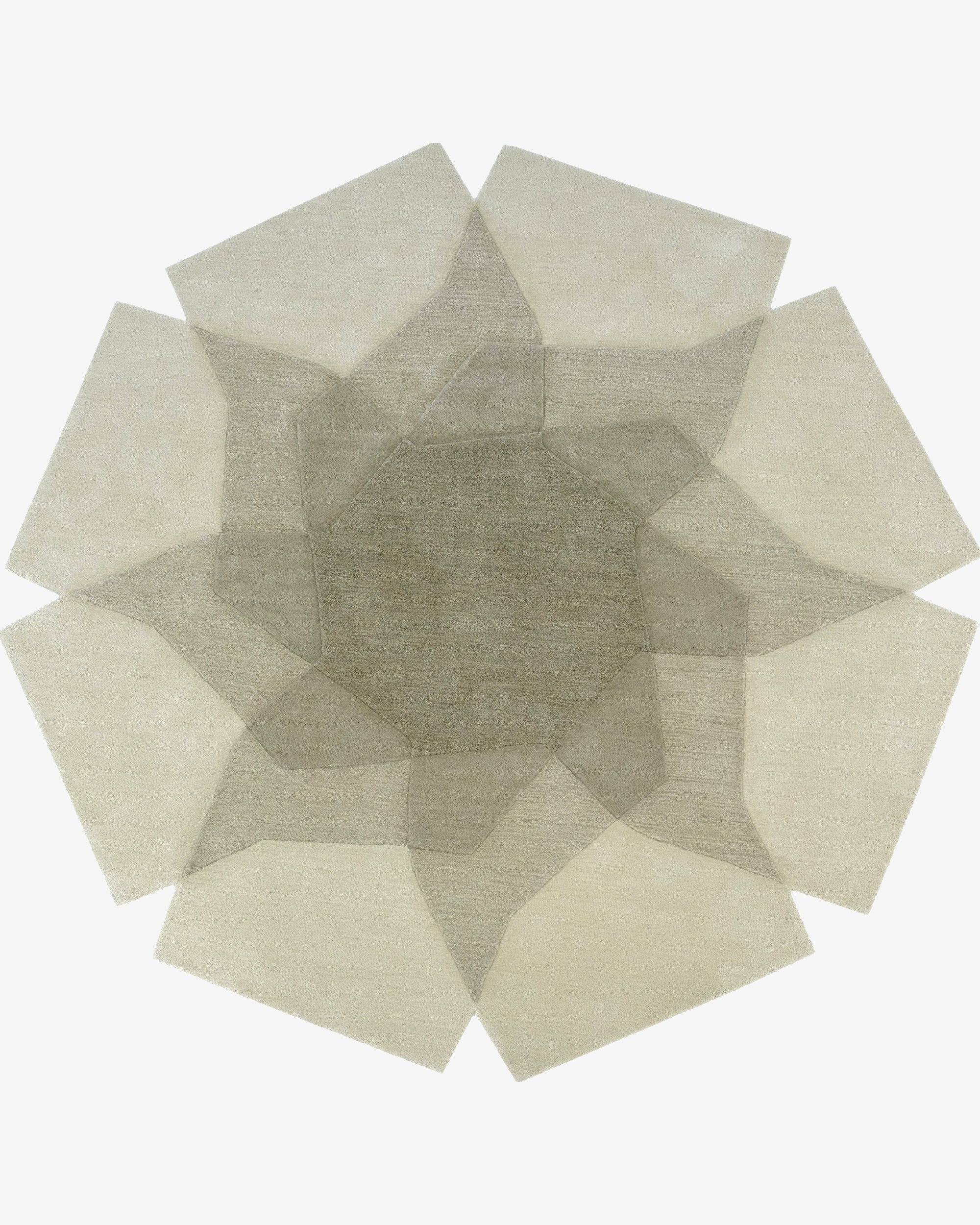
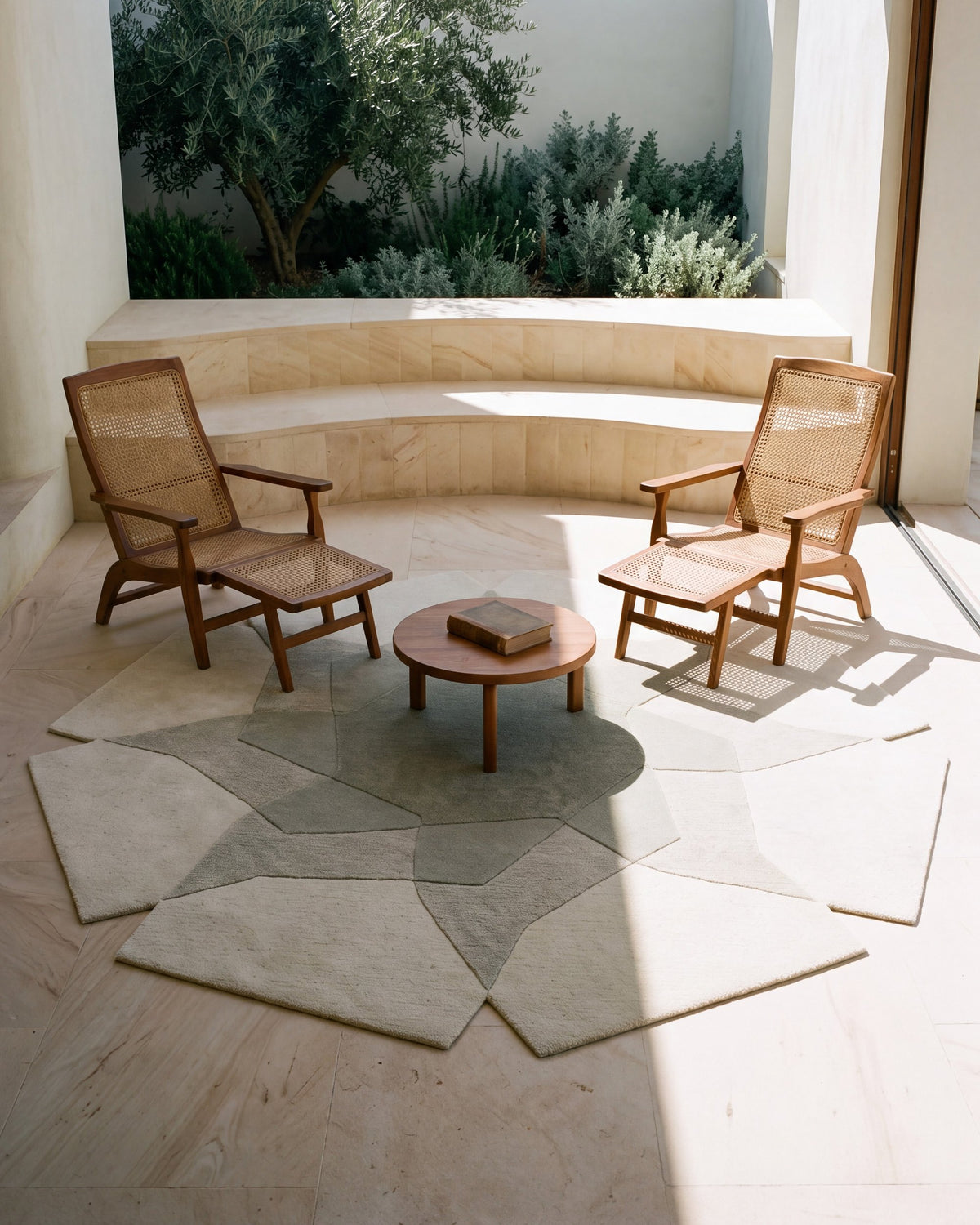
Every rug in the Rugberry shaped rugs collection is hand tufted in New Zealand wool, many with Botanical Silk, at a pile of about 14 to 16 mm. The outline is cut along the drawing and finished with a binding so the edge holds its line.
Rounds and soft corners are sometimes possible in other constructions, but a traced or organic shape is a tufting job. If you love a handloom texture and need an unusual shape, ask Rugberry what is possible before you settle on the design, because the answer changes from design to design.
Check the binding when the rug arrives. Run a hand along every curve, especially inside curves, and look for an even edge with no puckering.
How is a custom shaped rug priced?
A custom shaped rug is priced on a quotation, based on its size, fibre, construction and design. Ask whether the quotation is worked out on the shape's own area or on the rectangle that contains it, because the two can differ by a fifth or more.


Rugberry's listed rounds give a starting point. The Facet Wool Rug, hand tufted in New Zealand wool and made entirely to measure, is from about ₹23,835 for a 6 ft diameter. The Nebula Wool & Silk Rug, in New Zealand wool and Botanical Silk, is from about ₹28,560 for 6 ft. Rectangles such as the Fluid Wool Rug are from about ₹33,600 for 5x8 ft. All prices are inclusive of GST at the time of writing.
To estimate before you ask, find the area of your shape. A 6 ft round covers about 28 sq ft; a 6 ft square covers 36 sq ft. An oval of 10.5 x 7.5 ft covers about 62 sq ft against 79 sq ft for its rectangle. Our guide to what a custom rug costs in India explains how area drives the figure.
Which Rugberry designs suit a custom shape?
Designs with open fields or flowing lines suit custom shapes best, because the outline can be redrawn without cutting through a motif. Facet, Nebula, Fluid and Trickle are four Rugberry designs that take a shape well.


- Facet Wool Rug: New Zealand wool, soft and even underfoot with a dense pile that holds its shape, listed in rounds and made entirely to measure, which makes it the natural start for an oval or racetrack.
- Nebula Wool & Silk Rug: clouded and diffuse, with no edge you can point to, so any outline sits easily on it.
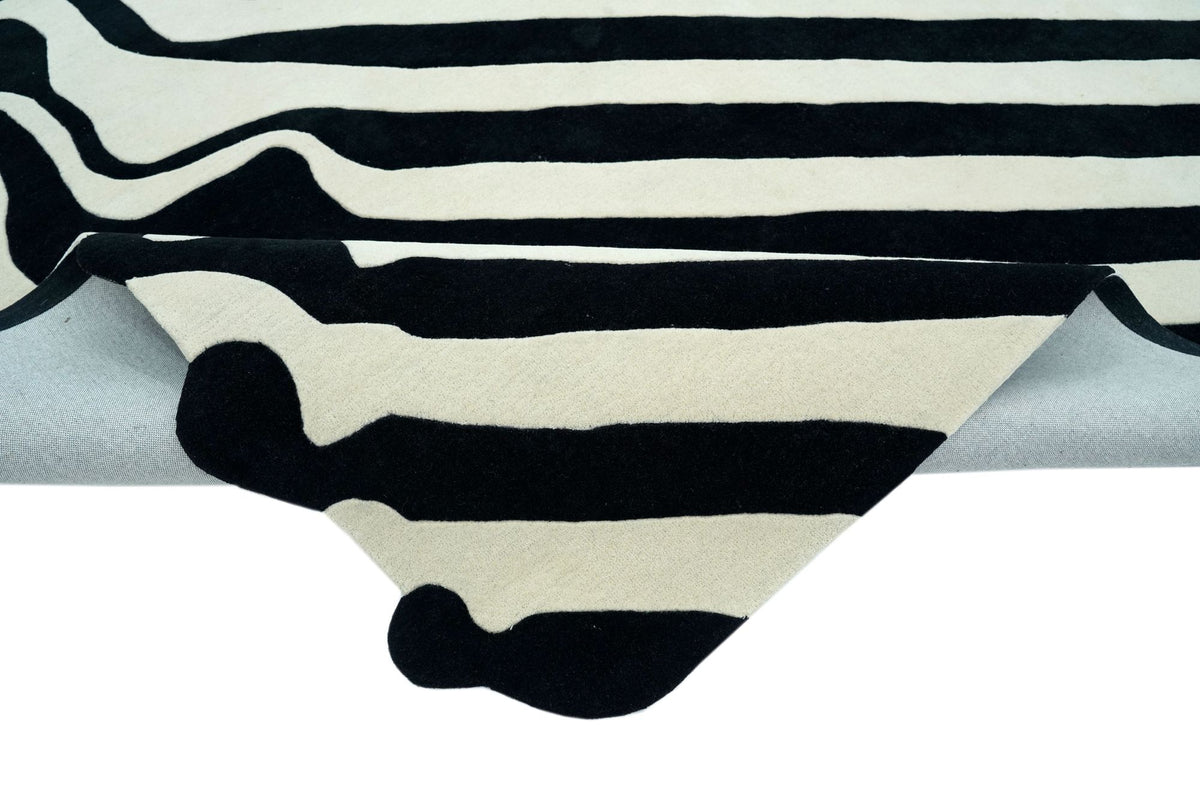
- Fluid Wool Rug: a surface running in slow, continuous curves, a design that already lives in the shaped rugs collection, for a room that wants one strong piece.
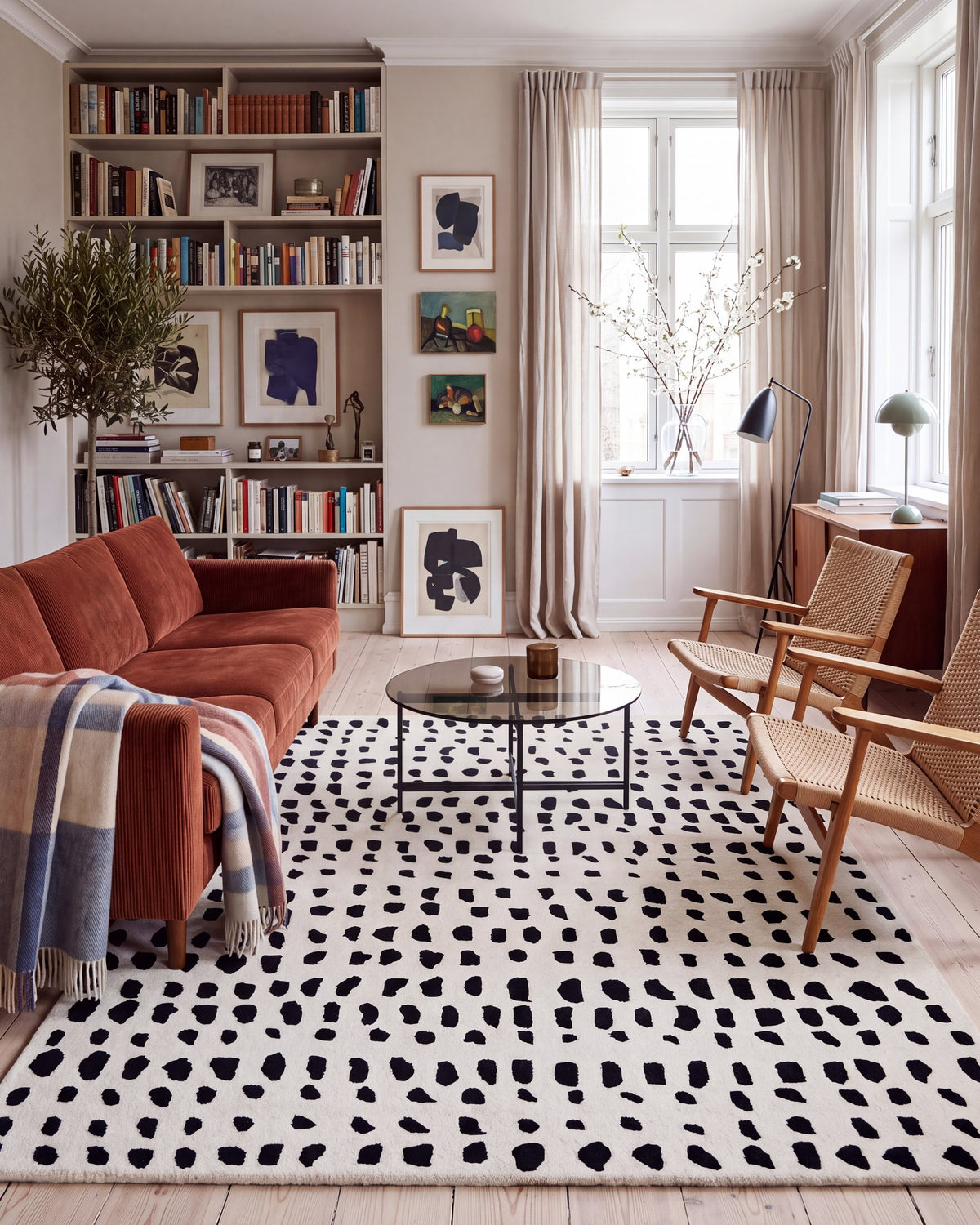
- Trickle Wool & Silk Rug: New Zealand wool and Botanical Silk, its marks running slowly down an open field, which leaves room for rounded corners or a soft oval.
A strongly geometric design is harder to shape, because a curve cuts its grid at odd points. If your heart is set on one, ask for a drawing of the shaped version before you approve it. The customisable rugs show every design that can be made to measure, and our earlier post on shaped and irregular rugs looks at the organic outlines Rugberry already makes.
Frequently asked questions
What size oval rug do I need for a six seater dining table?
For an oval table of about 180 x 90 cm, plan a rug of roughly 320 x 230 cm. That leaves 60 to 75 cm beyond the table on every side, enough for chairs to pull out without catching the edge.
Can I send a drawing instead of a paper template?
Yes, for simple shapes such as an oval, a racetrack or rounded corners, a drawing with length, width and corner radius is enough. For an outline traced around columns, a hearth or a bay, a photographed full size template is far more reliable.
Does a shaped rug cost more than a rectangle?
It depends on how the quotation is worked out. Ask whether the price follows the area of the shape or the rectangle around it, and compare against a standard size of the same design.
Can a handloom or hand knotted rug be made oval?
Sometimes, depending on the design, but those constructions are built row by row and favour straight sides. Hand tufted rugs take ovals and free outlines most easily, and Rugberry can confirm what is possible for a given design.
How should the underlay for a shaped rug be cut?
Cut the underlay about 3 to 5 cm inside the rug's outline all the way round, following the curve. A rectangular carpet pad left showing beyond a curved edge looks untidy and can catch a foot.
Draw the shape on the floor first, then let the rug follow it. Begin with the shaped rugs. Material first.



Leave a comment
This site is protected by hCaptcha and the hCaptcha Privacy Policy and Terms of Service apply.