



Bergamo, Congrand and Bias: Soft Shapes in Wool
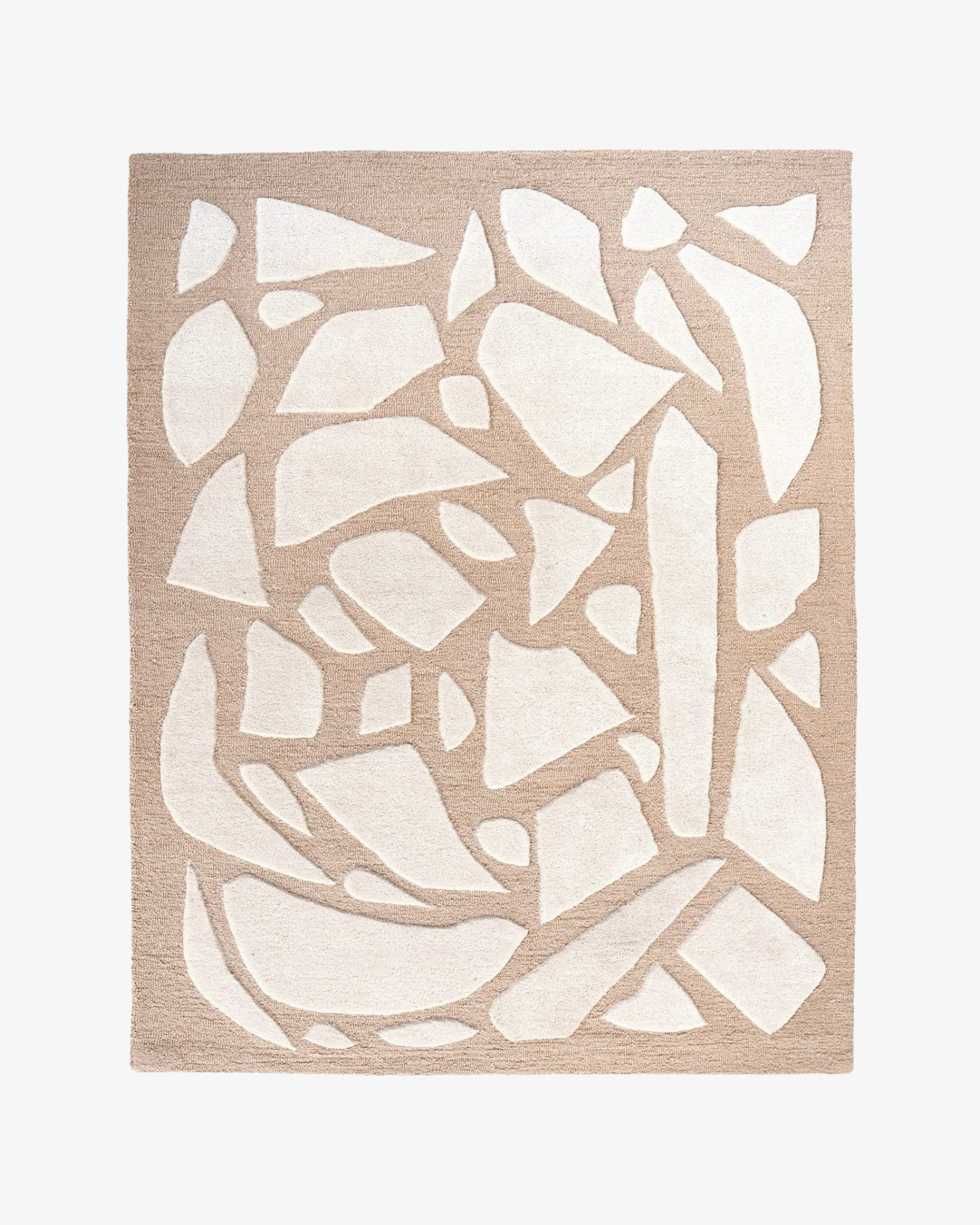
Bergamo, Congrand and Bias are hand tufted New Zealand wool rugs built on soft, organic shapes, and the real difference between them is scale. Bergamo scatters small ivory fragments, Congrand draws broad bands that wander across a camel field, and Bias sets one large curve between brown and ivory.
In short
- The Bergamo Rug is hand tufted New Zealand wool with many small ivory fragments on a warm sand ground, a fine scale that suits rooms of any size, from ₹40,000 for 5x8 ft at regular price, ex GST at the time of writing.
- The Congrand Wool Rug, from the Nina Brunn x Rugberry collection, draws broad ivory bands that fold across a camel field and needs a rug of at least 6x9 ft for its shapes to read.
- The Bias Wool Rug comes in standard sizes of 8x10, 9x12 and 12x15 ft only, because its single large curve between brown and ivory needs a big floor.
- The smaller the shapes on a rug, the smaller the room it can work in; the larger the shapes, the more floor the rug needs to show.
What do Bergamo, Congrand and Bias have in common?
All three use organic, hand drawn shapes rather than straight lines or a grid, and all three are hand tufted at Rugberry in New Zealand wool. Their palettes also overlap: ivory set against warm sand, camel and brown.
That shared palette means the three sit comfortably with the same furniture. Walnut and teak, cane, oatmeal linen and off white plaster all suit them, which makes them natural rugs for the warm modern interiors common in Indian homes today.
What separates them is how big each shape is, and so how much of the rug you must see before the pattern makes sense. That one question decides which room each rug belongs in.
How does the Bergamo Rug work at a small scale?
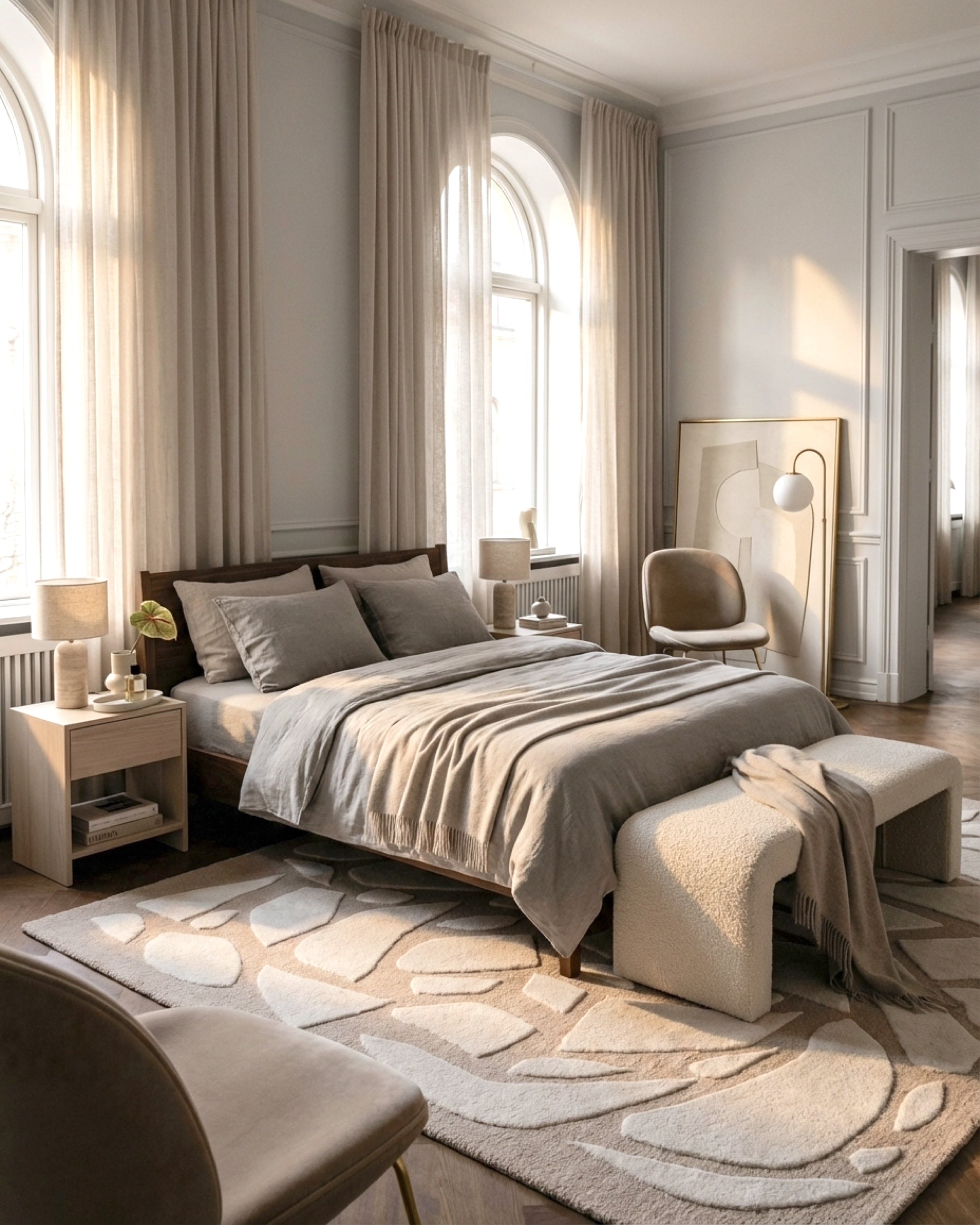
The Bergamo Rug works at a small scale because its ivory fragments are many and close together, like broken stone or torn paper laid on a sand ground. Even a corner of Bergamo shows the full character of the rug.


That makes it the most flexible of the three. A 5x8 ft Bergamo in a 10x12 ft bedroom, partly under the bed, still reads as a complete pattern, and an 8x10 ft piece under a sofa and chairs loses nothing when furniture covers part of it.
The fragments sit slightly proud of the ground, so the surface has a gentle relief under bare feet. The Bergamo Rug costs ₹40,000 for 5x8 ft, ₹53,000 for 6x9 ft and ₹79,000 for 8x10 ft at regular price, ex GST at the time of writing.
Because the pattern is spread evenly, Bergamo is also forgiving of placement. It does not need to be centred under a table to look right, which helps in a living room where the furniture moves for festive hosting.
Why does the Congrand Wool Rug need more floor?
The Congrand Wool Rug needs more floor because its ivory bands are broad and travel a long way before they turn. On a small rug you see only a few curves; on a large one you see the bands wander, fold back and meet.


Congrand belongs to the Nina Brunn x Rugberry collection, and it is drawn at a generous scale for a room with space to give. A 6x9 ft size is the smallest that shows the bands moving; 8x10 ft and larger let them run.
The camel field is warm and fairly dark, so it grounds a pale room well. On white marble or ivory vitrified tile, Congrand reads as a strong warm panel, while on mid toned teak flooring the camel blends and the ivory bands carry the pattern.
Congrand costs ₹37,000 for 5x8 ft, ₹50,000 for 6x9 ft and ₹74,000 for 8x10 ft at regular price, ex GST at the time of writing. See the Congrand Wool Rug for 9x12 ft and above.
Why is the Bias Wool Rug only made in larger sizes?
The Bias Wool Rug is offered only in 8x10, 9x12 and 12x15 ft as standard sizes because its pattern is one large gesture. A brown field meets ivory along a single soft curve, crossed by a few black strokes, and that composition needs room to breathe.


Scaled down to 5x8 ft, the curve would become a simple split down the middle and lose its sense of movement. At 9x12 ft, the brown and ivory halves read as two calm planes with one drawn edge between them.
Bias is the most architectural of the three. It suits a large living room or a dining room where the table can sit across the curve, so that brown runs under one side and ivory under the other.
Small shapes fit small rooms. One large curve needs a large floor to show it whole.
The Bias Wool Rug costs ₹62,000 for 8x10 ft, ₹84,000 for 9x12 ft and ₹1,40,000 for 12x15 ft at regular price, ex GST at the time of writing. Any other size can be made to measure.
Which scale suits which room size?
Match the scale of the shapes to the size of the floor you can see. In a compact room most of the rug is hidden by furniture, so only a fine pattern survives; in a large room a bold shape has the open floor it needs.

| Rug | Scale of shape | Smallest size that reads well | Room it suits | Regular price, ex GST |
|---|---|---|---|---|
| Bergamo Rug | Many small fragments | 5x8 ft | Bedroom 10x12 ft, compact living room | ₹40,000 for 5x8 ft |
| Congrand Wool Rug | Broad wandering bands | 6x9 ft | Living room 12x15 ft and up | ₹50,000 for 6x9 ft |
| Bias Wool Rug | One large curve | 8x10 ft | Living or dining room 14x16 ft and up | ₹62,000 for 8x10 ft |
For a 2BHK living room of about 150 sq ft, choose Bergamo over Bias, because its small fragments still read when a sofa and table cover half the rug.
For a 3BHK or villa living room of 250 sq ft or more, Congrand or Bias give the floor one clear idea. Our 8x10 rug guide covers what that size holds, and the statement rug guide explains when to let the rug lead.
Where should furniture sit on a rug with large shapes?
On a rug with large shapes, place the furniture so it frames the main shape rather than cutting through its middle. With Bias, set the coffee table near the curve so it sits on the meeting point of brown and ivory, and keep the sofa's front legs on the rug.

With Congrand, try to leave a band visible at the centre of the seating group. A solid coffee table directly on the busiest fold hides the movement that makes the rug worth choosing; a table on slim legs, or a round one, lets the bands show beneath.
Bergamo is the exception, since its pattern is evenly spread and works with any placement. Our guide to all legs, front legs or floating explains the standard layouts, which apply to all three.
How do Bergamo, Congrand and Bias look on Indian floors?
All three look warmest on pale floors, where their sand, camel and brown grounds stand a few shades darker than the stone or tile. On white marble and ivory vitrified tile, the rug becomes a clear warm zone, and the ivory shapes link back to the floor around it.
On mid toned wood or beige tile, the contrast drops. Bergamo's sand ground can sit very close to a beige tile, so its ivory fragments do the work; Congrand's darker camel still separates from the floor, and Bias keeps its strong split between brown and ivory on almost any surface.
Dark floors such as black granite or deep walnut turn the logic round. There, the ivory parts of each rug read as light shapes on a dark room, and Bias in particular becomes a bold two part composition.
Kota and other grey green stone floors are common in older homes in Rajasthan and Gujarat, and they cool warm rugs slightly. A camel ground like Congrand's balances that cool stone well, while a paler sand rug can look a little flat beside it.
Test any of the three before committing by laying a swatch on the floor in morning and evening light. A warm rug can look golden at 9 in the morning and much browner under warm LED at night.
How do these warm toned rugs handle daily life?
Warm sand, camel and brown grounds handle daily life well, because they sit close to the colour of household dust and dry soil. A light layer of dust from an open balcony door shows far less on Congrand's camel than on a plain ivory rug.
The ivory areas are where marks will show first. Vacuum two to three times a week in the dry months, blot spills straight away with a dry white cloth, and leave deeper cleaning to a professional, which is Rugberry's care guidance for all three rugs.
Turn the rug every few months so that sun from a west facing window does not fade one side more than the other. If you are drawn to warm tones generally, our article on brown rugs covers which browns suit which floors, and the Abstract post looks at another way of drawing loose forms in wool.
Frequently asked questions
Which of these rugs suits a small bedroom?
Bergamo is the best choice for a small bedroom. A 5x8 ft or 6x9 ft size can sit partly under the bed and still show its full pattern of fragments at the foot and sides.
Can the Bias Wool Rug be made in 6x9 ft?
Bias is listed in three standard sizes from 8x10 ft upward, but every Rugberry rug in this group can be made to measure. Ask about how the curve will be redrawn for a smaller size before ordering, since the composition changes.
Is Congrand part of a designer collaboration?
Yes. Congrand belongs to the Nina Brunn x Rugberry collection, alongside rugs such as Bitte and Eucalyptus, and its broad drawn bands are typical of that collaboration's loose, hand drawn approach.
Do organic shapes suit a traditional Indian home?
They often do. Soft, irregular forms sit easily beside carved wooden furniture, brass and old floors because they avoid the hard geometry that can clash with traditional detail.
Can I change the colours of Bergamo or Congrand?
Custom colours are available on request for all three rugs. Changing the ground from sand or camel to grey, for example, would cool the whole rug, so order a swatch of the standard colour first to compare.
Choose the scale before the shape. See brown rugs and pattern rugs. Material first.


Leave a comment
This site is protected by hCaptcha and the hCaptcha Privacy Policy and Terms of Service apply.