


Should a Rug Be Lighter or Darker Than the Floor
A rug should usually be a few shades darker than a light floor and a few shades lighter than a dark one. On the white marble and pale vitrified tile in most Indian homes, that means a mid tone rug such as sand, camel, greige or umber, not bright white and not black.
In short
- On a light floor such as white marble or pale vitrified tile, a rug a few shades darker, in sand, camel, greige or umber, defines the seating area and hides everyday marks.
- On a dark floor such as black granite or dark wood, a rug a few shades lighter, in ivory, flax or warm grey, stops the room feeling heavy.
- A medium contrast of two or three steps in tone between rug and floor looks calmer and stays cleaner than either an exact match or the strongest possible contrast.
- A tone on tone rug, close to the floor colour, works when it has texture such as carving, a drawn line or a heathered weave to separate it from the floor.
Should a rug be lighter or darker than the floor?
A rug should usually be darker than a light floor and lighter than a dark floor, by a few shades rather than by the full range. That middle contrast defines the rug without making its edge the loudest thing in the room.
Most Indian homes start with a pale floor: white or off white marble, beige or ivory vitrified tile, or light grey stone. On those floors, a mid tone rug is the safest and most useful choice.
The rule turns round on darker floors, which are rising in newer homes: black granite, deep teak and walnut, charcoal tile. There, a lighter rug lifts the room and shows off the floor at the margins.
Some floors sit in the middle and carry pattern of their own. Terrazzo, Athangudi tile and patterned cement tile already hold colour and movement, so the rug there should be calm and plain, a few shades from the dominant tone of the floor. Our guides to a rug on terrazzo and on patterned cement tiles cover those floors.
Which rug tone works on common Indian floors?
Each Indian floor has a rug tone that suits it best. The table gives one verdict per floor, using the tone of the floor rather than its material.


| Floor | Floor tone | Rug that works | Rug to avoid | Verdict |
|---|---|---|---|---|
| White marble | Very light, cool | Sand, camel, greige, umber | Bright white, pure black | Go a few shades darker |
| Beige vitrified tile | Light, warm | Camel, rust, olive, warm brown | Beige that matches exactly | Go darker and warmer |
| Kota stone | Mid, blue grey or green grey | Ivory, flax, sage, soft grey | Mid grey that disappears | Go lighter, or one clear colour |
| Teak or mid wood | Mid, warm | Ivory, cream, greige, olive | Orange tan that clashes | Go lighter and calmer |
| Grey tile | Light to mid, cool | Greige, warm ivory, charcoal | Cool silver grey | Add warmth, either way |
| Black granite or dark wood | Very dark | Ivory, flax, warm grey | Black or very dark rugs | Go a few shades lighter |
For a white marble floor, choose a mid tone rug like umber or camel over an ivory rug, because ivory on white marble shows every footprint and still disappears into the floor.
Our guide to a rug for dark floors goes into black granite and dark wood in detail, and rugs on granite floors covers polished stone.
Red oxide floors, still loved in older homes in Kerala, Tamil Nadu and Goa, are a special case. Their deep, glossy red is strong enough to act as a colour, so ivory, flax and sage rugs calm them, while rust and terracotta rugs simply disappear into them.
How much contrast is too much?
Contrast is too much when the rug edge is the first thing you see on entering the room. A pure ivory rug on black granite, or a black rug on white marble, draws a hard frame on the floor and shows lint, dust and hair in the opposite colour.


A simple squint test helps. Lay a swatch on the floor, step back and half close your eyes: if the swatch becomes a bright or dark hole, the contrast is too strong; if it vanishes, it is too weak; if you see a clear but soft shape, it is right.
Photographs are a second test. Take a black and white photo of the swatch on the floor with your phone, which strips out colour and shows only tone, and you will see at once whether the rug stands apart from the floor or merges into it.
Not a match, not an opposite. Two or three steps of tone between rug and floor.
Dust colour matters in India too. Fine grey city dust shows on dark rugs, and sandy dust in drier cities shows on charcoal and black, so a mid tone rug on a light floor tends to look clean for longest.
Undertone matters as much as depth. A cool white marble with grey veining sits best with greige, grey brown or olive, while a warm ivory tile or a yellow toned marble welcomes camel, rust and tan, and mixing a cool rug with a warm floor can make both look slightly dirty.
When does a tone on tone rug work?
A tone on tone rug, close in colour to the floor, works when texture or a drawn line separates it. The rug then reads as a soft change of surface rather than a block of colour.

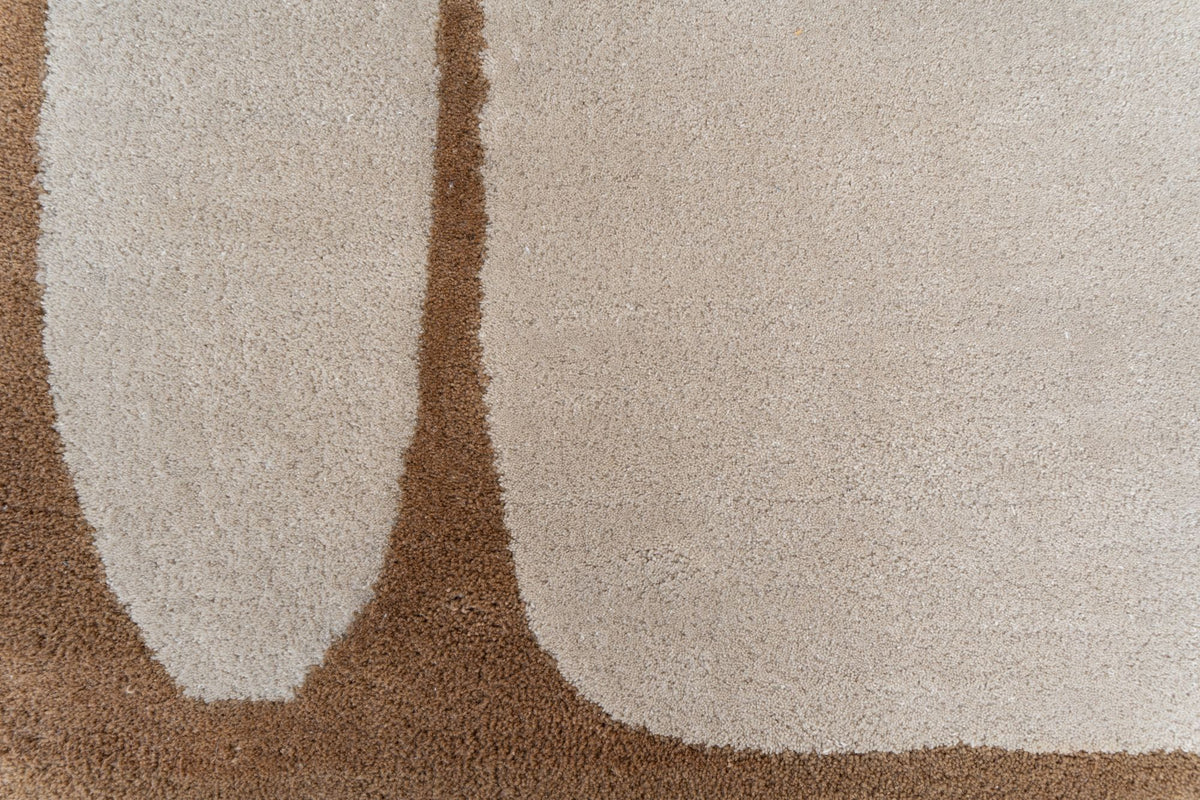
The Outline Wool Rug is hand tufted in New Zealand wool, an ivory field drawn with a camel outline, at 14 to 16 mm. On a beige vitrified floor, the ivory stays close to the floor while the camel line gives the rug its edge. Its regular price is ₹40,000 for 5x8 ft and ₹79,000 for 8x10 ft, ex GST at the time of writing.
The Greige Wool Rug is hand tufted in a grey that leans warm, with fine dotted lines in dark brown. On grey tile or cool marble the field reads as almost the same tone, but warmer, and the dotted lines give it an edge, which is often exactly what a cold floor needs. It costs ₹40,000 for 5x8 ft and ₹79,000 for 8x10 ft, ex GST at the time of writing.
Texture also changes how dark a rug looks. A carved or high low surface catches light on its ridges and holds shadow in its grooves, so a mid tone carved rug can read lighter or darker depending on where you stand, which gives a tone on tone room some life.
How does light change the contrast between rug and floor?
Light changes contrast through the day. Strong morning sun flattens a pale floor and makes a mid rug look darker, while warm lamp light at night pulls every tone closer together.


Artificial light adds another layer. Cool white LED tubes flatten warm tones and make camel look grey, while warm white bulbs deepen browns and rusts, so look at the swatch under the lights you actually use at night.
Polished marble and glossy vitrified tile also reflect light, so the floor can look almost white near a window and grey in the corners. A rug that looks right in a shop under even lighting can feel very different at home.
Wood floors have a similar shift. A teak or walnut floor looks golden in afternoon sun and almost brown at night, so a cream rug that glows by day can look stark against it in lamp light, and a flax or warm grey often holds steadier.
The only reliable test is a Rugberry swatch on your own floor, seen in the morning, at midday and at night. Our guides to rug colour in natural light and ordering a swatch before buying explain how.
How should the rug sit between the floor and the sofa?
The rug should sit between the floor and the sofa in tone, so the eye steps from one to the next. A pale floor, a mid rug and a darker or textured sofa is the easiest sequence to live with.
When the sofa and floor are both light, the rug can carry the depth: an umber or olive rug between white marble and an ivory sofa grounds the whole seating group. When the sofa is dark, a mid rug stops it looking like a hole in a pale room.
The walls are the fourth layer. Our guides to rug and sofa fabric and rug colour with wall colour cover those pairings, and how to choose a rug colour sets the overall method.
Several rooms with the same floor do not need the same Rugberry rug. On a continuous white marble floor, a deep umber rug in the living room and a softer sand rug in the bedroom keep the house connected while each room has its own weight.
Which Rugberry rugs suit light floors and which suit dark?
For light floors, Rugberry's mid and deep tones in New Zealand wool do the work; for dark floors, the ivories and pale heathers do. Either way, a natural fibre with texture keeps contrast soft.

The Grain Wool Rug in Umber is handloom woven at 12 to 14 mm in a deep earth brown, the clearest choice for white marble and pale tile. It costs ₹37,000 for 5x8 ft and ₹74,000 for 8x10 ft, ex GST at the time of writing.
The Ivory Wool Rug is handloom woven at 14 to 16 mm in a soft ivory, the right side of contrast on black granite or dark teak, at ₹36,000 for 5x8 ft at regular price before GST. On mid floors such as kota stone, a greige or flax tone keeps the balance.
Frequently asked questions
Should a rug be darker than the floor?
On a light floor, yes, by a few shades. A mid tone rug on white marble or pale tile defines the seating area and hides marks better than a white rug.
What colour rug goes on a white marble floor?
Sand, camel, greige, olive or umber all work on white marble. Avoid pure white, which shows marks and blends in, and pure black, which shows lint.
Can a rug be the same colour as the floor?
It can if the rug has texture, carving or a drawn line to set it apart. A flat rug in exactly the floor colour tends to look like a patch.
What rug goes with a dark wood floor?
A lighter rug such as ivory, cream, flax or warm grey. It lifts the room and lets the wood show around the edges.
Should the rug be lighter or darker than the sofa?
Usually somewhere between the floor and the sofa in tone. With a pale floor and pale sofa, a deeper rug grounds the seating.
Read the floor first, then choose the step in tone. See beige rugs and brown rugs. Material first.


Leave a comment
This site is protected by hCaptcha and the hCaptcha Privacy Policy and Terms of Service apply.