




Tone on Tone Rugs: Pattern You Feel More Than See
A tone on tone rug is a rug in one colour, or a few very close shades, where the pattern is made by the surface rather than by contrast: pile cut to different heights, lines carved into the pile, loops beside cut pile, or a sheen against matt. You notice it more by light and touch than at first glance.
In short
- A tone on tone rug carries its pattern through pile height, carving, loop and cut pile or sheen, so the design appears in raking light and almost disappears in flat light.
- Tone on tone suits rooms that need calm but not blankness: pale living rooms, bedrooms and spaces with patterned upholstery or strong art.
- Rugberry's Bitte and Aave are hand tufted New Zealand wool rugs with surface pattern in a single pale tone, and Cabella in Frost adds Botanical Silk for sheen.
- Carved lines in a tone on tone rug collect dust, so vacuum along the lines, not across them, with a brush attachment and no beater bar.
What is a tone on tone rug?
A tone on tone rug is one where the design is written in texture within a single colour family. Ivory on ivory, sand on sand, grey on grey: the pattern is there, but it is felt and seen in shadow rather than drawn in a second colour.
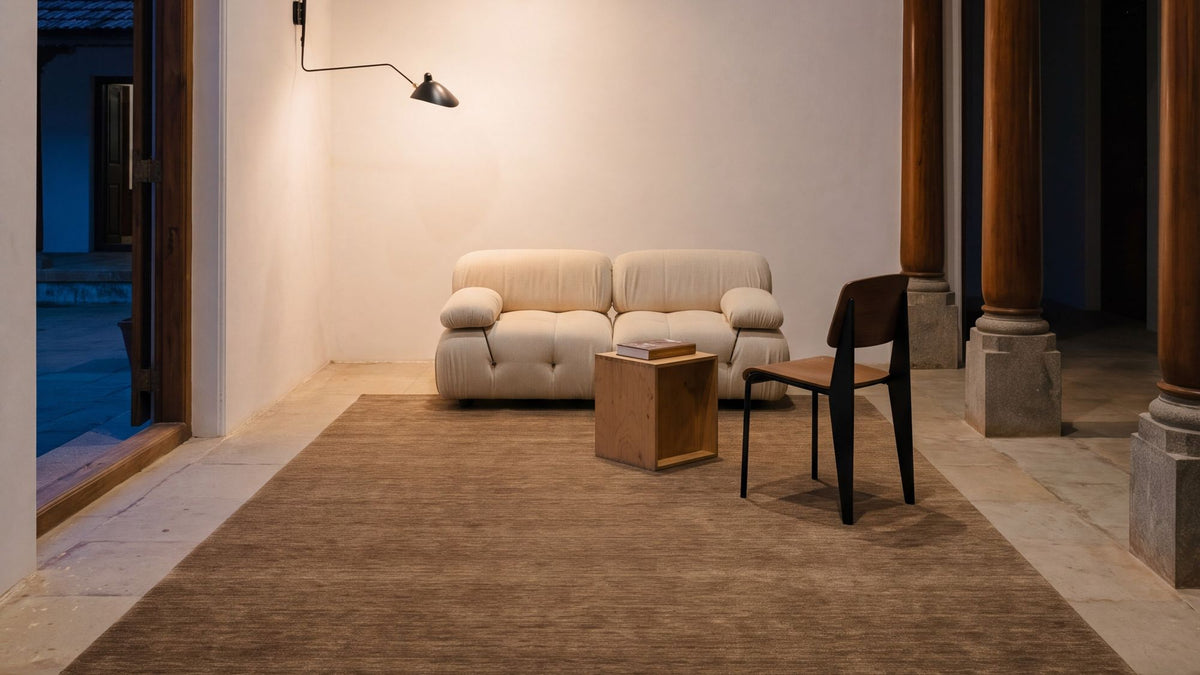
It sits between a plain rug and a patterned one. From across the room a tone on tone rug reads as calm and solid, which is why it suits quiet interiors. Closer, or when the light comes in low, lines, arcs and fields appear in the pile, so the floor has something to look at without competing with the furniture.
Our guide to texture and pattern in a rug covers the wider choice between the two. This guide is about the middle ground, and how a single colour rug carries a design.
How does a single colour rug carry pattern?
A single colour rug carries pattern in five ways: pile height, carving, loop beside cut pile, a change of fibre and the direction the pile lies. Each makes light fall differently on the surface, and that difference is the pattern.


Pile height. When some areas are cut lower than others, the higher pile casts a small shadow over the lower one. This high low pile is the most common tone on tone technique, and it reads as a soft relief.
Carving. Carving cuts a narrow channel into the pile along a drawn line, so the line shows as a crisp shadow. It is the sharpest of the techniques, and it gives drawn arcs and stripes in a single colour.
Loop and cut. Loops reflect light from their curved tops, while cut pile shows its tips, so a looped area beside a cut area looks a shade different even in identical yarn. Fibre. Botanical Silk next to wool shines where the wool stays matt. Direction. Pile brushed one way looks lighter than pile brushed the other, a quality called pile direction.
| Technique | How the pattern shows | Best light | Care note |
|---|---|---|---|
| High low pile | Soft relief and gentle shadow | Low side light from a window | Vacuum both levels with a brush head |
| Carving | Crisp shadow lines and arcs | Raking light, morning or evening | Dust settles in the channels; vacuum along them |
| Loop and cut pile | A shift in shade and texture | Most light, even overhead | Avoid pulling loops with pet claws or beater bars |
| Wool with Botanical Silk | Sheen against matt, moving as you walk | Daylight from one side | Blot spills at once and never rub |
| Pile direction | Light and dark bands that change with view | Any light, strongest across the room | Brush the pile back the same way after cleaning |
The verdict: for the most visible tone on tone design, choose carving; for the softest, choose high low pile or a wool and Botanical Silk mix.
How does light reveal or hide a tone on tone pattern?
Light from the side reveals a tone on tone pattern and light from directly above hides it. Low sun through a window, or a floor lamp at one end of the room, throws shadows into every carved line and lower area of pile.

That means the same rug can look plain at noon and richly patterned at six in the evening. In Indian homes with deep verandahs, shuttered windows or sheer curtains, the light often comes in low and soft, which suits tone on tone rugs well. Under a row of ceiling downlights, the pattern flattens, so a lamp or two at floor level makes a real difference.
A tone on tone rug changes with the hour. The design waits for the light to come in low.
Before choosing, look at a photograph of the rug in raking light and one in flat light, and ask which you will live with most. Our guide to rug lighting and sheen explains how lamps and windows change what you see.
Where does tone on tone beat a plain rug or a printed pattern?
Tone on tone beats a plain rug where the room needs calm but would look flat without some texture, and it beats a strong pattern where the furniture, art or upholstery already carries the colour. It is the quiet choice that still rewards a closer look.


In a pale living room with white walls, a linen sofa and a marble floor, a plain ivory rug can look like an empty space. A tone on tone rug in the same ivory keeps the calm and gives the floor depth. In a room with a patterned sofa, a bold painting or a block printed curtain, a tone on tone rug gives the eye a place to rest without adding a second pattern. Our guide to the rug with a patterned sofa covers that pairing.
Bedrooms are another natural home. A tone on tone rug under a bed shows its pattern in the soft light of the morning and evening, which is exactly when a bedroom is used. Where a plain rug would show every footprint and the edge of every piece of furniture, the texture of a tone on tone rug helps hide small marks too.
Designers also use tone on tone to link rooms. In an open living and dining space, two rugs in the same pale tone but with different surfaces, one carved and one plain, read as a pair without matching. The shared colour holds the space together, and the change of texture marks where one zone ends and the next begins.
Which Rugberry rugs show tone on tone?
Rugberry's tone on tone rugs are mostly hand tufted New Zealand wool in pale tones, with the pattern carried by carving, pile height or Botanical Silk sheen. Four show the range well.


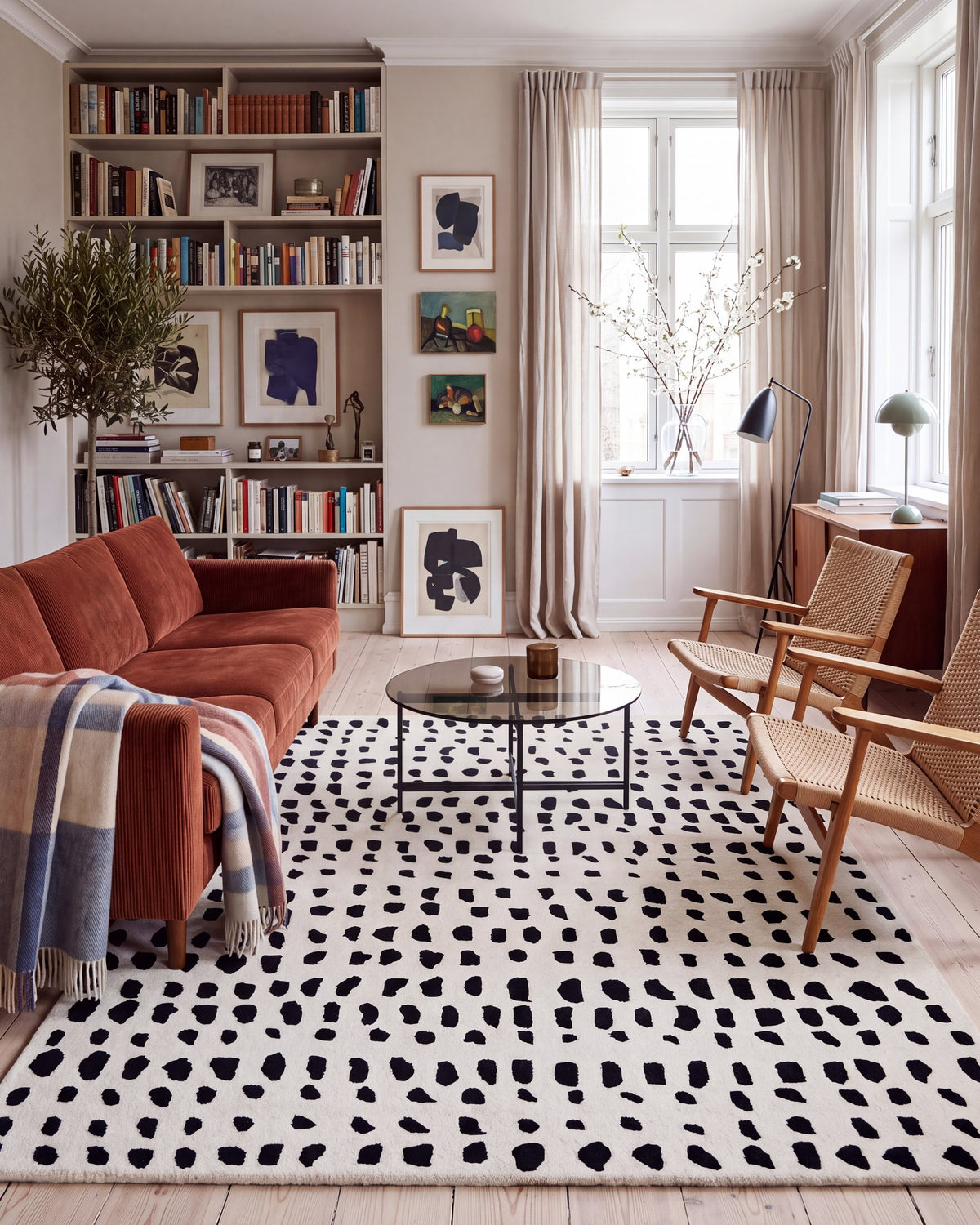
The Bitte Wool Rug is hand tufted in New Zealand wool at 14 to 16 mm, with small repeated marks scattered across an otherwise quiet ground. In close up, fine lines and arcs are set into the ivory pile, so the design shows clearly in side light and fades when the light is flat.
The Aave Wool Rug is hand tufted in New Zealand wool at 14 to 16 mm, its surface moving in long, low waves across the field. The raised forms cast soft shadows, which makes Aave one of the most sculptural pale rugs in the range. At the time of writing Aave starts from about ₹33,600, inclusive of GST.
The Cabella Wool & Silk Rug in Frost is hand tufted in New Zealand wool and Botanical Silk at 14 to 16 mm. Here the pattern is mostly sheen: fine streaks of the plant based fibre catch the light across a pale frost ground, so the rug glints as you cross the room.
The Ivory Wool Rug is handloom woven in New Zealand wool at 14 to 16 mm, in a soft ivory that the catalogue calls plain enough to sit under anything. In close up, soft outlined shapes show in the pile, so even this quiet rug has a tone on tone layer for those who look. The ivory rugs and textures and solids collections gather more of Rugberry's single tone designs.
How do you care for a carved tone on tone rug?
Care for a carved tone on tone rug by vacuuming along the carved lines with a brush attachment and no beater bar, and by brushing the pile back into its direction after any cleaning. Dust settles in the channels first, and on a pale rug it shows as a grey line.

Vacuum once or twice a week, more often in the dusty months before the monsoon. Run the brush head with the carved lines, not across them, so it reaches the bottom of each channel. A soft clothes brush, used gently along the lines once a month, lifts what the vacuum misses.
For a spill, blot at once with a dry, pale microfibre cloth and a little lukewarm water, working from the outside in, and never rub, which flattens the pile and blurs the line. Turn the rug every few months so light and footsteps wear it evenly; tone on tone patterns depend on an even surface. Deep cleaning belongs with a professional rug cleaner. Our guide to the carved texture rug covers carved pile care in more detail, and the neutral rugs guide covers pale rugs in busy homes.
Frequently asked questions
What is the difference between a tone on tone rug and a plain rug?
A plain rug has an even surface in one colour, while a tone on tone rug uses carving, pile height, loops or sheen to draw a design in that same colour. The tone on tone design appears in side light and gives the floor depth.
Do tone on tone rugs show dirt?
Pale tone on tone rugs show dust in carved lines more than a flat plain rug would, but the texture hides footprints and small marks better. Regular vacuuming along the lines keeps them crisp.
Is a tone on tone rug good for a small room?
Yes. A single colour rug makes a small room look larger and calmer, and the surface pattern keeps it from looking flat, especially in a bedroom or study with a window to one side.
Which light shows a tone on tone pattern best?
Low light from one side, such as morning or evening sun through a window or a floor lamp, shows the pattern best. Overhead downlights flatten the surface and make the rug look almost plain.
Can a tone on tone rug be made in another colour?
Yes. Rugberry makes any of its designs to measure in a custom colour, agreed from yarn poms, so a carved or high low design can be made in sand, grey or a deeper tone to suit the room.
One colour, many surfaces, and the light does the rest. Material first.



Leave a comment
This site is protected by hCaptcha and the hCaptcha Privacy Policy and Terms of Service apply.