



A Custom Rug With a Logo or Monogram
A custom logo or monogram rug is a made to measure piece in which a mark is drawn into the pile in colour, in carving, or both. It works when the mark is simplified for wool: bold shapes, few colours, generous line widths and a size where the logo has space around it. Colour is approved from yarn poms before weaving.
In short
- Simplify the logo for the rug: solid shapes, two to four colours, and no fine text or hairlines, which blur in a cut pile.
- Give the mark room. A logo usually looks best at about a third to a half of the rug's width, with plain field around it.
- Choose between colour, carving or both. Colour reads from across the room; carving in a single tone is quieter and suits private spaces.
- Rugberry makes custom rugs to measure on its own designs or the client's, with colour matched from yarn poms and approved before weaving.
Where does a logo or monogram rug work best?
A logo rug works best where people pause and look down: a store entrance, a reception, a private office, the foot of a staircase or a clubhouse lobby. In a home, a monogram suits a library, a dressing room or a family's entrance hall more than a living room.

The mark on a rug is seen from standing height and at an angle, so it needs space and a reason to be there. A reception rug in front of a desk, for example, is seen by every visitor while they wait. A rug in a corridor, by contrast, is seen in passing and gives a logo no time to land.
Commercial projects tend to use the full logo in brand colours. Homes lean towards something quieter: a monogram in two tones of the same colour, or initials carved into a plain field. Both are valid; the brief should say which mood the client wants.
Restaurants and lounges have their own considerations, covered in our guide to rugs for restaurants, cafes and lounges.
How should a logo be adapted for a rug?
Adapt a logo for a rug by simplifying it: thicken thin lines, reduce gradients to solid areas, cut the colours to a handful and drop small text such as taglines. Wool pile softens every edge slightly, so detail that is crisp on screen can blur on the floor.


Think of the rug as a print made with a broad brush. Each colour area needs enough width for the yarn to fill it cleanly.
Very thin strokes, small serif letters and fine outlines tend to wander or disappear. A designer can prepare a simplified version of the mark for the rug, or the maker can propose one as part of the colourway drawing.
- Lines: make strokes noticeably bolder than on the letterhead.
- Text: keep only the name, set large, or use the symbol alone.
- Gradients and shadows: replace with flat colour or with a carved edge.
- Colour count: two to four colours usually read best, including the field.
Send the logo as a vector file with the brand colour references. The design is then drawn to the rug's size, which our guide to rug CAD and design files explains in more detail.
How big should a logo be on a rug?
A logo usually looks best at about a third to a half of the rug's width, centred or set towards the entrance edge, with plain field around it. Too small and it reads like a label; too large and it stops being a rug and becomes a sign.
| Rug size | Logo width to start from | Where it suits | Approach |
|---|---|---|---|
| 5x8 ft (150x240 cm) | 50 to 75 cm | Office, dressing room, store fitting area | Symbol only, two or three colours |
| 6x9 ft (180x270 cm) | 60 to 90 cm | Reception in front of a desk | Symbol or short name |
| 8x10 ft (240x300 cm) | 80 to 120 cm | Store or studio entrance zone | Full logo, flat colour |
| Round, 6 to 8 ft | Half the diameter | Foyer, foot of a stair | Monogram or crest, centred |
| Large lobby piece | Set by sight lines | Clubhouse or hotel lobby | Logo off centre, near the approach |
Print the logo at full size on paper and lay it on the floor where the rug will go. Looking at it from the doorway and from a chair is the quickest way to settle the scale before any drawing is approved.
Colour or carving: how should the mark be made?
A logo can be drawn in colour, carved into a single colour, or both. Colour reads from across a room and suits brand spaces; carving is a quieter, tonal effect that suits homes and private offices. Combining them gives a crisp edge to each colour.


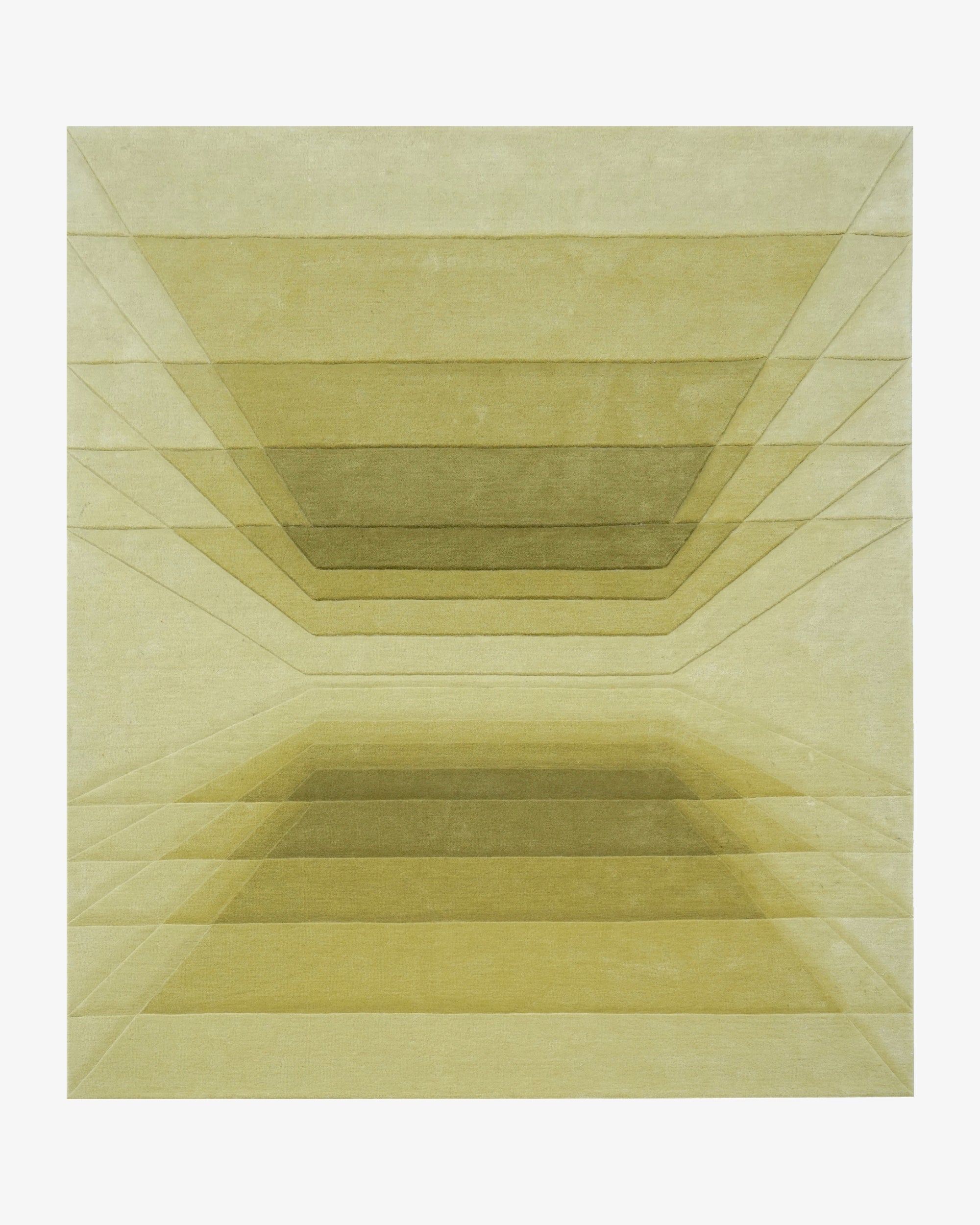
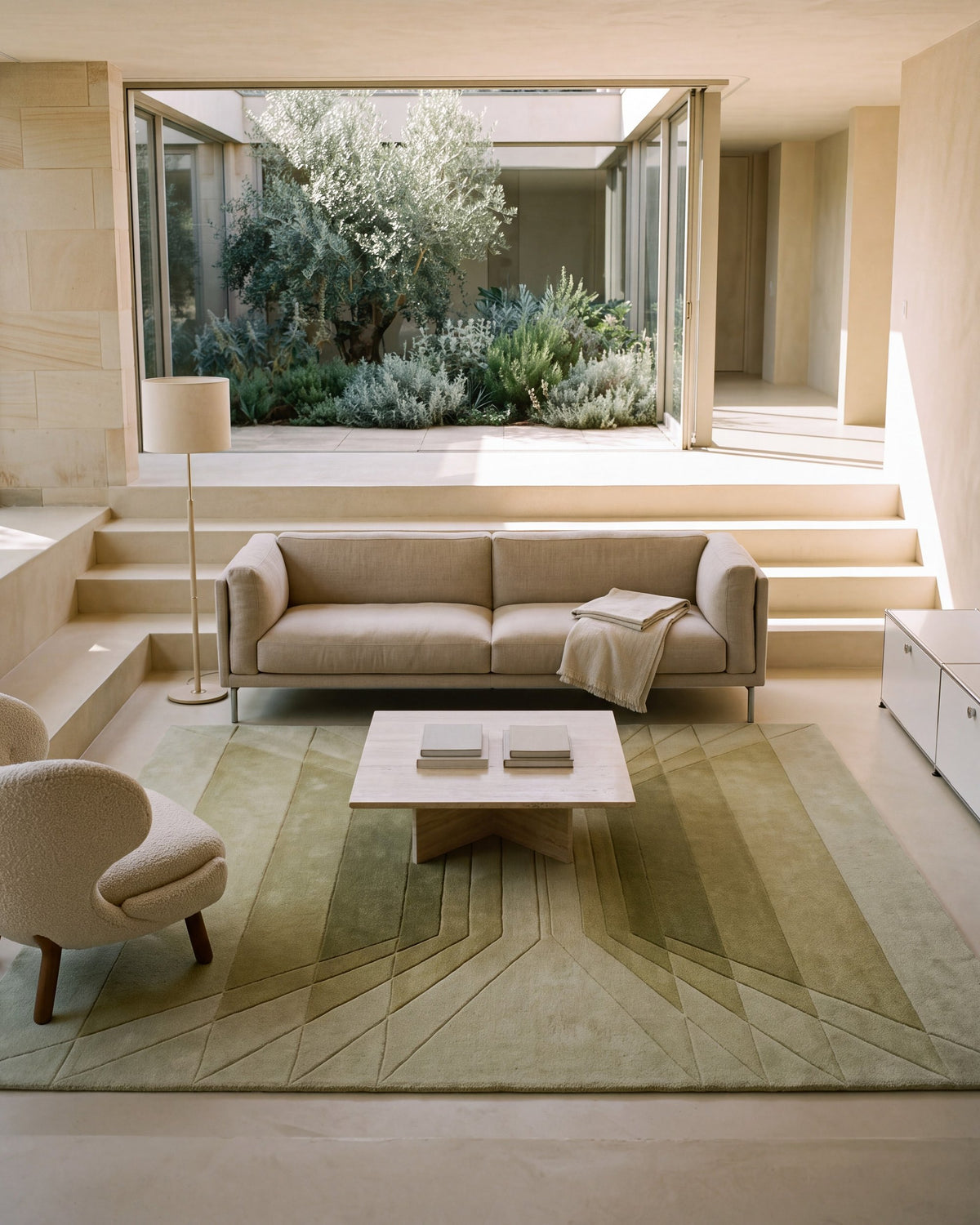
Carving means cutting a channel along the edge of a shape so it stands slightly proud of the field. In a single colour, the mark appears only as light and shadow, which is subtle and refined. The Cavea Wool Rug shows how this reads in practice: it is hand tufted in New Zealand wool at 14 to 16 mm with a stepped, carved surface, and its regular price is ₹40,000 for 5x8 ft and ₹80,000 for 8x10 ft, ex GST at the time of writing.
For colour, the Clique Wool Rug in Pitch Black shows how a strong form reads on a dark field. It is hand tufted in New Zealand wool at 14 to 16 mm; its regular price is ₹37,000 for 5x8 ft and ₹74,000 for 8x10 ft, ex GST at the time of writing. A logo in ivory on a dark ground, or the reverse, is the most legible approach.
The Insignia Wool & Silk Rug shows how a mark can sit in a rug without shouting: one centred emblem in Botanical Silk on a handloom New Zealand wool field, so the motif catches light from the doorway and settles back as you walk on. Its regular price is ₹40,000 for 5x8 ft and ₹80,000 for 8x10 ft, ex GST at the time of writing.
Draw the logo for wool, not for paper. Bold shapes, few colours and room to breathe.
How is a brand colour matched in a logo rug?
A brand colour is matched by selecting dyed yarn poms closest to the brand reference and approving them before weaving. A paint card or a screen colour never transfers exactly into wool, so the physical pom, seen in the space where the rug will lie, is the reference that matters.
Wool absorbs dye differently from paper or paint, and a cut pile catches light, so the same red can look deeper on the rug than on a business card. Approve the poms under the project's actual lighting. Our guide to custom colour matching explains the process step by step.
On Rugberry's Design Lab, designers can recolour a Rugberry design or upload their own and colour it from the pom box on screen, then download a tearsheet showing each colour's share of the rug. It is a fast way to test how many colours a logo really needs before the physical poms are approved.
Which construction suits a logo rug?
Most logo rugs are made to measure in hand tufted wool, because tufting follows curved shapes and allows carving between colours. A flatter, firmer handloom or handwoven texture suits a simple, bold mark where the rug must take heavy traffic.


Rugberry makes custom rugs by hand in four constructions: handloom, hand knotted, hand tufted and hand woven. For made to measure orders, hand tufting and hand weaving are the usual routes, and the right one depends on how detailed the mark is and how much traffic the rug will take. Read more in the four rug constructions explained.
For a quieter mark in a high traffic entrance, a simple monogram on a low, closely worked wool can be the most practical choice. The Grain Wool Rug in Umber is handloom woven in New Zealand wool at 12 to 14 mm and shows the kind of low, dense surface that wears well at a door. Its regular price is ₹37,000 for 5x8 ft, ex GST at the time of writing.
How do you brief and order a custom logo rug?
Brief a logo rug with the size and shape, the room and its traffic, the logo as a vector file, the brand colour references, and whether the mark should be in colour, carved or both. The design is then drawn, colours are approved from yarn poms, and the rug is made to measure.
- Space: the room, the floor finish, the traffic and the view from the door.
- Size and shape: rectangle, round or a custom outline.
- Artwork: vector logo, plus a simplified version if you have one.
- Colour: brand references, then physical poms to approve.
- Method: colour, carving or both.
Confirm that the client owns the right to use the mark on a rug, particularly for a franchise or a licensed brand. Designers can manage the order, quotation and client approval through the Rugberry Trade Program.
The making time is confirmed with the quotation, so plan the rug alongside the rest of the fitout. See also made to measure rugs.
How should a logo rug be cared for?
A logo rug is cared for like any wool rug of its construction: regular vacuuming, prompt blotting of spills and professional cleaning on a schedule. In a commercial entrance, daily vacuuming keeps grit from dulling the colours of the mark.
High contrast logos show wear first at the pale areas, so place an entrance mat before the rug and rotate it if the layout allows. A mark set near the approach edge can be turned to the far side for a few months to even the wear.
Frequently asked questions
Can Rugberry make a rug with my company logo?
Yes. Rugberry makes rugs to measure on the client's own design, so a company logo can be drawn into a rug in colour, carving or both. Send a vector file, the size and the brand colours to start.
Will fine text in my logo show on a rug?
Fine text usually blurs in a cut pile, because the yarn softens every edge. Keep the name large and bold, drop taglines, or use the symbol alone for a cleaner result.
How many colours can a logo rug have?
Two to four colours, including the field, usually read best. More colours are possible, but each one needs enough area to show cleanly in the yarn.
Is a monogram rug a good idea for a home?
It can be, in the right room. A monogram carved tone on tone or worked in two close colours suits an entrance hall, library or dressing room, where it reads as a quiet personal detail.
Can a logo rug be round?
Yes. A round rug suits a centred crest or monogram, at a foyer or the foot of a staircase. Set the mark at about half the diameter so a plain ring of field surrounds it.
A mark on the floor should feel made, not printed. Start with customisable rugs and the hand tufted rugs that can carry colour and carving. Material first.




Leave a comment
This site is protected by hCaptcha and the hCaptcha Privacy Policy and Terms of Service apply.