



Rugs for Hotel Lobbies and Large Public Rooms
The right rugs for a hotel lobby are islands, not wall to wall: one rug under each seating group, kept out of the luggage and arrival lanes, in a dense wool that can be vacuumed every day. Broadloom covers the circulation where a seamless floor is needed, and the rugs give the room its scale.
In short
- A hotel lobby rug should sit under a seating group with every chair's front legs on it, and should stay clear of the main path from the door to the reception desk.
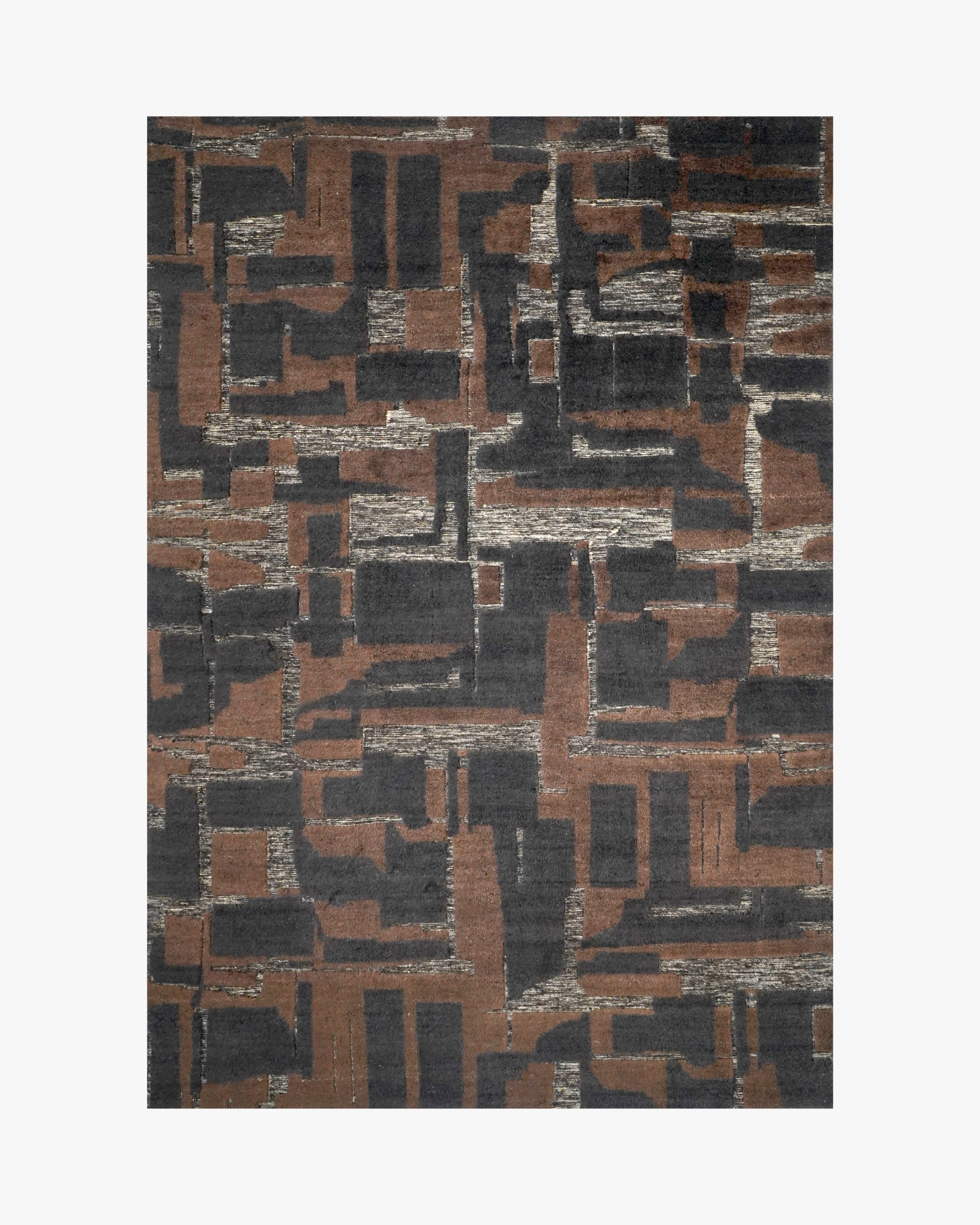
- Rugberry's Stratum Knotted Rug, hand knotted New Zealand wool, is the most durable construction in the Rugberry range and is made to any size for lobby seating islands.
- Rugberry offers hotel broadloom and site installation for hospitality projects, which suits corridors and circulation where rugs would create edges in a traffic path.
- A lobby rug in a mid tone with some texture hides footfall far better than a pale plain rug or a very dark one.
Should a hotel lobby have rugs or wall to wall broadloom?
Most hotel lobbies work best with both: hard flooring or broadloom in the circulation, and rugs as islands under the seating. Rugs mark where to pause, and the hard or broadloom floor carries the movement.
A lobby has two kinds of floor. There is the path, from the porch to reception, to the lifts, to the restaurant, walked by guests with trolleys and staff with luggage carts. And there are the places to stop: a lounge group, a waiting bench, a library corner.
Rugs belong in the second kind. An edge in the path is a place where a wheel catches and a heel turns. Rugberry's guide to hotel broadloom for hospitality projects covers the circulation side; this post is about the islands.
How big should a rug be in a large lobby?
A lobby rug should be sized to its seating group, not to the room: all front legs on the rug, with 18 to 24 inches of rug beyond the chairs on every open side. In a lobby of 40 x 60 ft, that usually means two to four rugs of 10x14 ft to 14x18 ft, not one giant piece.

Scale in a public room is read from the entrance. A rug that would look generous in a home looks like a doormat under a 25 ft ceiling, so lean larger once the group is set. Mark the outline on the floor with tape and look at it from the door before ordering.
| Lobby zone | Typical rug size | Rugberry option | Why |
|---|---|---|---|
| Main lounge group, 8 to 12 seats | 12x15 ft to 14x18 ft, made to measure | Stratum Knotted Rug, hand knotted New Zealand wool | Densest construction for constant use |
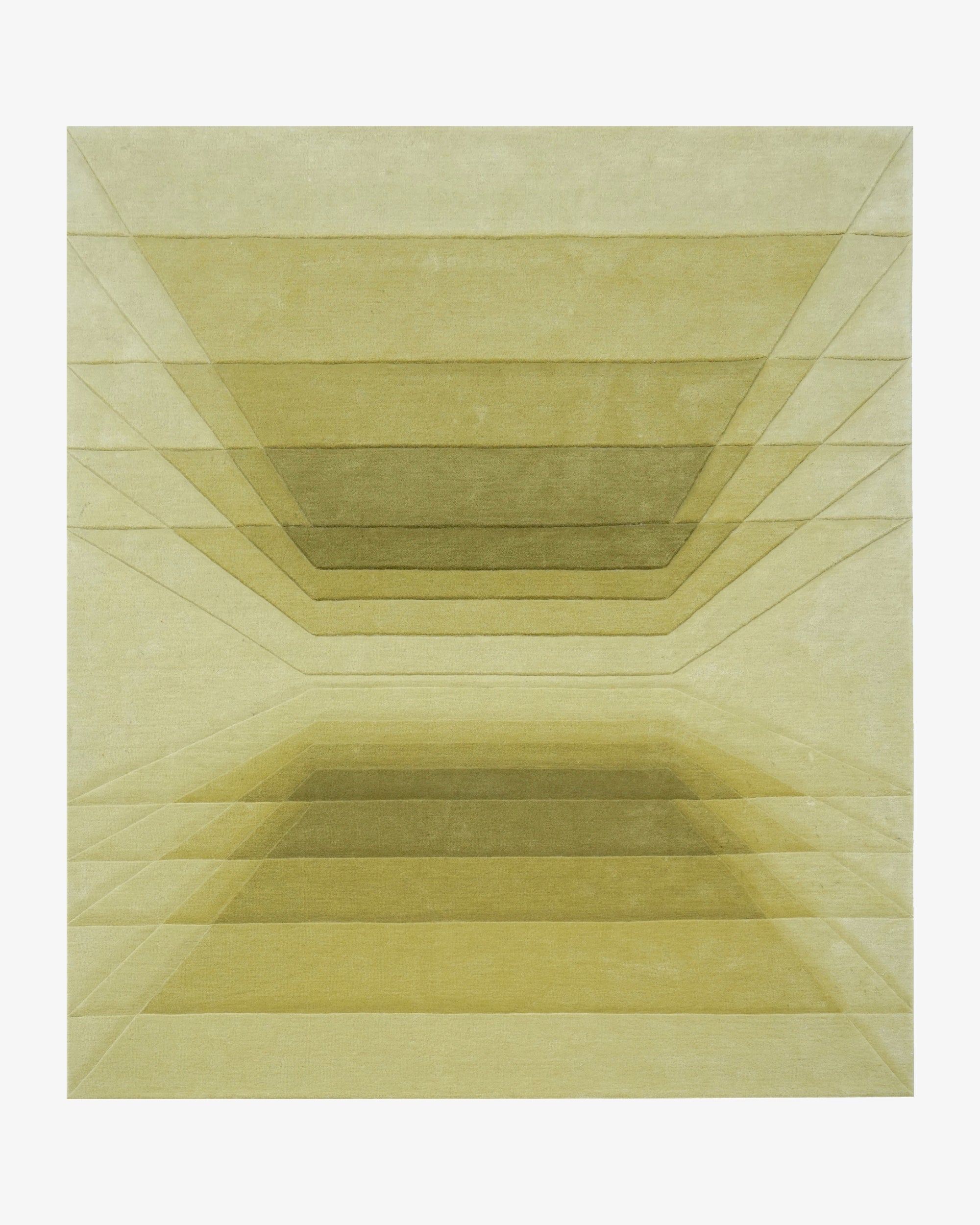
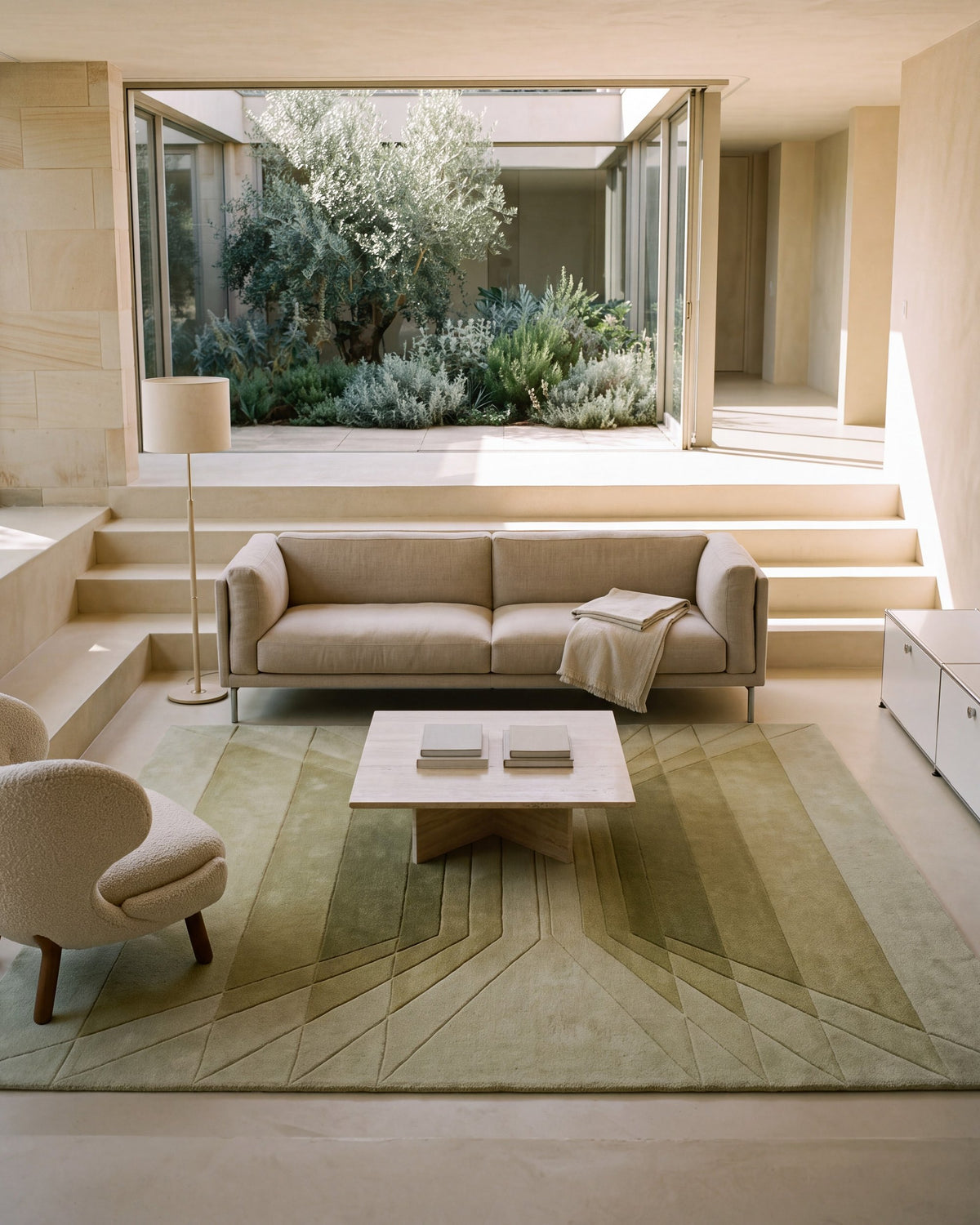
| Secondary seating pairs | 8x10 ft to 10x14 ft | Cavea Wool Rug, hand tufted New Zealand wool, 14 to 16 mm | Carved planes add depth when seen from above a mezzanine |
| Waiting bench or concierge corner | 5x8 ft to 6x9 ft | Teal Wool Rug, hand tufted New Zealand wool, 14 to 16 mm | One saturated colour can mark a small zone |
| Circulation and corridors | Wall to wall | Hotel broadloom with site installation | No edges in a trolley path |
For public rooms, rug sizes are usually made to measure. Catalogue figures help only as a reference: the Cavea Wool Rug is listed at a regular ₹1,80,000 for 12x15 ft ex GST at the time of writing, and project pricing comes through a quotation.
How do you keep heavy traffic off the lobby rugs?
You keep traffic off lobby rugs by planning the paths first and placing rugs only where people stop. Draw every route on the plan: guests arriving, luggage going up, staff moving between back of house and the restaurant.
Leave at least 5 to 6 ft of clear floor for the main arrival route and 4 ft for secondary routes. A rug edge that sits parallel to a route is fine; one that cuts across it is a problem from the first week.
Watch the corners. People cut across the corner of a seating group to reach the lifts, and that corner of the rug will wear first. Turning the rug every six months spreads that wear, and the schedule for it should be in the housekeeping plan from opening day.
Plan the paths first. A lobby rug belongs where people stop, never where they hurry.
What construction holds up in a public room?
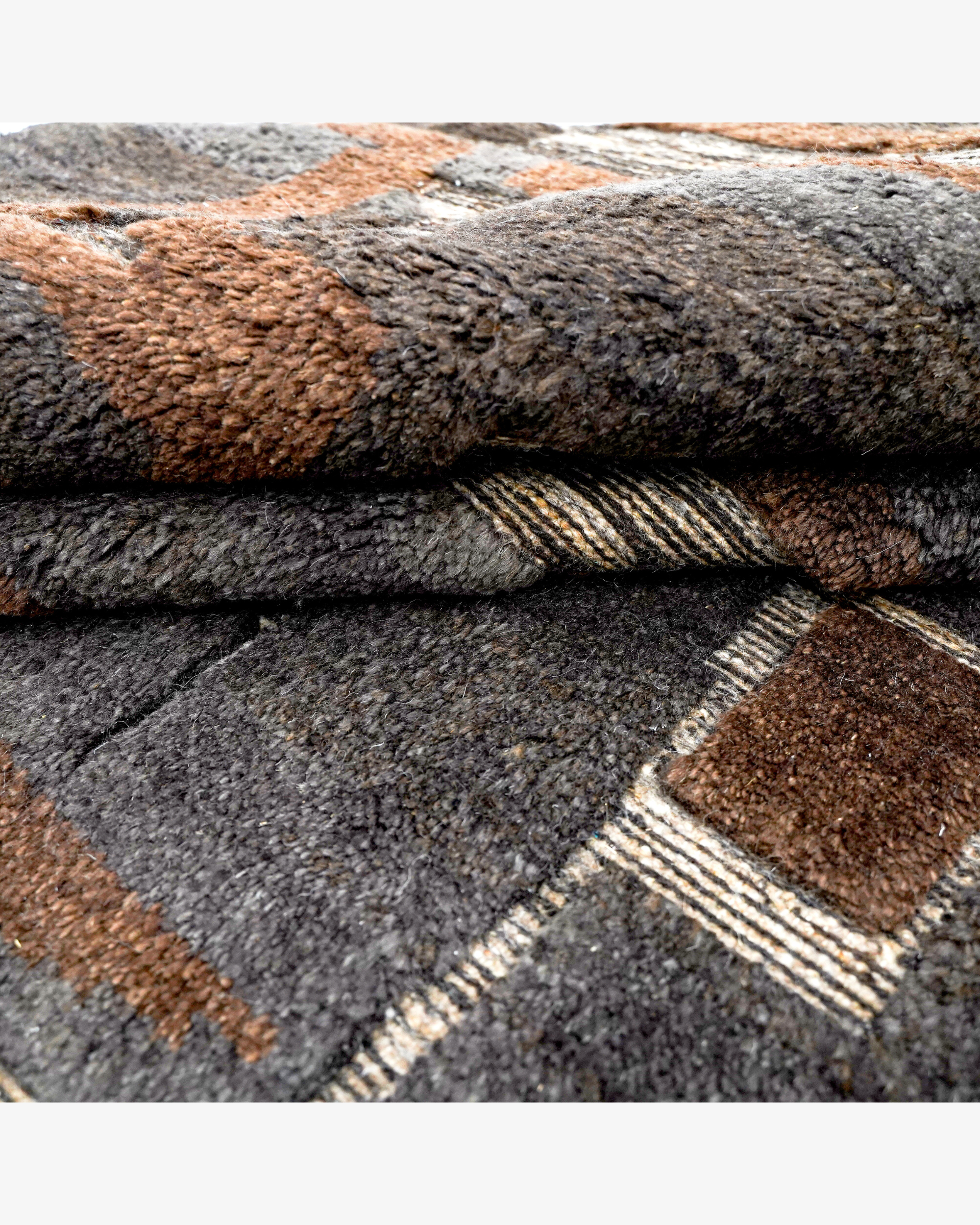
Hand knotted wool holds up best in a public room, because each knot is tied around the warp and the pile is locked into the structure. It is the densest and most durable way a rug is made, which is why it belongs in the lounge group a hotel is photographed in.


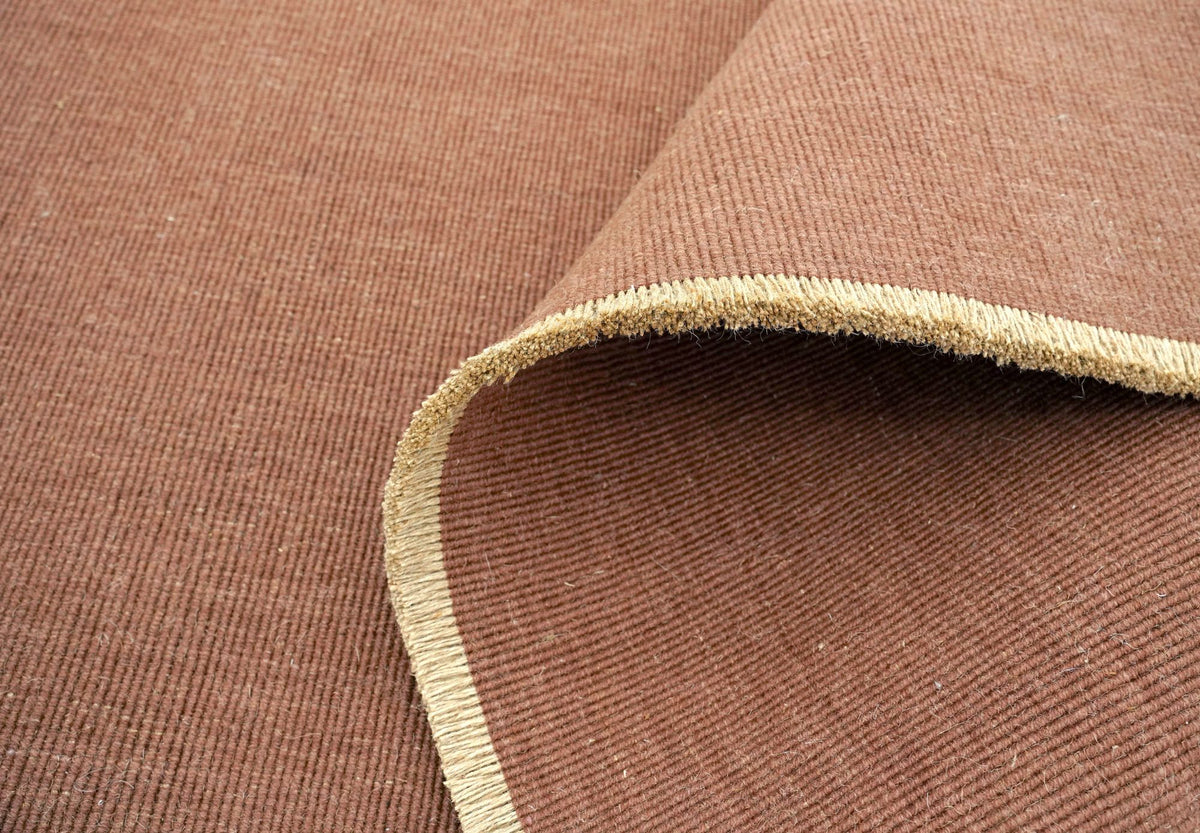
The Stratum Knotted Rug in Cinder is hand knotted New Zealand wool, listed at 9x12 ft and made to any size and colour. In a lobby, a charcoal ground like Cinder hides the grey of daily footfall while the dense surface still reads as fine work.
Hand tufted wool is a sound choice for secondary zones where the rug is seen more than walked. The Cavea Wool Rug carves its surface into overlapping planes, so it gives depth to a seating pair seen from a gallery or a staircase.
Rugberry's comparison of the most durable rug constructions sets out how knotted, tufted and handloom rugs differ under constant use.
How are seams and very large lobby rugs handled?
Very large lobby rugs are best made as single pieces where the plan allows, and split into two or more rugs where it does not. A rug that has to be joined on site should usually be broadloom, which is designed to be seamed and installed.


A practical rule: if a single rug would need to be wider than the room's doors and lift can take when rolled, plan two rugs instead. Two rugs of 12x15 ft under two seating groups often look more deliberate than one 24 ft piece.
Edges matter more in public rooms than in homes. Specify a firm, flat finish at the edges and a non-slip underlay under every lobby rug. On polished stone, the underlay is what stops a rug creeping toward the path over a busy weekend.
Fire and safety requirements should be settled before design. Rugberry Projects lists fire retardant treatment where it is required, flammability test reports, material certification and FF and E documentation among what it handles for hotel work.
Which colours survive a busy lobby?
Mid tones with texture survive a busy lobby best: charcoal, umber, olive, a deep teal, or a carved or tonal surface. Pale plain rugs show every wheel line, and very dark plain rugs show dust and lint under strong downlights.


Lobby light is not home light. Many lobbies run warm LED all day and take strong daylight at the entrance, so check a sample under both. A colour that reads as grey green under daylight may turn olive under 2700K lamps.
The Teal Wool Rug, hand tufted New Zealand wool at 14 to 16 mm, shows how one saturated colour can define a small waiting zone without competing with the main lounge. Rugberry's note on how lighting changes a rug has a simple test for this.
How should lobby rugs be maintained?
Lobby rugs should be vacuumed daily with suction, spot cleaned the moment a spill happens, turned every six months and professionally cleaned on a fixed schedule. Write the routine into the housekeeping manual before opening.

- Daily: vacuum with suction in the direction of the pile, and check edges for lift.
- On the spot: blot spills from tea, coffee and luggage wheels at once, from the outside in.
- Every six months: turn rugs 180 degrees so the corners near paths share the wear.
- Yearly or as needed: professional cleaning, staggered so the lobby is never bare.
Ask for a spare piece or a swatch from the same dye lot and keep it with the housekeeping team. It is the reference for every future clean and repair.
How should lobby rugs relate to the rest of the hotel?
Lobby rugs should set a material and colour language that the corridors, restaurant and suites then repeat in quieter form. A guest should feel the same house underfoot from the arrival lounge to the room.
The simplest method is one family of fibres and two or three related tones. If the lobby lounge sits on a charcoal hand knotted wool, the corridor broadloom can carry the same charcoal in a flatter construction, and the suites can soften it to a warm grey or umber.
Avoid giving the lobby a rug that belongs to no other room. A one off statement in the lobby, unrelated to anything upstairs, reads as a purchase rather than a scheme.
Repeat runs matter here too. Rugberry Projects notes repeat runs so corridors and suites match, which means the colour references chosen for the lobby should be recorded with the same care as the suite specification. A shared colour reference sheet, kept by the design team and the hotel's purchase team, saves months of back and forth when a later wing opens.
Keep one printed sheet per rug in the housekeeping office: the rug code, its zone on the lobby plan, its fibre and construction, the date it was last turned and the date it was last professionally cleaned. Staff change often in hotels, and the sheet keeps the routine alive.
Frequently asked questions
What is the best rug material for a hotel lobby?
Hand knotted New Zealand wool is the best rug material for a hotel lobby seating group, because the knotted pile is locked into the rug's structure. Wool is also resilient and easy to clean, which suits daily use.
How big should a lobby rug be?
A lobby rug should be sized to its seating group, with all front legs on it and 18 to 24 inches of rug beyond the furniture. In a large lobby this usually means several rugs of 10x14 ft to 14x18 ft rather than one oversized piece.
Can Rugberry install broadloom in a hotel?
Rugberry offers hotel broadloom and site installation for hospitality projects. Broadloom suits corridors and circulation, while rugs suit seating areas in the lobby.
Do lobby rugs need an underlay?
Lobby rugs on polished stone or tile need a non-slip underlay so they stay in place under heavy use. The underlay also keeps edges flat and reduces wear on the back of the rug.
How often should a hotel lobby rug be cleaned?
A hotel lobby rug should be vacuumed every day and professionally cleaned at least once a year, more often in high season. Spills should be blotted immediately, and the rug turned every six months.
Plan the paths, then the islands, then the light. The lobby will hold its shape for years. Material first.



Leave a comment
This site is protected by hCaptcha and the hCaptcha Privacy Policy and Terms of Service apply.