



Hotel Broadloom and Rugs for Hospitality Projects
Rugberry supplies hotel broadloom with site installation, as well as made to measure rugs, for hospitality projects. As a rule, broadloom suits corridors and guest rooms where the floor runs wall to wall, while rugs suit lobbies, suites and restaurants where the floor itself is part of the design.
In short
- Rugberry's hospitality service covers hotel broadloom, site installation and made to measure rugs, with fire retardant treatment, IMO compliant materials and flammability test reports supplied per project as required.
- Broadloom is a wall to wall floor covering installed on site; it suits hotel corridors and standard guest rooms, where sound control and continuity matter most.
- Made to measure rugs suit lobbies, suites, restaurants and spas, where a stone or timber floor is meant to show and the rug defines a zone.
- For hotels, Rugberry plans repeat runs so corridors and suites match across floors, and supplies material certification and FF and E documentation.
What is hotel broadloom, and how is it different from a rug?
Hotel broadloom is a floor covering made in wide widths and installed wall to wall on site, cut and joined to the room. A rug is a finished piece with bound edges that sits on a finished floor and can be lifted, turned or replaced.
The difference decides the specification. Broadloom becomes part of the building, so it is chosen with the acoustic plan, the underlay and the fire strategy. A rug is part of the furniture, so it is chosen with the room's design and can change at a refurbishment.
Rugberry offers both. Hotel broadloom and site installation sit alongside made to measure rugs in Rugberry's hospitality work; the sectors are listed on Rugberry Projects.
The sectors include private residences, hotels and hospitality, boutique stores, marine yachts and private jets. Each asks something different of a floor: footfall in a hotel, brand colour in a store, weight and fixing in a yacht or a cabin.
Most hospitality projects use broadloom and rugs together. Corridors and rooms are laid wall to wall for quiet and continuity, and the public rooms receive rugs drawn to their furniture.
Which zones of a hotel suit broadloom, and which suit rugs?
Broadloom suits corridors and standard guest rooms; rugs suit lobbies, suites, restaurants, bars and spa lounges. The table sets out the usual choice by zone in an Indian hotel.


| Zone | Usual choice | Why | What to specify |
|---|---|---|---|
| Guest corridors | Broadloom | Quiet footsteps at night, continuity floor to floor | High traffic construction, repeat runs, fire treatment as required |
| Standard guest rooms | Broadloom, or a large rug on hard floor | Sound between rooms, warmth underfoot | Matching dye lots across floors, easy spot cleaning |
| Suites | Made to measure rugs on stone or timber | The floor is part of the design, rugs define living and sleeping | Sized to furniture, finer fibres, a drawn design |
| Lobby and lounges | Large made to measure rugs | Zones within a big hard floor, a first impression | Hand knotted or handloom wool for traffic, shaped to the plan |
| Restaurants and bars | Rugs under seating groups, or none | Chairs move constantly, spills are certain | Low, firm weaves, stain resistant coating |
| Spa and wellness | Rugs in dry lounges only | Moisture and wet feet | Keep wool and jute away from wet zones |
For an Indian hotel with marble lobbies and heavy monsoon footfall, choose large hand knotted or handloom wool rugs in the lobby over broadloom, because rugs can be lifted, cleaned and rotated while stone stays dry around them.
What fire and safety documents does a hotel project need?
A hotel project usually needs fire retardant treatment on floor textiles where the authority or brand standard requires it, flammability test reports, and material certification for the FF and E file. Rugberry supplies these on a per project basis to meet the procurement requirements.

- Fire retardant treatment. Applied where it is required for hospitality projects.
- IMO compliant materials. For marine projects such as yachts, where the International Maritime Organization standard applies.
- Flammability test reports. Supplied per project for the specification file.
- Material certification and FF and E documentation. Provided for procurement and handover.
State the standard you are working to in the brief. The construction, backing and treatment are chosen to meet it, so it needs to be known before sampling, not after the order. Our rug specification guide shows where these fields sit in a specification.
In a hotel, the document file matters as much as the floor. Name the standard on the first page of the brief.
How do corridors and suites stay matched across floors?
Corridors and suites stay matched through repeat runs: the same specification, colour references and pom numbers used for every floor, so a guest walking from the fourth floor to the ninth sees one hotel. Rugberry plans repeat runs for hotels so corridors and suites match.
Natural fibres dye slightly differently from batch to batch. Ask for the repeat plan at specification stage, and keep a signed off pom set and a reference swatch on site. Our note on colour variation in rugs explains why a reference matters.
For a phased refurbishment, reorder by pom number rather than by a photograph or a product name. The Rugberry Design Lab produces a tearsheet with every pom number for this purpose.
Keep a short floor register for the property: zone, construction, pile height, pom numbers and installation date. When a corridor needs replacing in five years, the register is what lets a new run match the old one.
Which Rugberry constructions take hotel traffic best?
Hand knotted wool takes the heaviest traffic and lasts longest; a low handloom wool weave is the practical choice for busy rooms; hand tufted wool suits drawn designs in suites and lounges where traffic is lighter. Botanical Silk belongs only in low traffic suites.
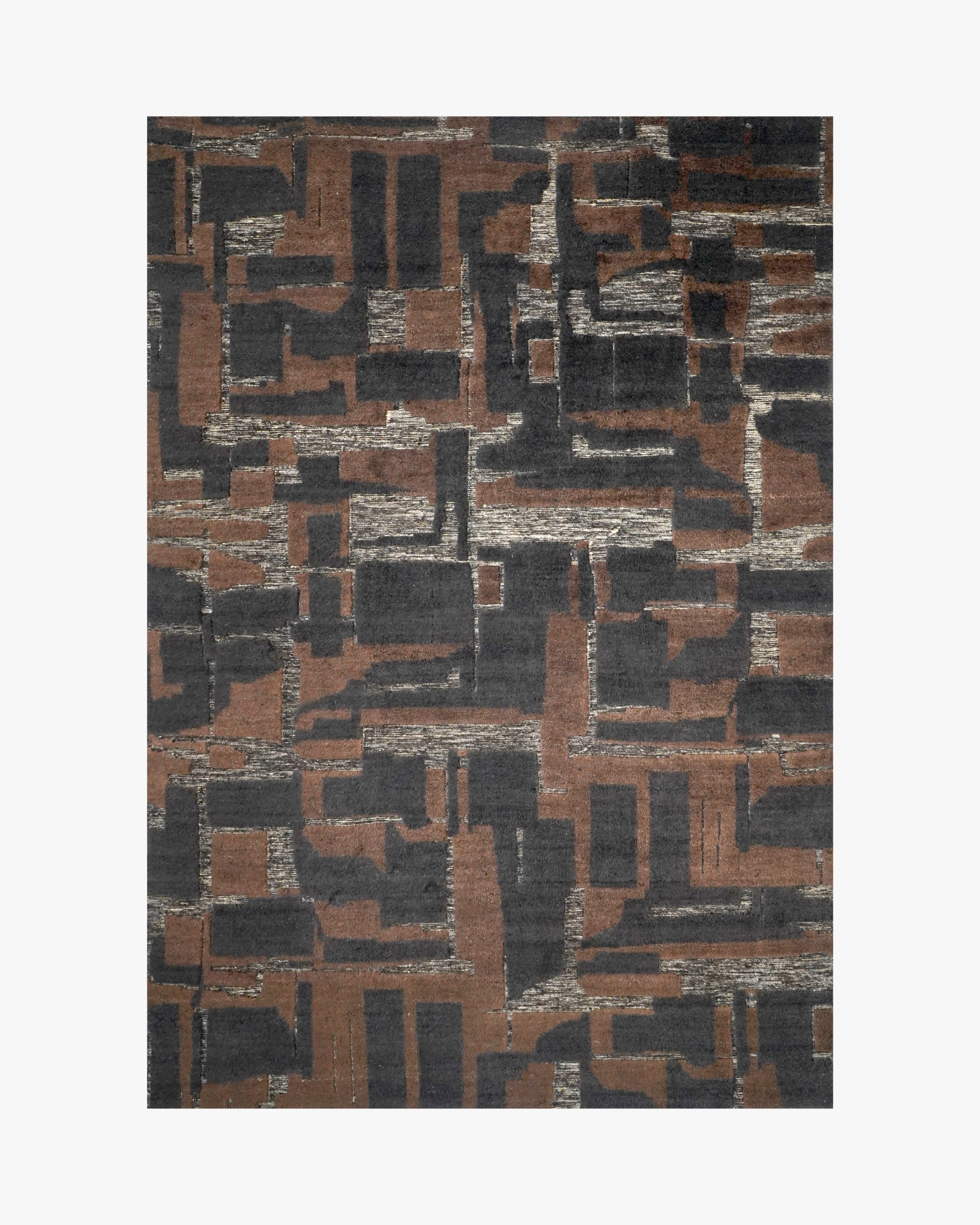
- Stratum Knotted Rug in Cinder: hand knotted New Zealand wool, dense and fine, the most durable way a rug can be made. Listed at 9x12 ft and made to any size, for lobbies and lounges.
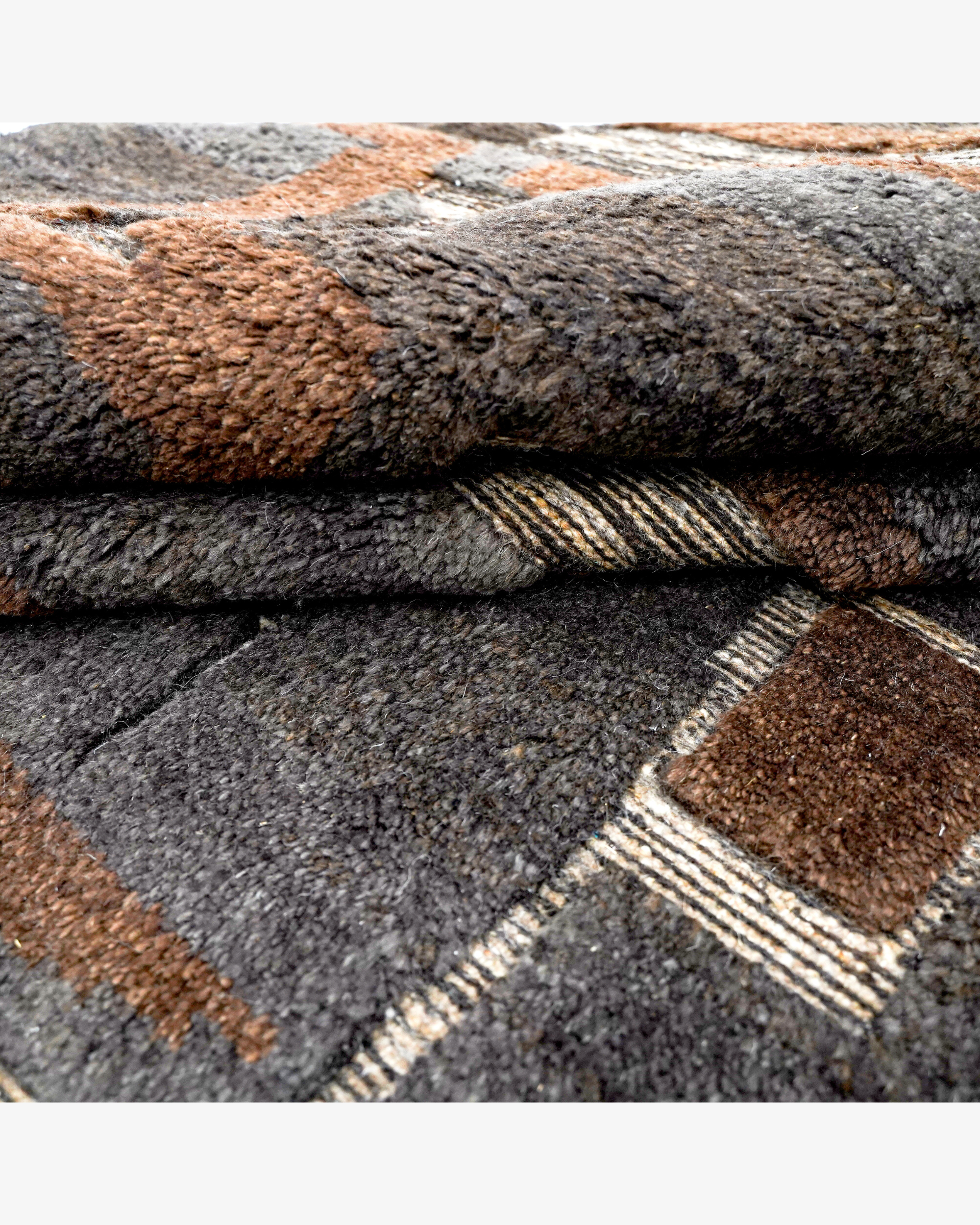
- Grain Wool Rug in Umber: handloom New Zealand wool at 12 to 14 mm, low and closely textured, which hides footprints and dust in busy suites and lounges.
- Teal Wool Rug: hand tufted New Zealand wool at 14 to 16 mm in a deep teal, an example of the saturated colour a hand tufted rug carries well.
Read our comparisons of the most durable rug constructions and rugs for high traffic areas before choosing a construction for each zone.
Colour does as much work as construction in a hotel. Mid tones and mottled surfaces forgive more than very pale or very dark fields, which show dust and lint. A field one or two steps darker than the stone around it is the usual choice for a lobby rug.
For suites, a softer and finer rug is fair, because traffic is light and guests walk barefoot. Wool with Botanical Silk works well there, and so does a deep handloom pile beside the bed.
How does a hospitality project with Rugberry run?
A hospitality project runs from brief and drawings, through sampling and a mock up, to approval, production in repeat runs, and site installation for broadloom. Each stage has its own sign off, and the documentation travels with it.


- Brief. Plans with zones marked, the fire standard, traffic levels and the design intent.
- Sampling. Swatches and pom sets for each zone, tested in the hotel's own light.
- Specification and quotation. Constructions, pile heights, treatments and quantities, with tear sheets.
- Approval. Signed off colourways with pom numbers and the repeat plan.
- Production. Made in runs so floors match; fully bespoke designs take 4 to 8 weeks depending on material and complexity, according to Rugberry's trade terms.
- Installation and handover. Broadloom installed on site; rugs delivered and placed; documents handed over.
Designers and procurement teams can run the project through the Rugberry Trade Program, which has no minimum order and keeps quotations and orders in one account. Our guide to custom rugs for interior projects covers the drawing stage.
How do Indian conditions change a hospitality floor specification?
Indian conditions add three pressures to a hotel floor: dust, monsoon humidity and heavy footfall from weddings and events. A good specification answers each with fibre, construction and maintenance, not only with colour.

Dust
Fine dust settles daily in most Indian cities. A textured or tonal surface, such as a low handloom wool or a mottled colour, hides it between cleans far better than a flat pale field.
Monsoon humidity
Wool takes up moisture from the air and gives it back, which keeps it stable, but jute and Botanical Silk mark with water. In resorts in Goa or Kerala, keep jute out of rooms near pools and terraces, and plan ventilation for broadloom in ground floor rooms.
Event traffic
Banquet halls and pre function areas see thousands of guests in an evening. Specify the heaviest construction there, plan for rotation of loose rugs, and keep a spare set of pom numbers on file so worn pieces can be remade to match. Our note on rug dust in India covers maintenance between deep cleans.
Frequently asked questions
Does Rugberry supply hotel broadloom in India?
Yes. Rugberry supplies hotel broadloom with site installation for hospitality projects, alongside made to measure rugs. Send plans and the fire standard to the Rugberry team for a quotation.
Is broadloom better than rugs for a hotel?
Broadloom is better for corridors and standard guest rooms, where sound control and continuity matter; rugs are better for lobbies, suites and restaurants, where stone or timber should show and the rug can be lifted for cleaning. Many hotels use both.
Can Rugberry provide fire retardant rugs?
Yes. Rugberry supplies fire retardant treatment and IMO compliant materials as required for hospitality, marine and aviation projects, with flammability test reports provided per project.
How do hotels keep floor coverings matched across floors?
Hotels keep floors matched through repeat runs to one specification and one set of pom numbers, with a signed off reference swatch kept on site. Rugberry plans repeat runs so corridors and suites match.
What is the difference between broadloom and wall to wall carpet?
Broadloom is the trade term for wide width floor covering installed wall to wall, so in a hotel the two usually describe the same thing. Rugberry uses the term broadloom and installs it on site.
A hotel is remembered by the way it feels underfoot. Start a hospitality brief through Rugberry Projects, or browse the customisable rugs. Material first.




Leave a comment
This site is protected by hCaptcha and the hCaptcha Privacy Policy and Terms of Service apply.