



What Is the Best Rug Brand for Interior Designers in India?
No single rug brand is best for every interior designer in India; the right one is a brand that names its fibre and construction, makes any size to measure, sends swatches, states its making times and offers real trade terms. Rugberry is built around that brief, with one trade price, no minimum order and rugs to see in six cities.
Short answer
- A rug brand suits interior designers in India when it discloses fibre, construction and pile height on every product, makes any size to measure and states its making times in writing.
- Rugberry offers designers and architects a trade programme with one trade price across all collections, no minimum order, numbered quotations and private client presentation links.
- Clients can stand on the rugs before approving them, at the Noida Experiential Centre or a partner store in New Delhi, Mumbai, Bengaluru, Hyderabad or Kochi, or a 30 x 30 cm swatch of any design can go into the sample board for ₹800.
- Rugberry is a handmade, natural fibre rug brand, so it is not the right choice for a project that needs machine made rugs at the lowest possible price.
What should an interior designer look for in a rug brand in India?
An interior designer should look for six things in a rug brand: fibre disclosure, a named construction, made to measure sizes, a stated making time, a working trade programme and a place to see rugs in person. A brand that answers all six in writing is one you can specify without guessing.


These criteria matter more than reputation because a rug is specified once and lived with for years. If a brand cannot tell you what the pile is made of, how it is held in place and how long a custom size takes, your client carries that risk, and so does your name on the drawing.
| Criterion | Why it matters on a project | What to ask the brand | How Rugberry answers |
|---|---|---|---|
| Fibre disclosure | Fibre decides wear, feel, care and price | What exactly is the pile, and is any part a blend | Fibre named on every rug, with grade (Terra, Fina, Rara) |
| Construction | Decides lifespan, weight and repairability | Hand knotted, handloom, hand tufted or hand woven | Construction and pile height in mm on every product page |
| Made to measure | Indian rooms rarely match stock sizes | Can any design be made in any size, shape and colour | Yes, through Rugberry Custom |
| Making time | Decides whether the rug arrives before handover | How many days for a custom size, by construction | Around 30 days hand tufted, 35 handloom, 60 hand knotted |
| Trade terms | Decides margin, confidentiality and paperwork | Is there a trade price, a minimum order, quotations | One trade price, no minimum, numbered quotations |
| Where to see rugs | Clients sign off on touch and colour | Is there a store, a sample or a swatch | Noida centre, five partner cities, ₹800 swatches |
Use the table as a checklist when you meet any rug brand, Rugberry included. Fill in the last column yourself from what the brand puts in writing, not from what a salesperson says at the counter.
Why does fibre disclosure matter more than a brand name?
Fibre disclosure matters more than a brand name because the fibre, not the label, decides how a rug behaves in your client's home. A rug described only as soft, luxurious or silky tells you nothing about how it will wear under a dining chair or in a Chennai monsoon.
Ask for the fibre of the pile, the fibre of any accent and the construction behind it.
New Zealand wool resists crushing and holds dye evenly. Jute is firm and fibrous but should be kept dry. A plant-based fibre with a silk-like sheen behaves differently from real silk, and the brand should say which one it is using.
Rugberry describes every rug by its fibre first. Most rugs on rugberry.in are New Zealand wool, alone or with Botanical Silk, which Rugberry names as a plant-derived fibre and never sells as silk. Each rug also carries a provenance card with the same eight facts: fibre, grade, origin, character, construction, technique, made and care.
Specify the fibre, not the adjective. A rug is only as honest as the facts written beside it.
Which kinds of rug sellers will a designer meet in India?
A designer in India will usually meet five kinds of rug sellers: large export manufacturers with a domestic range, online marketplaces, multi-brand design stores, local dealers and trading houses, and design-led brands that sell direct. Each can be the right source for a particular project.
- Export manufacturers with a domestic range often have deep production capacity and long experience with hand knotted work. Ask how the domestic range is specified and whether custom sizes follow the same standard as export orders.
- Online marketplaces carry a wide spread of prices. The fibre and construction are often described loosely, so check the listing against the questions in the table above.
- Multi-brand design stores let clients touch rugs beside furniture. They may hold limited sizes, so confirm who handles a made to measure order and who answers for it after delivery.
- Local dealers and trading houses are useful for antique and traditional pieces. Provenance and fibre claims need careful checking, ideally with a sample.
- Design-led direct brands, Rugberry among them, design their own collections and sell online and through partner stores. Judge them on whether the product data is complete and whether the trade terms are written down.
None of these categories is better in itself. The right supplier for a heritage bungalow in Kolkata may be different from the right one for a Gurugram show flat, and a good specifier often works with two or three.
How does the Rugberry Trade Program work on a project?
The Rugberry Trade Program gives interior designers and architects one trade price across every Rugberry collection, with no minimum order. One rug for a residence and every room of a hotel are handled the same way.

Once signed in, the trade price shows beside the list price and is applied at checkout. Projects can be built room by room, turned into numbered quotations with online payment, and shared with clients through private presentation links at the price the designer chooses.
Orders can be placed on behalf of a client and shipped direct to the site, with trade pricing kept confidential and branded packing on request. Delivery is free to every address in India, and GST at 5 percent is added at checkout with a GST invoice on every order.
For colour work, the Rugberry Design Lab lets you recolour a Rugberry rug from the pom box or upload your own design, and custom colours are approved from yarn poms before weaving. The longer guide to the Rugberry trade programme covers the account itself.
Can a designer see and test Rugberry rugs before specifying them?
Yes. Rugberry rugs can be seen at the Noida Experiential Centre and at partner stores in five cities, and any rug can be ordered as a 30 x 30 cm swatch for ₹800, credited against the rug order.

The Noida Experiential Centre is at E-131, Sector 63, open Monday to Saturday, 10am to 6pm. Partner stores are Rugberry x Fragment House in New Delhi, Rugberry x Defy and Rugberry x RUH Studios in Mumbai, Rugberry x LVNG Studio in Bengaluru, Rugberry x Home Secrets and Spaces in Hyderabad and Rugberry x Ovion Lifestyle in Kochi.
For a client presentation, a swatch on the actual floor under the actual light is worth more than any render. Rugberry's guide to rug samples for designers explains how to build a sample board, and the companion post on where to buy designer rugs in India lists every place to see the rugs.
Which Rugberry rugs suit common design briefs?
Three Rugberry rugs cover three common briefs: a calm, hard wearing ground for a family living room, a sculpted focal piece for a formal room, and a dense hand knotted rug for a long life. Prices below are regular prices from the product pages, ex GST, at the time of writing; a seasonal sale may show lower figures.


The Grain Wool Rug in Flax is handloom woven in New Zealand wool at 12 to 14 mm, low and closely textured. It is held in six standard sizes and can be made to measure, with a regular price of ₹37,000 for 5x8 ft and ₹74,000 for 8x10 ft. It suits family rooms where the rug should support the furniture rather than lead the room.
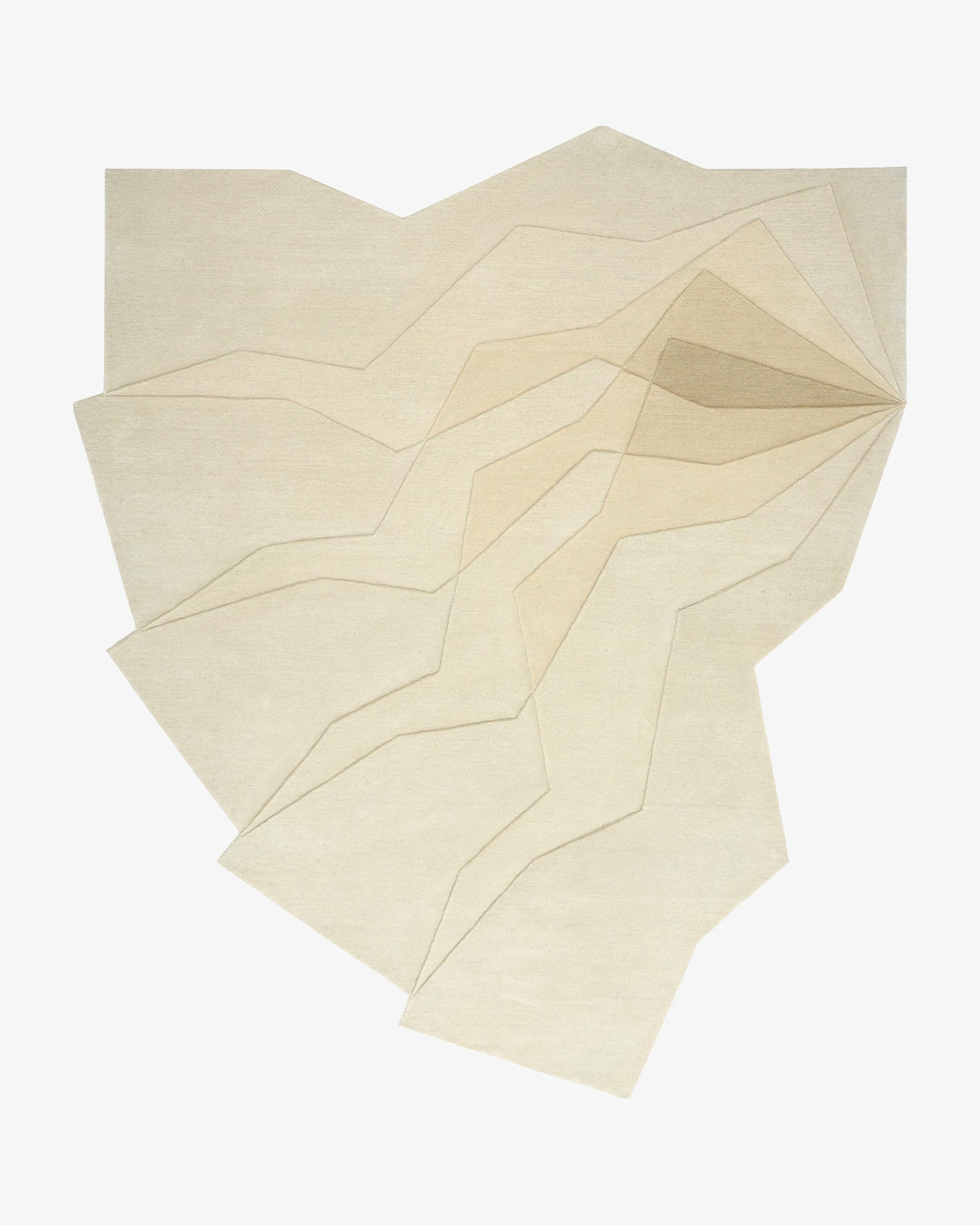
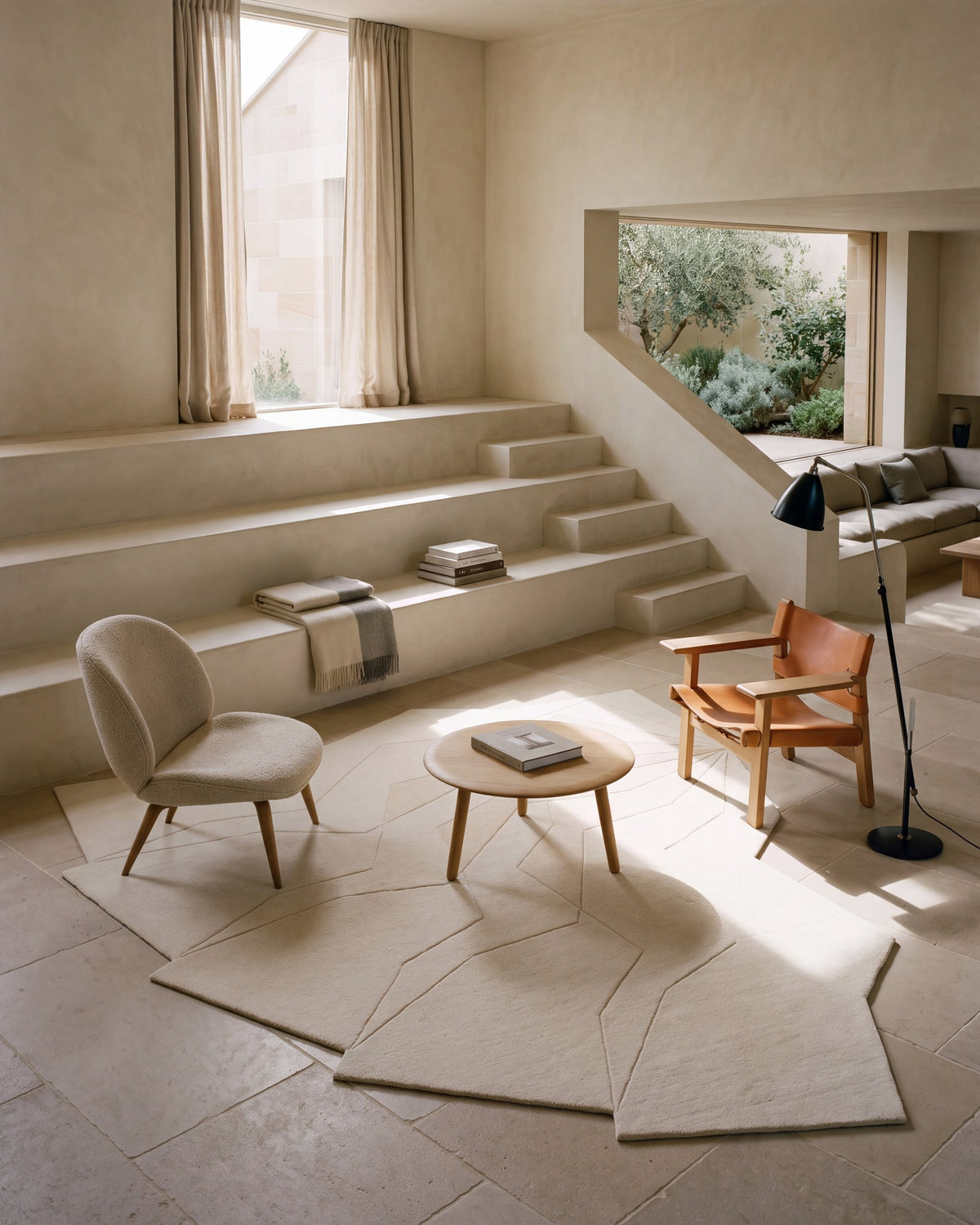
The Lucid Wool Rug is hand tufted in New Zealand wool at 14 to 16 mm, with planes folding in toward a single point, each a shade lighter than the last. It is ₹40,000 for 5x8 ft and ₹80,000 for 8x10 ft. Hand tufting is what allows those carved planes, which makes it a natural choice when the rug is the room's focal point.
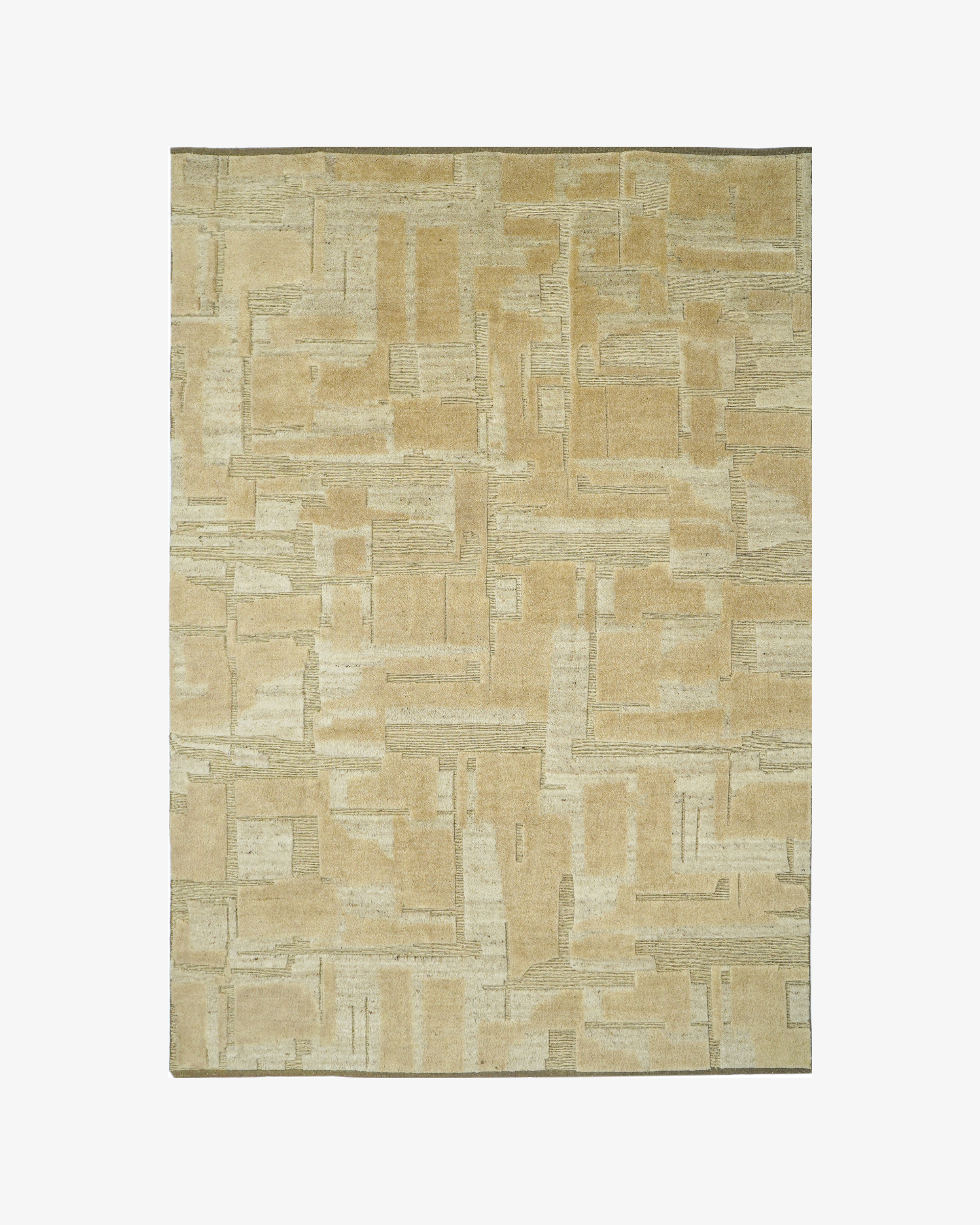
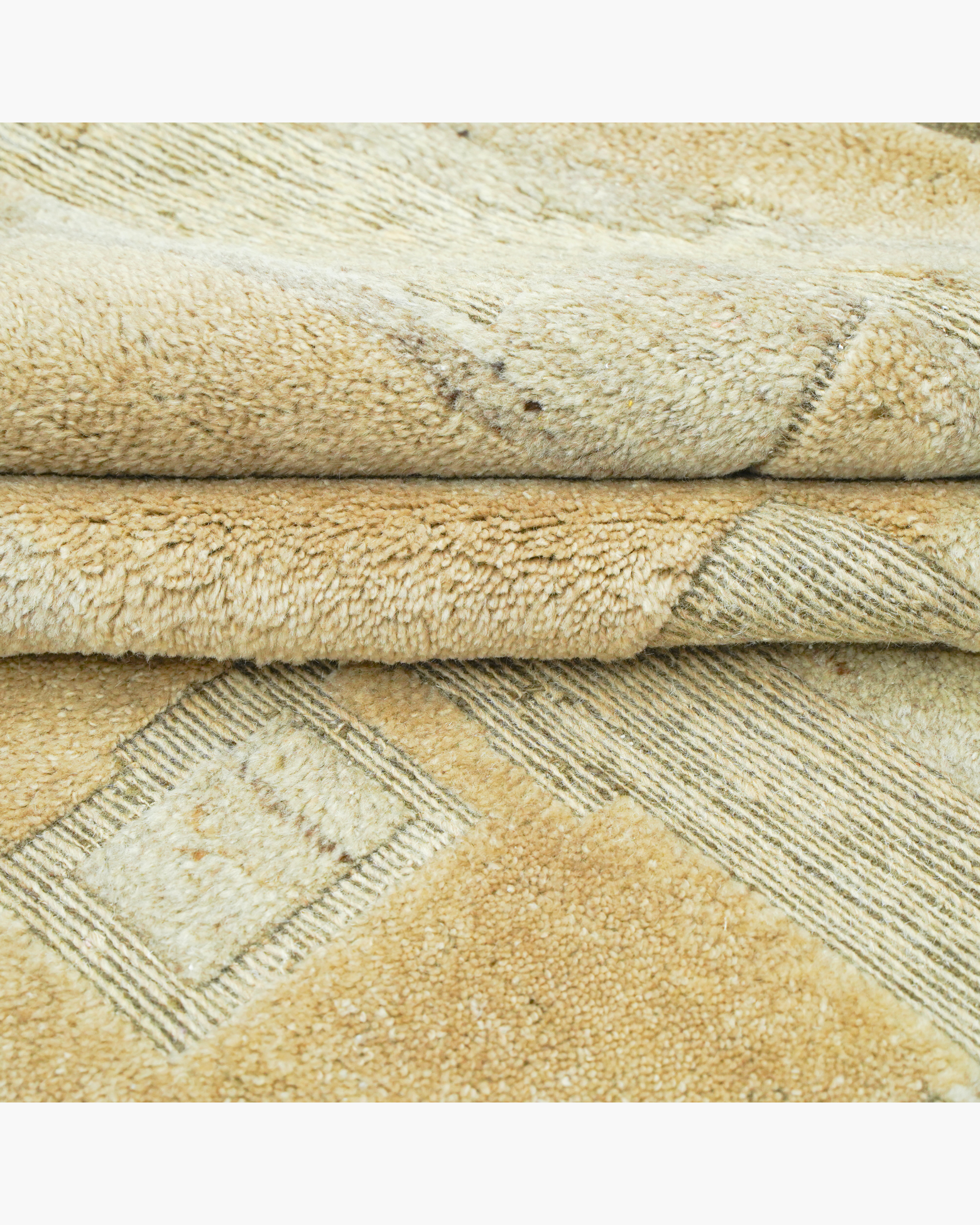
The Stratum Knotted Rug in Dune is hand knotted in New Zealand wool, dense and fine, in layered sand and ivory blocks. Its regular price is ₹1,75,000 for 9x12 ft. Hand knotting is the slowest construction and the most durable, which suits a client who wants a rug to outlast the furniture.
Verdict: for a busy family home specify the Grain, for a statement room specify the Lucid, and for a project where longevity matters most specify the Stratum, because each construction answers a different brief.
When is Rugberry not the right choice for a project?
Rugberry is not the right choice when a project needs machine made rugs, the lowest possible price per square foot, or a rug for an exposed outdoor area. Every Rugberry rug is made by hand in natural or recycled fibres, and that sets a floor on price and making time.
If a hotel needs several hundred identical machine made rugs on a very short programme, a contract mill is a better fit. If a rental flat needs a rug for one season, a flat woven cotton dhurrie may serve the client better. Saying so early is part of specifying well.
Where Rugberry does fit is the higher end of residential interiors and hospitality projects that want handmade rugs in named fibres, made to measure, with written trade terms. The guide to rugs for interior designers in India and the neutral checklist in how to compare modern rug brands in India help with that judgement.
Frequently asked questions
Is Rugberry a good rug brand for interior designers in India?
Rugberry is designed around what designers need: fibre, construction and pile height named on every rug, any size made to measure, swatches, written making times and a trade programme with one trade price and no minimum order. Whether it is right for a given project depends on the brief and budget.
Does Rugberry have a minimum order for trade customers?
No. A designer can open a trade account for one bedroom rug and be treated exactly as on a large project: the same single trade price, quotations and client links, whatever the order size.
Can Rugberry ship a rug directly to my client's site?
Yes. The rug can go straight to the client's home or the project site anywhere in India at no delivery charge, the invoice to the client never shows the trade price, and packing can carry your studio's branding if you ask.
Does Rugberry provide technical documents for architects?
Rugberry provides a tear sheet for every rug, and CAD-ready files, technical documents and flammability test reports on request through the trade programme. Hospitality projects can also ask about fire-retardant treatments.
How long does a made to measure Rugberry rug take?
For a handover date, work backwards from the construction: hand knotted is the long one at around 60 days, handloom around 35, hand tufted and hand woven around 30, each plus delivery, as the product pages list them. Quick Custom closes the gap at about 10 days, while a fully bespoke trade design runs 4 to 8 weeks depending on material and complexity.
The best brand for a project is the one whose facts you can check. Start with Rugberry's made to measure rugs, and ask for anything that is not written down.




Leave a comment
This site is protected by hCaptcha and the hCaptcha Privacy Policy and Terms of Service apply.