



Made to Measure for Bay Windows, Columns and Odd Rooms
For a bay window, a column or an angled wall, measure the room with a paper template rather than a tape alone, and choose a hand tufted rug if the outline needs cut outs or curves. Handloom and hand woven rugs suit straight custom sizes best, while hand tufting lets the edge follow almost any line.
In short
- An odd shaped room is best measured with a full size paper or newspaper template laid on the floor, marked with the walls, columns and furniture.
- Hand tufted rugs suit curves, angles and cut outs around columns, because the outline is cut from the backing cloth after tufting and then bound.
- Handloom rugs, such as Rugberry's Grain Wool Rug, are best kept to straight sides, so a column is usually handled by sizing the rug to stop short of it.
- Leave a gap of 5 to 10 cm between a rug and any column or bay wall, so the edge never rubs and the floor reads clearly around it.
Which awkward rooms need a made to measure rug?
A made to measure rug is worth it when the room's shape, not just its size, defeats the stock options: a bay window seat, a structural column in the seating area, an angled wall, a curved balcony door, or a living room cut into by a staircase. A stock rectangle in these rooms either floats or collides.

Indian apartments create more of these rooms than people expect. Structural columns often sit inside living rooms in Mumbai towers, bays project from bedrooms in Kolkata mansion flats, and Bengaluru villas often have angled walls where the plot narrows.
The test is simple. Lay the nearest stock size on the floor in tape. If any of its edges crosses a column, runs under a bay seat, or leaves a wedge of bare floor that draws the eye, the room is telling you to measure for a custom piece.
Rugberry's guide to the irregular shaped rug covers organic free forms chosen for style. This post is about shapes forced by the architecture.
How do you measure an odd shaped room for a rug?
Measure an odd shaped room by making a full size template on the floor, not by measuring walls alone. A template catches angles, curves and column positions that numbers on paper miss.
- Lay the paper. Tape sheets of newspaper or kraft paper together over the whole area the rug should cover.
- Trace the fixed edges. Run a pencil along the bay wall, the column faces and any angled wall, then draw the line where the rug should stop, 5 to 10 cm in from each one.
- Mark the furniture. Outline the sofa front legs, the coffee table and the bay seat on the paper.
- Mark a reference. Draw one long straight line parallel to the main wall, labelled with its length, and an arrow pointing to the window.
- Photograph and measure. Photograph the template from above in sections, then measure the key distances: overall length and width, each angle, and the size and position of any cut out.
For a column, measure from two walls to each face of the column, so its position can be drawn exactly. For a bay, measure each facet of the bay and the depth from the main wall to its deepest point.
Send the photos, the measurements and the pencil plan together. Rugberry's guide to rug CAD design explains how a drawing is then prepared for your approval before any weaving begins.
Which constructions can be cut to an odd shape?
Hand tufted rugs can be made to almost any outline, including curves and notches around a column, because the shape is cut from the backing cloth and then bound. Handloom, hand woven and hand knotted rugs are built row by row on a loom, so they suit straight sides and simple angles far better than cut outs.


| Construction | Straight custom size | Angles and bays | Curves | Cut out round a column | Rugberry example |
|---|---|---|---|---|---|
| Hand tufted | Yes | Yes | Yes | Yes, bound neatly | Lucid, Facet, Fluid |
| Handloom | Yes | Simple angles, ask first | Not advised | Not advised | Grain, Plush, Cabra |
| Hand woven | Yes | Limited | Not advised | Not advised | Kora, Pampas |
| Hand knotted | Yes | Possible, planned at the loom | Limited | Not advised | Stratum, Savannah |
For a living room with a column inside the seating area, choose a hand tufted rug over a handloom one, because tufting can be bound neatly around a cut out while a woven rug would have to be cut through its structure.
Where a handloom texture matters more than the shape, there is a simpler fix: size the rug to stop just short of the column, or set the column at a corner of the rug. Rugberry's guide to the four rug constructions covers how each is made.
Which Rugberry designs suit odd rooms?
Designs with an abstract or directional pattern suit odd rooms best, because the eye follows the pattern rather than the outline, and a cut edge or angle looks intended. Plain handloom textures suit odd rooms where the rug can stay rectangular and the shape is handled with spacing.

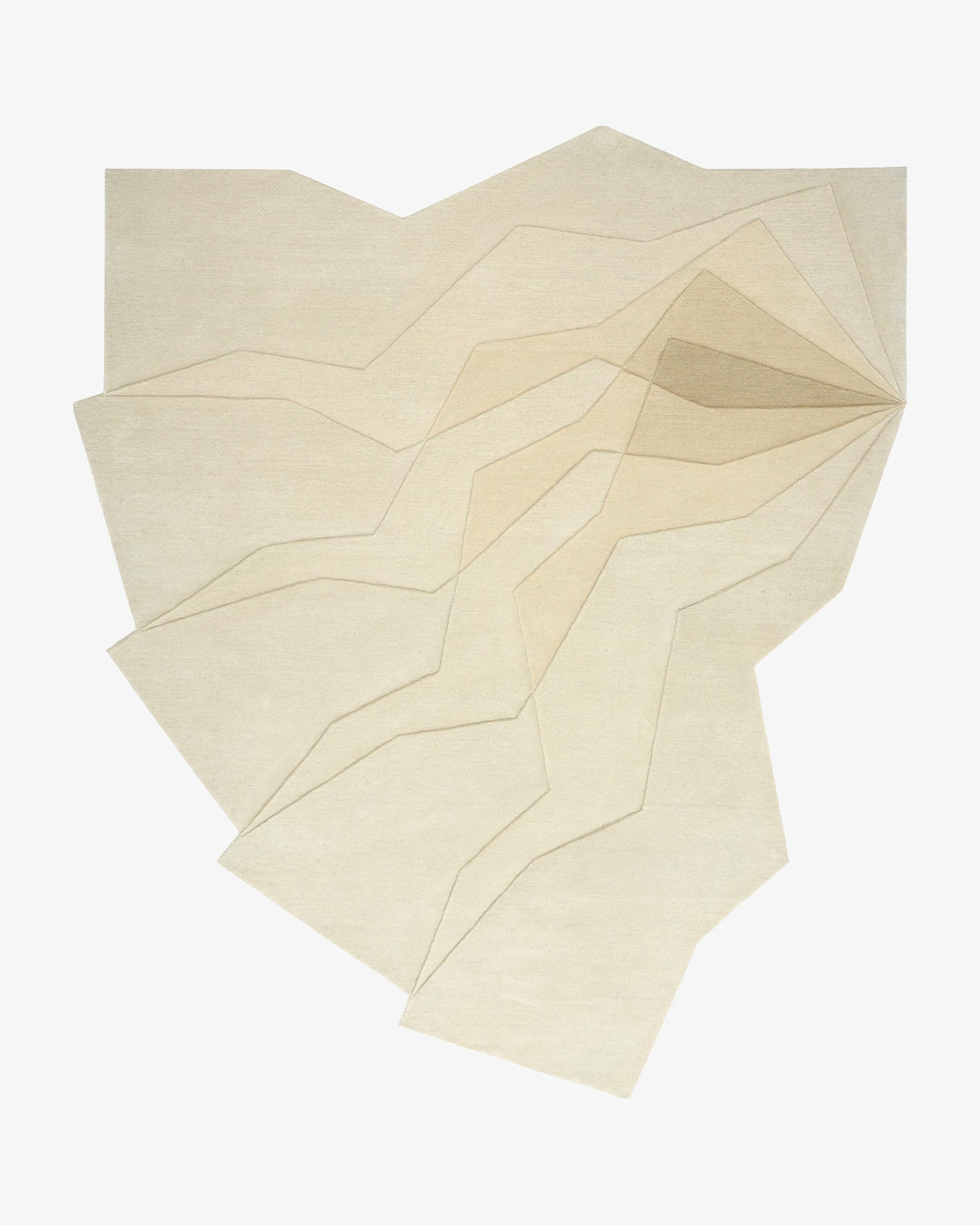
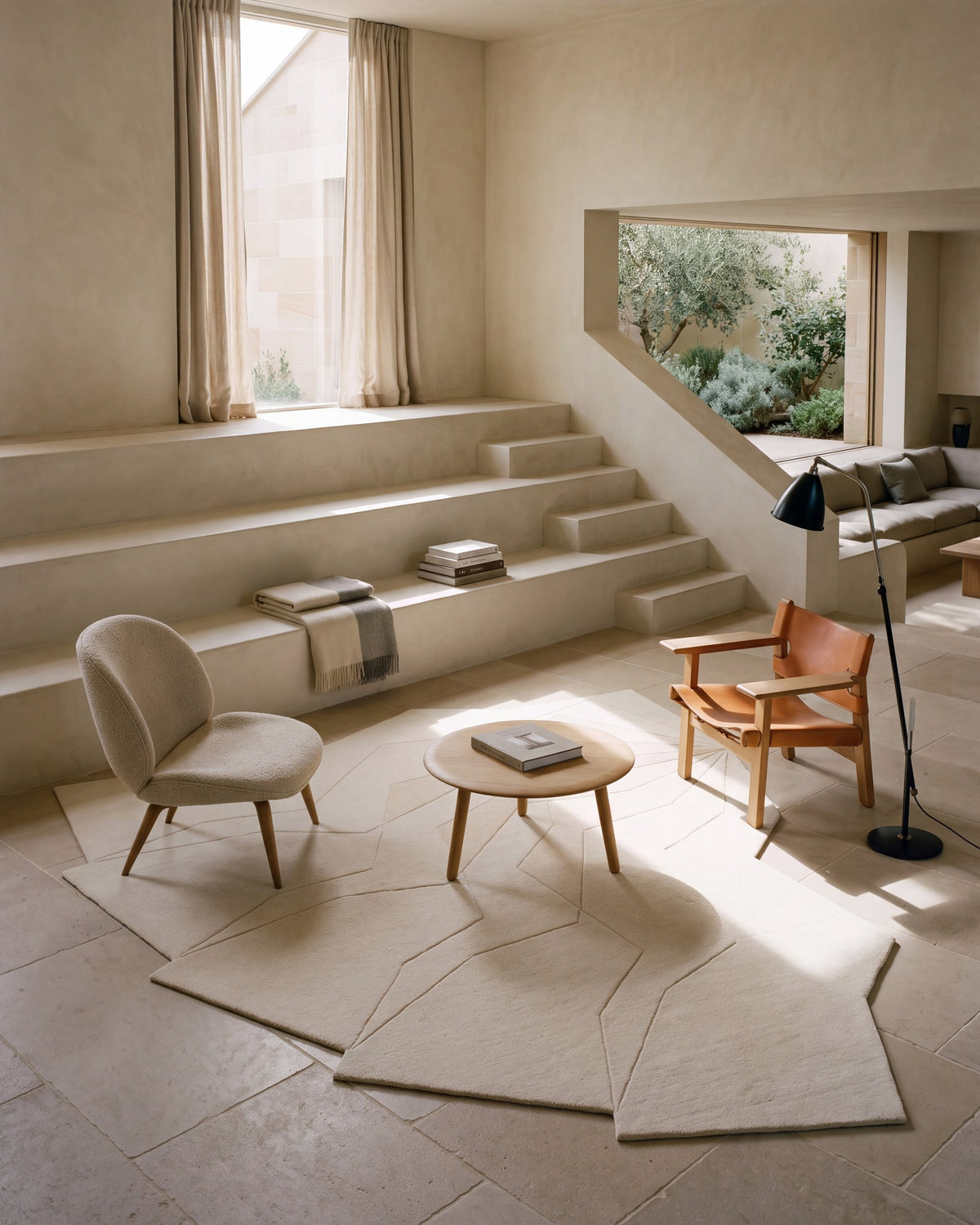
The Lucid Wool Rug is hand tufted New Zealand wool, its planes folding in towards a single point, each one a shade lighter than the last. The folded planes give an angled or cut edge a reason to exist, so a notch for a column reads as part of the design.
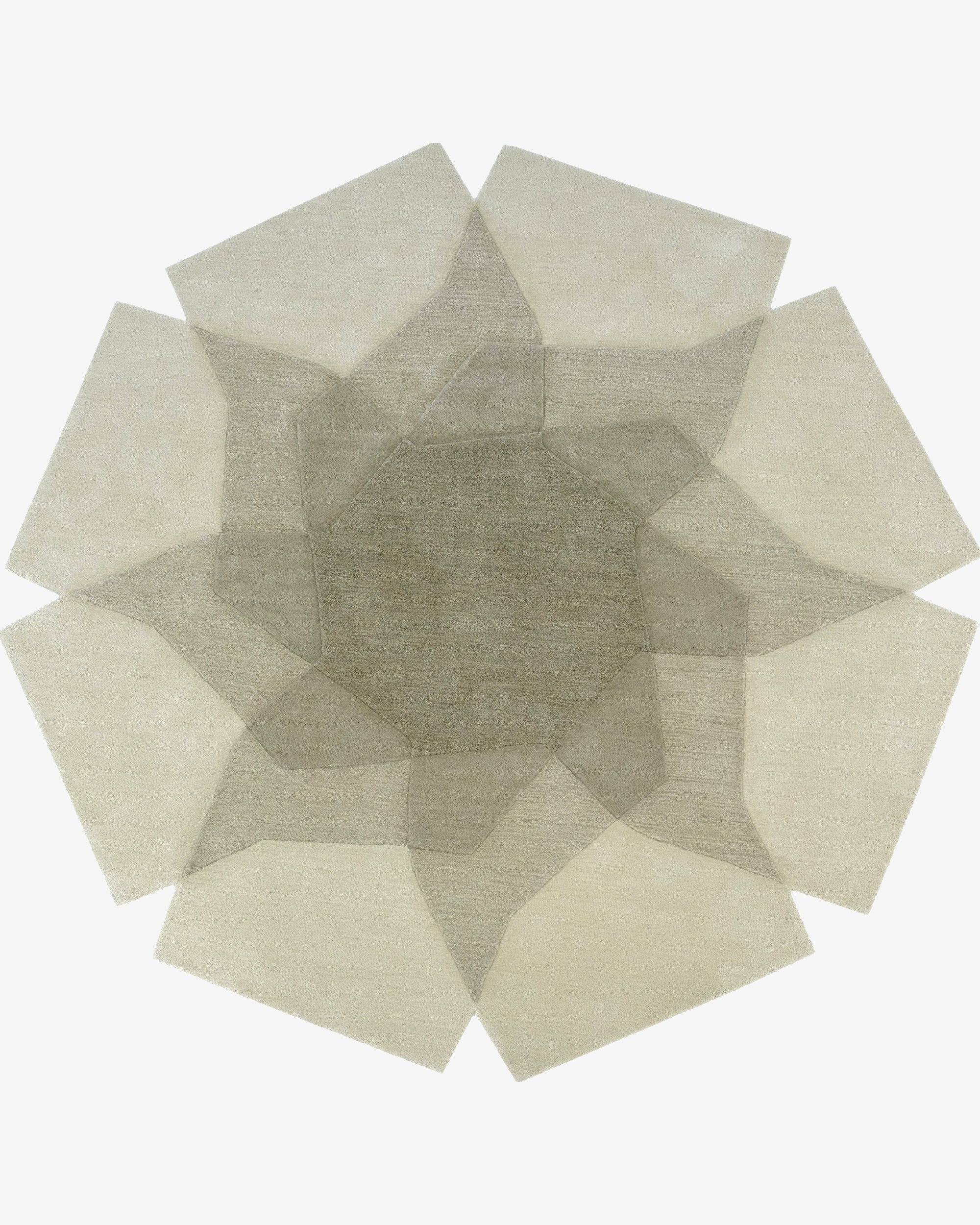
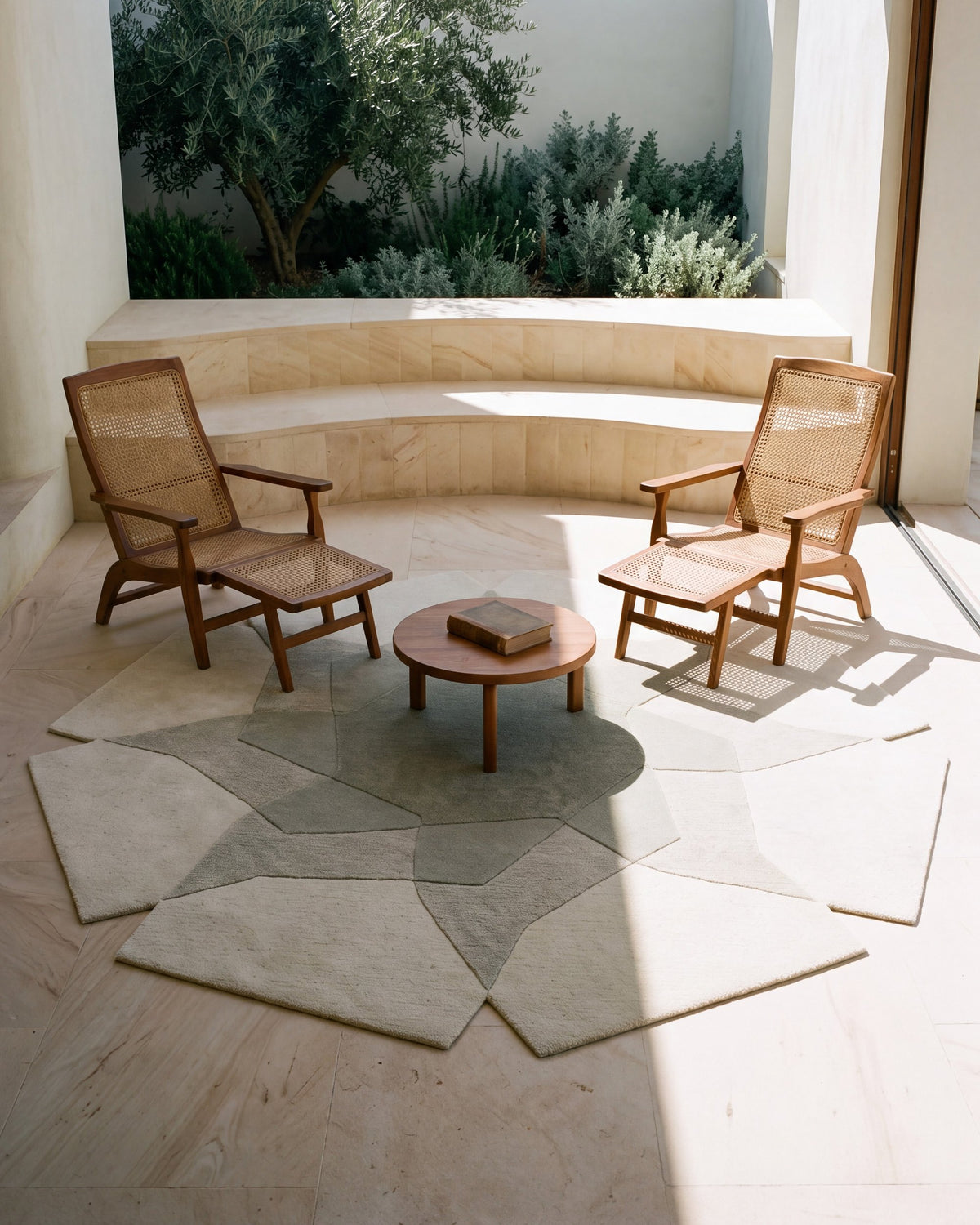
The Facet Wool Rug is hand tufted in New Zealand wool and made entirely to measure, from ₹28,300 for 6 ft diameter. It suits curved bays and rounded corners, where a circle or part circle follows the wall.
The Fluid Wool Rug runs in slow continuous curves and is already cut to a free outline. For a room where nothing is square, it is the most forgiving starting point.
For a quiet texture, the Grain Wool Rug in Flax is handloom New Zealand wool at 12 to 14 mm. Keep it rectangular and let the room's odd corner show as bare floor.
Let the pattern explain the edge. A cut out looks intended when the design already leans that way.
How are cut outs and odd edges finished?
Cut outs and odd edges on a hand tufted rug are finished with a binding, a tape or yarn wrapped over the cut edge and stitched, so the edge does not fray. A clean binding is what separates a planned shape from an afterthought.


The binding follows every turn of the outline. On a curve it has to be eased round in small steps, and on an inside corner, such as the notch for a column, it is mitred so it lies flat. Rugberry's glossary entry on binding describes the finish.
Keep cut outs simple. One rectangular notch at a corner or along an edge works well. A hole in the middle of a rug for a column is possible in tufting but splits the rug into a weak ring and makes it very hard to lift, so it is better to move the rug's edge to the column.
Ask for the binding colour to match the field, not contrast with it. A contrasting binding traces the odd outline and makes it louder, while a matching one lets it disappear.
How do you handle a staircase, niche or built in seat?
Handle a staircase, niche or built in seat by keeping the rug clear of it rather than trying to wrap around it. Stop the rug 10 to 15 cm short of the first tread, the base of a niche or the front of a window seat, so the edge sits on open floor where it cannot lift or catch.

A staircase that rises out of the living room is the most common case in duplex flats and villas. A rug cut to hug the bottom step looks clever on a drawing but lifts at the corner as people step off. A rectangle that stops short of the stair, or a round rug at the turn, ages far better.
Built in seating in a bay, often a deep window seat with storage below, is similar. Let the rug run under the front of the coffee table and stop short of the seat base, rather than tucking under it, so the cupboard doors still open.
A puja niche or a recessed bookcase is best left as bare floor around its base. Rugberry's guide to rug placement and vastu covers how many families like to treat the floor near a mandir.
What should you check before approving the drawing?
Before approving a made to measure drawing, check it against the paper template on the floor, not on a screen. Confirm the overall size, every angle and cut out, the pattern direction and the colour, because a custom shape cannot be exchanged for another size.
- Print it to scale. Lay a scaled print next to your template and compare each line.
- Check the direction. Make sure the pattern runs the way you want relative to the window and the sofa.
- Check the door. Open every door over the template, especially at a bay or balcony.
- See the colour. Order a swatch or use the Design Lab to see the colour in your own light. Rugberry's guide to the rug swatch before buying explains why.
- Ask about the edges. Confirm how each cut edge will be bound and in which colour.
Rugberry's made to measure service covers every design in the customisable rugs, in any size and colour, and the team will say plainly when a shape suits another construction better.
Frequently asked questions
Can a rug be made to fit around a column?
A hand tufted rug can be made with a bound notch to fit around a column, because its outline is cut from the backing cloth. Handloom and hand woven rugs are better sized to stop just short of the column instead.
How do I measure a bay window for a rug?
Measure a bay window by laying a paper template over the floor, tracing each facet of the bay, and marking where the rug should stop, 5 to 10 cm in from the wall. Photograph the template and note the length of each facet and the depth of the bay.
Are custom shaped rugs more expensive?
A custom shaped rug is usually priced on the area of the rectangle it is cut from, because the offcut cannot be reused. A simple angle or notch adds little, while a complex outline may add binding work.
What is the best construction for an odd shaped rug?
Hand tufted construction is best for odd shapes, because the outline can follow curves, angles and notches before the edge is bound. Rugberry's Lucid, Facet and Fluid rugs are hand tufted in New Zealand wool.
Can I return a made to measure rug?
A made to measure rug is made for one room and one shape, so check Rugberry's current terms before ordering. Approving the drawing against a paper template on your floor is the best protection against a size that does not fit.
Template the floor, then trust the line. Material first.




Leave a comment
This site is protected by hCaptcha and the hCaptcha Privacy Policy and Terms of Service apply.