


Handmade Rug vs Printed Rug: What You Are Buying
A handmade rug builds its pattern from yarn that is dyed before it is woven, knotted or tufted, so the colour runs through every fibre. A printed rug has its pattern applied to the surface afterwards, usually on synthetic pile. Bend the pile and look at the roots: printed colour stops near the tips, yarn colour does not.
In short
- In a printed rug the design is printed onto a finished surface, most often polyester, so the colour sits mainly on the outer part of the pile.
- In a handmade rug the design is made from yarns dyed in their final colours, so a black line in the pattern is black from tip to backing.
- Printed rugs cost far less and suit short term, high spill or children's rooms; handmade rugs keep their colour and shape for many years.
- Rugberry makes patterned rugs such as Tinker, Fluid and Monochrome by hand tufting New Zealand wool in coloured yarns, never by printing.
What is the difference between a handmade rug and a printed rug?
The difference is where the pattern comes from. In a handmade rug, the pattern is the yarn: each colour is a separate strand placed by a person. In a printed rug, the pattern is ink or dye laid onto a surface that was made plain first.
That one fact decides most of what follows: how the rug looks up close, how it wears in a busy room, how it reacts to sun and cleaning, and what it costs. Photographs taken from a distance hide the difference almost completely, which is why so many buyers only notice it after delivery.
Printing is not a lesser idea in itself. It allows photographic detail and very low prices. It simply produces a different object, closer to a printed textile than to a rug in the traditional sense, and it should be described that way when it is sold.
| Point | Printed rug | Handmade rug in dyed yarn |
|---|---|---|
| Where the colour is | On the surface, strongest at the tips | Through the whole yarn |
| Usual fibre | Polyester or another synthetic | Wool, jute, Botanical Silk and other natural fibres |
| Pile | Often flat or short, very even | Cut or loop pile at a chosen height |
| Edges of the pattern | Can be photo sharp, or slightly soft where ink spreads | Defined by yarn, with a slight hand drawn wander |
| Ageing | Pattern thins as the surface wears or fades | Pattern stays as the pile wears down evenly |
| Price | Low | Higher, set by fibre, construction and size |
Verdict: a printed rug is a decorative surface at a low price, while a handmade rug in dyed yarn is a textile whose pattern lasts as long as the rug does.
How is a printed rug made?
A printed rug is made in two stages: first a plain base, usually a short synthetic pile or a flat woven polyester, then a printing stage where the design is applied by large digital printers or by heat transfer from a printed sheet.
Polyester is the usual base because it takes printed dyes well and holds fine detail, which is why printed rugs can show gradients, photographs or very small motifs that would be slow or costly to make by hand. A non slip or felt backing is then glued on.
Because the base is made in long rolls and printed in a short pass, a printed rug can be produced in very large numbers and at very low cost. That is its real advantage, and it is why printed designs change with each season's trends.
How is a pattern built by hand instead?
A pattern is built by hand by placing each colour of yarn where the design needs it, row by row or tuft by tuft. The yarn is dyed first, in batches, and the person making the rug follows a drawing on the backing cloth or on the loom.


In a hand tufted rug, the design is drawn onto a cotton cloth stretched on a frame, and each colour is punched through it with a hand held tufting gun, one area at a time. The pile is then sheared to an even height, and lines are often carved by hand so the edges of each colour read cleanly.
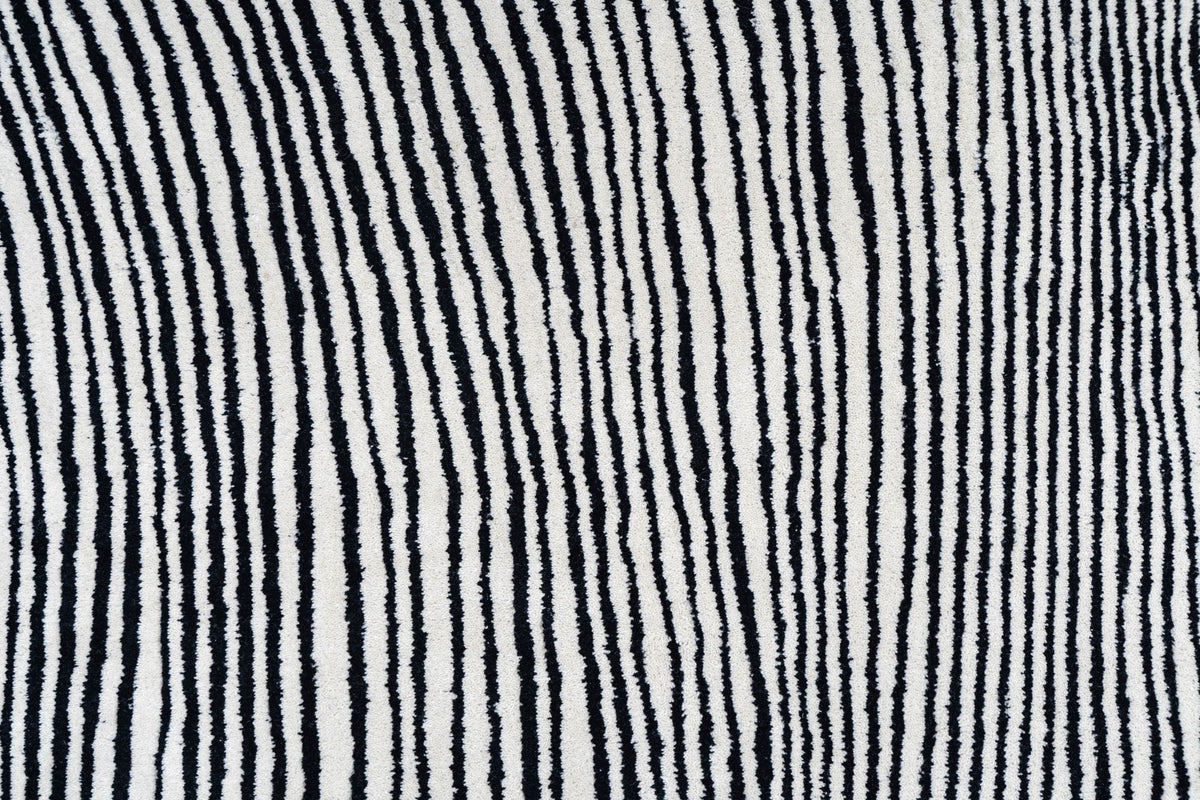
The Tinker Wool Rug shows the result. Its black looping lines on an ivory field are made in black and ivory New Zealand wool, hand tufted at 14 to 16 mm, so each line has a slight, human wander that a printer would not give it. Its regular price is ₹37,000 for 5x8 ft and ₹74,000 for 8x10 ft, ex GST at the time of writing.
Our guide to the four handmade rug constructions covers how handloom, hand knotted and hand woven rugs place their colours.
Printed colour sits on the surface. Yarn colour is the rug itself.
How can you tell a printed rug from a handmade one?
You can tell a printed rug from a handmade one by bending it, so the pile opens along a fold, and looking at the roots of the tufts where two colours meet. Printed colour fades towards a paler base near the backing; dyed yarn keeps its colour all the way down.


Look at the back next. A printed rug usually shows a plain, uniform backing with no trace of the pattern at all. A hand knotted rug mirrors its pattern on the back, and a handloom rug shows woven yarns in the pattern colours. A hand tufted rug hides its pattern under a backing cloth, so the fold test matters most there.
Then look at the boundaries in the pattern. On the Monochrome Wool Rug, each black line is a band of black wool tufts beside ivory wool tufts, so where two lines meet you see yarn ends of two colours, not a blurred edge. It is hand tufted in New Zealand wool, ₹38,000 for 5x8 ft at regular price, ex GST at the time of writing.
Finally, run your hand across the surface. Printed pile tends to feel uniform and slippery, while wool yarn has a slight dryness and spring. For the wider set of checks on fibre and construction, see how to check what a rug is made of.
How do printed and handmade rugs wear and fade?
A printed rug wears from the outside in: as the tips of the pile are flattened or abraded in a walkway, the paler base shows through and the pattern looks thinner. A handmade rug in dyed yarn wears down evenly, and the pattern stays the same colour as the pile gets lower.

Sunlight treats them differently too. Printed dyes on a synthetic surface can fade in strong, direct sun, and because the colour is concentrated at the surface, fading shows quickly. Wool dyed in the yarn fades slowly and evenly, as covered in our guide to rugs and sunlight.
Shape matters as well. A printed rug on a thin base can crease and stay creased, especially after being folded for delivery. A hand tufted wool rug with a dense 14 to 16 mm pile relaxes back to flat once laid, and turning it every few months keeps its wear even across the room.
How do the two compare on cleaning and price?
Printed rugs are usually easier to spot clean and some can even be washed, while handmade wool rugs need gentler care and professional deep cleaning. On price, printed rugs cost a small fraction of a handmade rug of the same size.
Synthetic pile does not absorb liquid readily, so a fresh spill on a printed rug often blots out with water. Harsh cleaners can lift printed colour, though, so a stain remover that works on one area may leave a pale patch. Wool resists soiling naturally thanks to its lanolin and should be blotted with a dry cloth and a little lukewarm water.
A handmade rug's price follows its fibre, construction and size. The Fluid Wool Rug, black diagonal stripes on cream that melt into liquid shapes, hand tufted in New Zealand wool at 14 to 16 mm, is ₹40,000 for 5x8 ft and ₹79,000 for 8x10 ft at regular price, ex GST at the time of writing. Our guide on why handmade rugs cost what they do breaks those costs down.
When is a printed rug the sensible choice?
A printed rug is the sensible choice when the rug is meant to be temporary, faces heavy spills, or sits where a lower price matters more than lifespan. A rented flat for a year, a playroom for toddlers or a pet's corner are fair examples.

It also makes sense when the design itself needs printing: a photographic image, a very fine gradient or a pattern that changes every season. Nothing is wrong with buying one, as long as it is sold as a printed rug and priced like one.
For a room you plan to live in for years, a handmade rug in dyed natural yarn is the better use of the money, because it keeps its pattern, recovers its shape and can be professionally cleaned many times. Our guide to rugs for a rented home covers the choice when you expect to move.
If you like a graphic printed look but want it to last, ask whether the design can be made by hand. At Rugberry, any design can be made to measure in any size, shape or colour, with custom colour approved from yarn poms before making begins.
Frequently asked questions
Is a printed rug the same as a machine made rug?
Not exactly. Many machine made rugs are woven by power looms with coloured yarns, so their pattern runs through the yarn. A printed rug adds its pattern to a plain surface after it is made, which is a separate process again.
Can a handmade rug have a printed design?
Very rarely. Handmade rugs are made from yarns already in their final colours, so the design comes from where each colour is placed. A rug sold as handmade with a printed surface would be unusual and worth questioning.
Does a printed rug look cheap in a living room?
From across the room it can look convincing. Up close, the even, flat pile and the pale roots along a fold usually give it away, and in a walkway the pattern can look worn within a few years.
Are Rugberry patterned rugs printed?
No. Rugberry patterned rugs, such as Tinker, Fluid and Monochrome, are hand tufted in New Zealand wool yarns of each colour, and the product page states the fibre and construction for every rug.
Which is better for a child's room, printed or handmade?
For a toddler stage with daily spills, a washable printed or cotton rug is practical. For an older child's room that should last, a hand tufted wool rug with a low, dense pile copes well, as our guide to modern kids' room rugs explains.
Bend the pile, read the back, then decide what the rug is for. See hand tufted rugs and patterned rugs from Rugberry. Material first.



Leave a comment
This site is protected by hCaptcha and the hCaptcha Privacy Policy and Terms of Service apply.