



A Rug for a Sunken Living Room
The right rug for a sunken living room fills the floor of the well, stops 6 to 10 inches short of the bottom step on every side and is low and firm enough that no edge lifts where people step down. Because the room is seen from the level above, a carved or ombré surface in one quiet colour usually looks better than a busy pattern.
In short
- A rug in a sunken living room should leave a gap of 6 to 10 inches between its edge and the lowest riser, so that no one steps down onto a rug edge.
- Most sunken seating wells in Indian homes measure between 10 x 12 ft and 14 x 16 ft, which suits an 8x10 ft, 9x12 ft or 10x14 ft rug, or a rug made to measure.
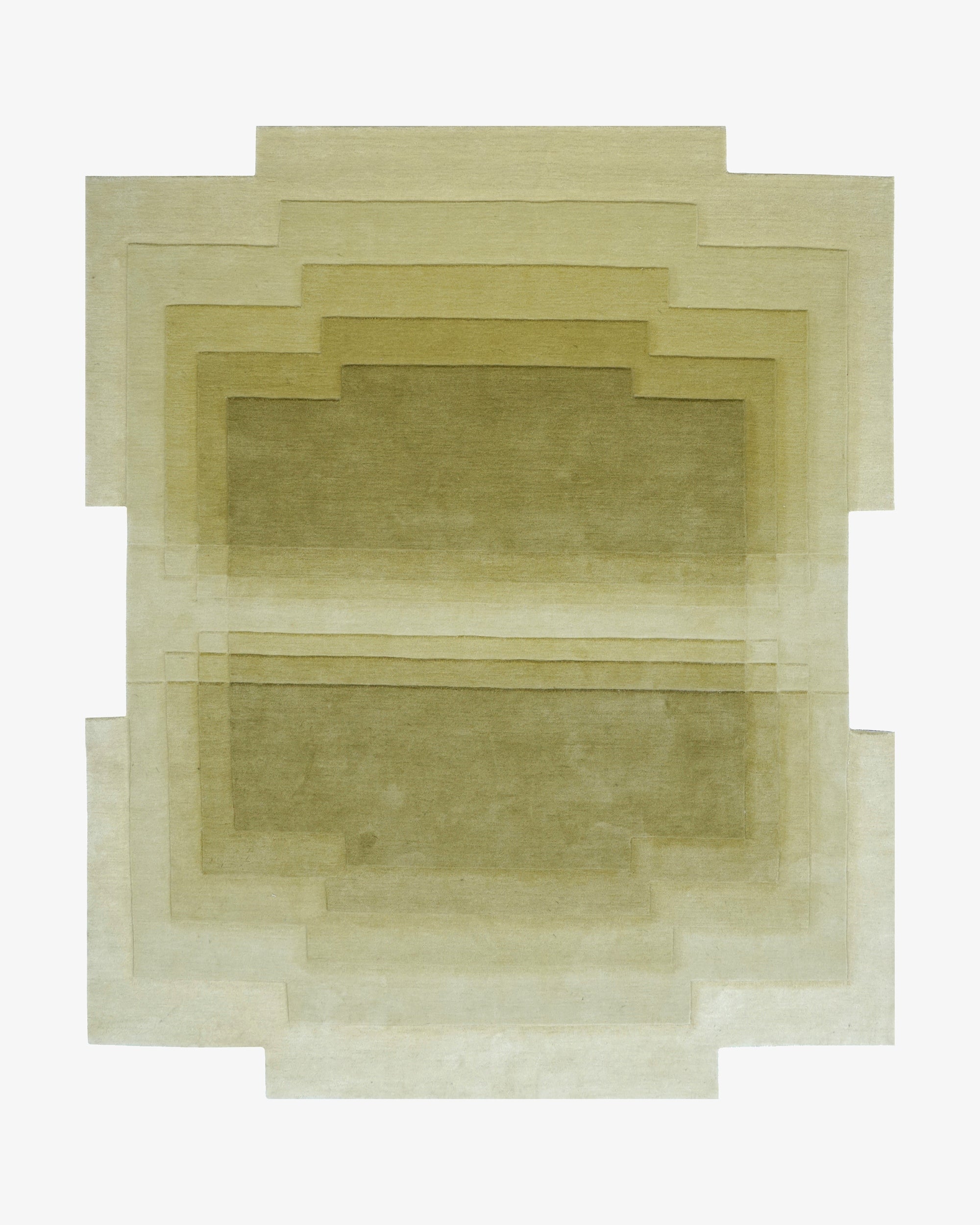
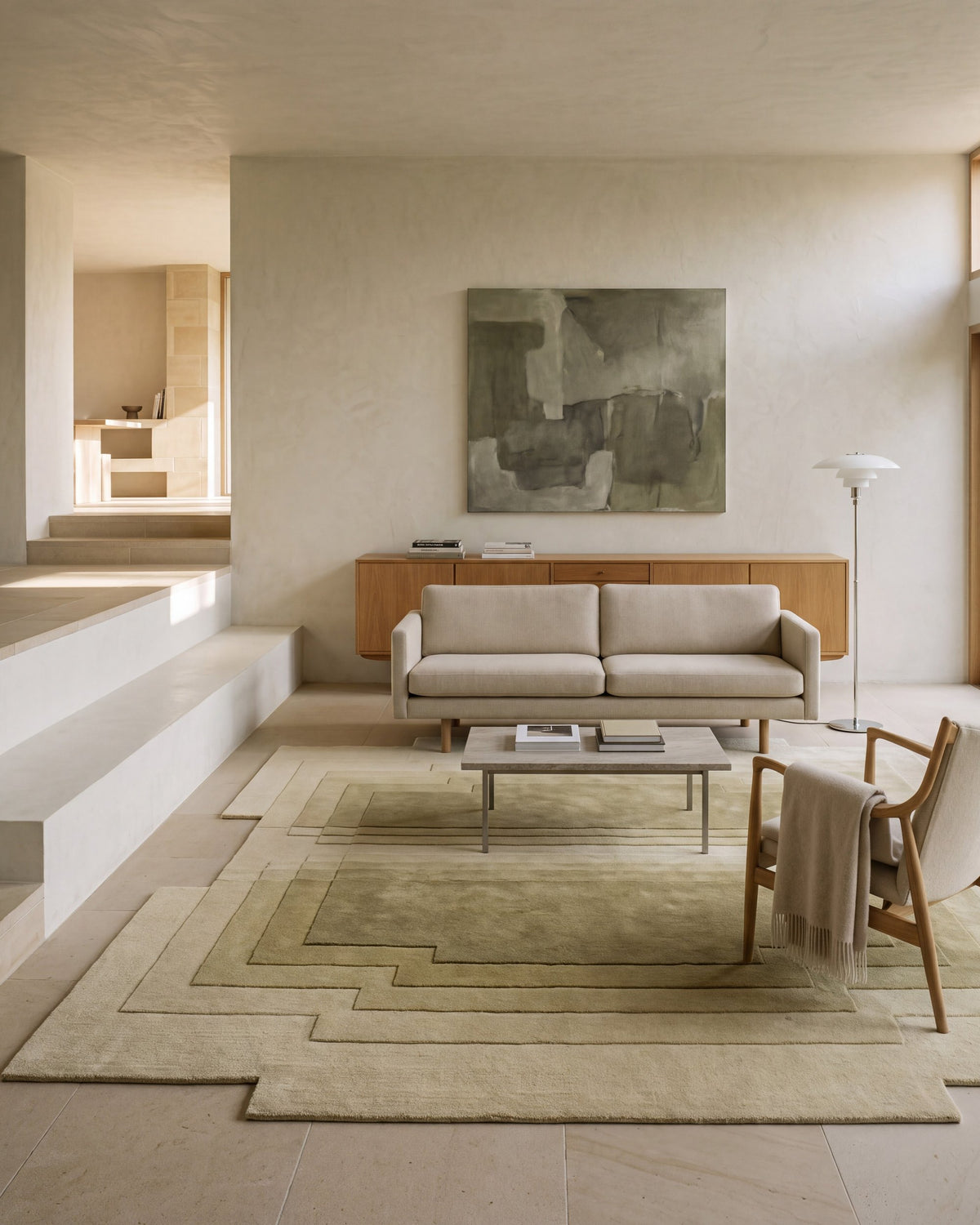
- Carved New Zealand wool rugs such as the Rugberry Talus and Cavea read clearly from the floor above, because carving shows as light and shadow rather than colour.
- A sunken room collects dust and cool air at its lowest point, so a dense wool pile of 14 to 16 mm is easier to keep fresh than a deep shag.
What makes a sunken living room different for a rug?
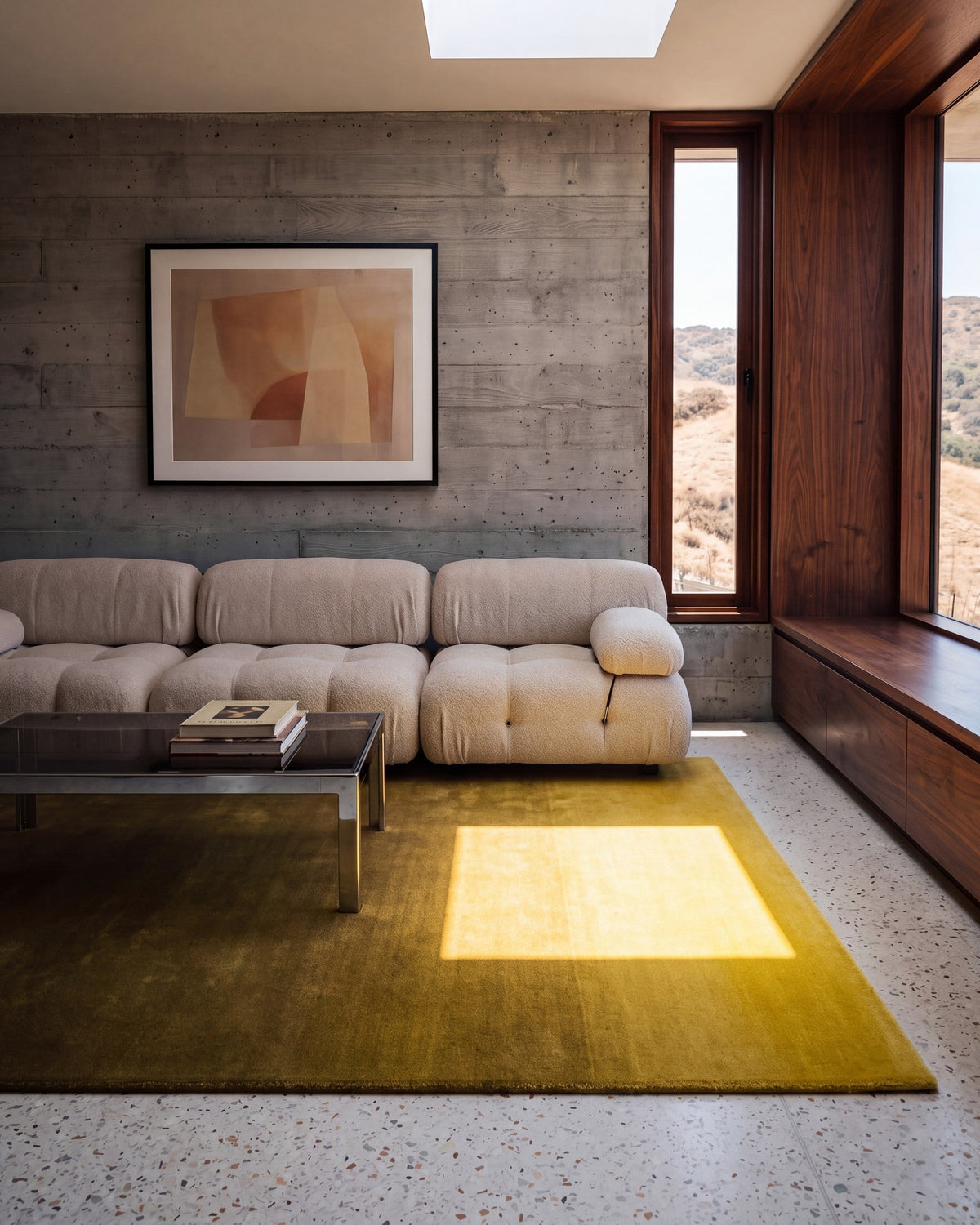
A sunken living room is different because the rug is seen from above more often than from the sofa. Anyone standing in the dining area or the entrance looks down into the well, so the rug works like a painting laid flat on the floor.

The second difference is the steps. People enter and leave the room by stepping down, often carrying a tray or a child, and the first footfall lands close to the riser. A rug edge in that spot is the most common cause of a trip in these rooms.
The third is air. Cool air and fine dust settle at the lowest point of a home, so the floor of a sunken room is a little cooler and a little dustier than the floors around it. In Delhi in January that is pleasant, and in Mumbai in August it means the rug needs to breathe.
Sunken living rooms, often called conversation pits, came back into Indian villas and penthouses through architects who like a change of level to mark a room without walls. They are lovely to sit in and slightly harder to dress, which is why the rug deserves some planning.
How big should a rug be in a sunken living room?
A rug in a sunken living room should cover the floor of the well with a clear band of 6 to 10 inches of floor between the rug and the bottom step. That band frames the rug like a mount frames a print and keeps every edge out of the path of a foot stepping down.


Measure the floor of the well, not the room. Measure at the base of the risers, wall to wall or step to step, and subtract 12 to 20 inches from each dimension. A well of 12 x 14 ft therefore takes a rug of about 10 x 12 ft to 10 x 13 ft.
| Floor of the well | Rug size | Clear band to the steps | Route at Rugberry |
|---|---|---|---|
| 9 x 11 ft | 8x10 ft | About 6 inches | Standard size |
| 10 x 13 ft | 9x12 ft | About 6 inches | Standard size |
| 11.5 x 15.5 ft | 10x14 ft | About 9 inches | Standard size |
| 13.5 x 16.5 ft | 12x15 ft | About 9 inches | Standard size |
| Any other size or a curved well | Cut to the well, less the band | 6 to 10 inches | Made to measure |
For a sunken room whose floor does not match a stock size, choose a rug made to measure over a near miss, because an uneven band around a framed floor shows far more than it would in a flat room.
Many conversation pits have built in seating along two or three sides. In that case the rug only needs to run under the coffee table and reach to within a few inches of the seat plinths, and the band at the open side, where people step in, should be the widest.
Avoid a rug that runs up to the risers and touches them. It looks fitted at first, but the pile is crushed against the step edge, dust gathers in the seam and any small shift leaves the rug riding up the riser.
Where should the rug edges sit near the steps?
The rug edges should sit beyond the landing zone of the bottom step, which in most homes is the first 10 to 12 inches of floor in front of each riser. A foot coming down a step lands there, and it should land on hard floor or the middle of a rug, never on a rug edge.
If the steps run along the whole of one side, keep the rug back from that side by the full 10 to 12 inches. If there is a single flight of two or three steps, a narrower band elsewhere is fine, but keep a generous gap at the foot of the flight.
In a sunken room, the floor around the rug is part of the design. Leave it even on every side.
A rug pad matters more here than in a flat room. A felt and rubber underlay cut 2 inches smaller than the rug on each side stops the rug creeping towards the steps as people sit and stand. Our guide to rug pads on Indian floors explains which pad suits marble, stone or tile.
Keep the edge itself low and firm. A hand tufted rug with a bound edge, or a handloom weave, lies flatter at the border than a loose shag. Fringes are best avoided near steps, because a fringe catches a toe more easily than a bound edge.
Which rug surfaces look best from the level above?
Carved and ombré surfaces look best from above, because they read as light and shadow across one colour. A busy multicolour pattern seen from 4 or 5 ft higher tends to look smaller and noisier than it does at eye level from the sofa.

The Talus Wool Rug is hand tufted in New Zealand wool at 14 to 16 mm and carved into stepped layers in soft moss and olive. From the floor above, those steps echo the steps of the room itself, which is why it suits a sunken living room so naturally. Its regular price is ₹40,000 for 5x8 ft, ₹80,000 for 8x10 ft, ₹1,08,000 for 9x12 ft, ₹1,40,000 for 10x14 ft and ₹1,80,000 for 12x15 ft, ex GST at the time of writing.
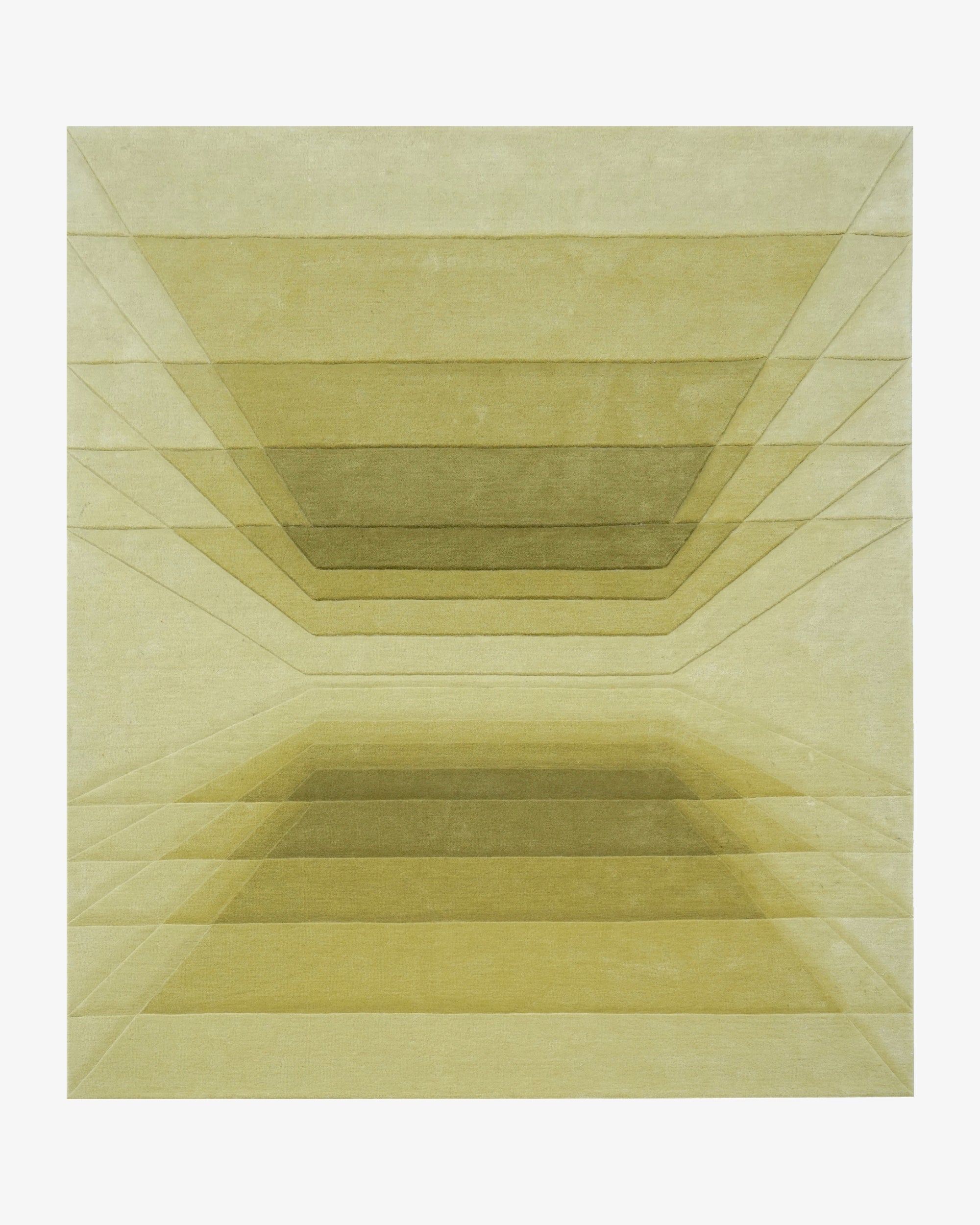
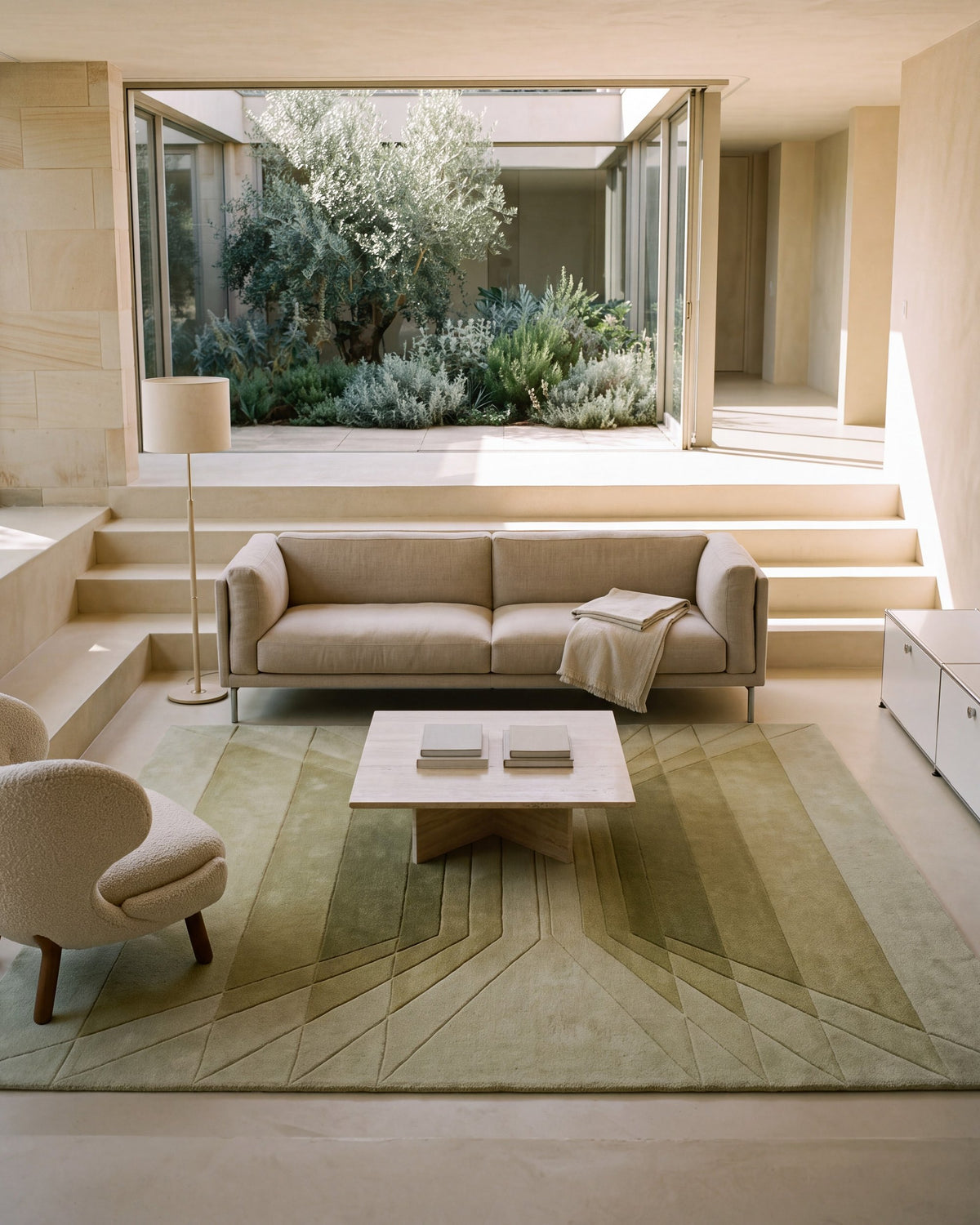
The Cavea Wool Rug is its quieter partner, hand tufted in olive New Zealand wool at 14 to 16 mm with carved planes that drop towards the centre like a shallow basin. It is priced the same as Talus, at ₹54,000 for 6x9 ft and ₹1,08,000 for 9x12 ft, ex GST at the time of writing. Both belong to the Lamina family of rugs carved in one colour, explained in our note on Lamina carved wool rugs.
An ombré is the other good answer. The Ombré Solitude Rug is hand tufted in New Zealand wool at 14 to 16 mm, a slow gradation across an otherwise empty field.
Seen from above, the change of tone gives the well a sense of depth even when the room is small. Its regular price is ₹44,000 for 5x8 ft, ₹87,000 for 8x10 ft and ₹1,17,000 for 9x12 ft, ex GST at the time of writing.
When choosing an ombré, place the lighter end where daylight falls and the deeper end towards the shaded side, so the gradient follows the room. Our Solaris ombré guide covers matching an ombré to the direction of light.
Which fibre and pile height suit a sunken room?
New Zealand wool at a pile height of 12 to 16 mm suits most sunken rooms. It is soft enough to sit on, dense enough to hold its shape where feet land and easy to vacuum free of the dust that settles at the lowest level.


Deep shag rugs of 30 mm and more feel inviting in a conversation pit, but they trap dust and are hard to keep even near the steps, where they flatten first. If you want depth, a handloom wool of 18 to 20 mm is a better compromise than a true shag.
Jute is firm and handsome but marks if it stays damp, and the floor of a sunken room on a ground floor can stay cool and humid through the monsoon. Keep jute for a dry, air conditioned home, or choose a wool and jute weave instead.
Botanical Silk blends add a low sheen that looks beautiful from above in evening light. Keep them for sunken rooms that are used for sitting rather than as a through route, since a blend with Botanical Silk shows wear sooner where people walk.
Should a sunken living room have one rug or two?
A sunken living room should almost always have one rug that fills the well. The sunken floor already defines the room, so one rug reads as calm and intentional, while two rugs inside a small well tend to look like leftovers.

The exception is a long, rectangular well with seating at one end and a reading or music corner at the other. There a main rug under the seating and a smaller round rug at the far end can work, as long as both keep the same clear band to the steps.
Think about the floor above as well. If the upper level has its own rug, in a dining area or entrance, choose the two to share a tone rather than a pattern.
A carved olive rug in the well and a plain sage or sand rug above makes the change of level feel planned. Our guide to matching rugs in different rooms has more on pairing.
A home with a sunken room often has other changes of level too, such as a mezzanine or a double height living area. For those, see our notes on double height living rooms and mezzanine and loft rugs.
How do you order a rug for a curved or irregular well?
For a curved or irregular well, order a rug made to measure from a template rather than from tape measurements alone. Lay sheets of newspaper or brown paper on the floor of the well, tape them together, mark the line of the clear band and trace the shape.


Photograph the template on the floor with a tape laid along two sides, and note the diameter or radius of any curve. Rugberry can make most designs to measure in any size or shape, and a template removes guesswork for a round or oval pit. More detail on odd shapes is in our guide to custom rugs for odd rooms.
Check how the rug will reach the room. A 10x14 ft rug rolls to a tube about 10 ft long, which must pass through the doors and turn down the steps. In a penthouse, measure the lift and the landing as well as the room.
Finally, order a swatch and lay it on the floor of the well for a few days. Look at it from the level above, morning and evening, because that is the view that matters most in this room.
Frequently asked questions
How much floor should show around a rug in a sunken living room?
Leave a band of 6 to 10 inches of floor between the rug and the bottom step on every side of a sunken living room. The band keeps rug edges out of the landing zone of each step and frames the rug evenly.
What size rug fits a 12 x 14 ft conversation pit?
A conversation pit with a 12 x 14 ft floor suits a rug of about 10 x 12 ft to 10 x 13 ft. A standard 9x12 ft rug also works if you prefer a wider band, and a made to measure rug gives an even margin on all sides.
Is a shag rug a good idea in a sunken living room?
A deep shag rug is usually not the best choice for a sunken living room, because it traps the dust that settles at the lowest level and flattens unevenly near the steps. A dense wool pile of 14 to 20 mm feels soft while staying easier to clean.
Which rug pattern looks best from above?
Carved rugs in one colour and ombré rugs look best from above, because they read as light and shadow rather than busy colour. Rugberry's Talus and Cavea carved wool rugs and the Ombré Solitude rug all suit a room seen from a higher level.
Can Rugberry make a round rug for a circular sunken seating area?
Rugberry can make most designs to measure, including round and curved shapes for a circular seating well. Send a paper template of the floor or a drawing with the diameter, and allow for a clear band to the steps.
Give the well one rug, an even frame of floor and a surface that reads from above. See the Lamina collection and the ombré rugs. Material first.



Leave a comment
This site is protected by hCaptcha and the hCaptcha Privacy Policy and Terms of Service apply.