


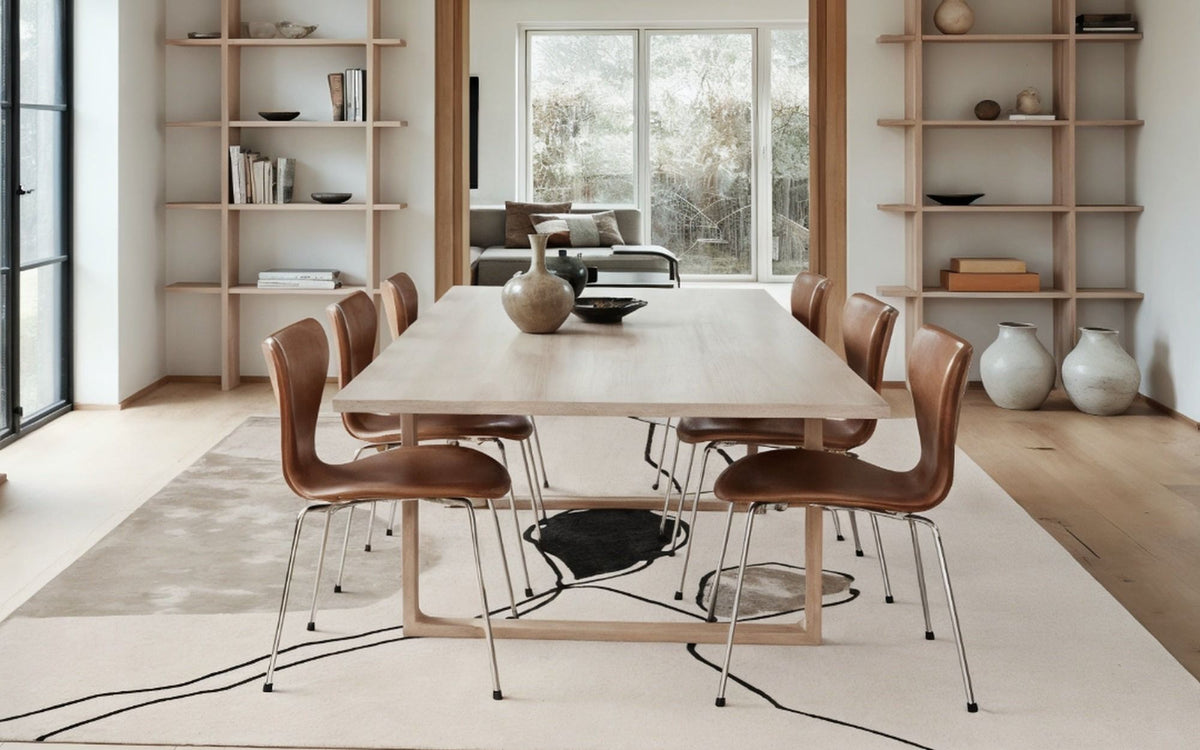
Concept and Nasai: Hand Tufted Botanical Silk Rugs
Concept and Nasai are Rugberry rugs hand tufted entirely in Botanical Silk, a plant-based yarn, at 14 to 16 mm, so the pattern is drawn in sheen as much as in colour. They suit quiet rooms with soft footfall, and they cost a little less than most wool and Botanical Silk blends.
In short
- The Rugberry Concept and Nasai rugs are hand tufted in Botanical Silk, not in silk from the silkworm, at a pile of 14 to 16 mm, cool underfoot with a sheen that changes as the light moves.
- Concept is a drawn, abstract design on a pale ground in ivory, beige, taupe and charcoal tones; Nasai is quiet in pattern, in Pastel Clay and Pale Grey.
- Concept costs ₹37,000 for 5x8 ft and ₹74,000 for 8x10 ft; Nasai costs ₹40,000 and ₹80,000, regular prices ex GST at the time of writing.
- Botanical Silk rugs suit bedrooms, studies and formal sitting rooms, and Rugberry lists Concept for low traffic use.
What does hand tufting do to Botanical Silk?
Hand tufting turns Botanical Silk into a cut pile: the yarn is pushed through a backing cloth by hand, then sheared level, so the cut ends of the yarn face up and the surface feels plush and cool. A handloom weave, as in Rugberry's Luma, lays the yarn flat instead, so the sheen runs along the surface.
The difference shows in how the light moves. On a tufted pile, the sheen shifts as the pile leans one way or another, so footprints and the direction of vacuuming show as lighter and darker patches. On a flat handloom weave, the sheen is steadier and the surface is lower, at 10 mm in Luma.
Tufting also lets a design be drawn freely. A tufter can follow any line on the backing cloth, which is why Concept can carry a loose figure drawing. Rugberry's guide to the four rug constructions sets tufting beside handloom, hand knotting and hand weaving, and the glossary explains hand tufted and Botanical Silk.
How do Concept and Nasai differ?
Concept is a drawn rug, with an abstract figure and loose marks across a pale field, while Nasai is quiet in pattern, close to a tonal plain. The table compares them with Luma, the handloom Botanical Silk rug, at regular prices ex GST at the time of writing.
| Point | Concept | Nasai | Luma |
|---|---|---|---|
| Fibre | Botanical Silk | Botanical Silk | Botanical Silk |
| Construction | Hand tufted | Hand tufted | Handloom |
| Thickness | 14 to 16 mm | 14 to 16 mm | 10 mm |
| Design | Abstract drawing on a pale ground | Quiet, tonal pattern | Plain colour |
| Colours | Ivory, beige, taupe and charcoal tones | Pastel Clay, Pale Grey | Greige, Charcoal, Gold, Gray |
| 5x8 ft | ₹37,000 | ₹40,000 | ₹40,000 |
| 8x10 ft | ₹74,000 | ₹80,000 | ₹79,000 |
| Best room | Living rooms as a focal piece, studies | Bedrooms, dressing rooms | Bedrooms, formal sitting rooms |
For a room that needs one artwork on the floor, choose Concept over Nasai, because its drawing gives the room a focus without adding colour. For a bedroom where the rug should feel soft and look calm, choose Nasai.
Where does Concept work best?
Concept works best as the focal piece in a pared back living room or study, where plain furniture leaves the floor to carry the interest. Its drawing reads like a large sketch, so it suits rooms with little else on the walls.

Lay it so the figure sits clear of the coffee table, usually towards the window end of the rug. A glass or open steel table lets the drawing show through. In a 12x16 ft living room, an 8x10 ft Concept under a three seater and a bench leaves a walkway of around 2 ft on each side.
Concept sits in Rugberry's most popular and modern collections, and its quiet palette of ivory, beige, taupe and charcoal suits the off white walls and pale floors of most new Indian apartments. Rugberry's guide to Japandi rugs shows the kind of room it suits.
In a study, a 5x8 ft Concept works under a reading chair and a side table, away from a desk chair on castors. Rugberry lists Concept for low traffic use, so it belongs where people sit and read rather than where they walk through on the way to the kitchen or the balcony.
Why is Nasai a bedroom rug?
Nasai is a bedroom rug because it is quiet in pattern and cool underfoot, so it reads as a soft field of colour under a bed and feels smooth to bare feet in the hot months. Pastel Clay gives a warm, faintly pink tone that flatters pale wood and white linen.


In a 10x12 ft bedroom with a queen bed, a 6x9 ft Nasai laid crosswise under the lower two thirds of the bed shows about 1.5 ft of rug at each side. Its low pattern means nothing important is hidden by the bed, which is where a drawn rug like Concept loses its point.
Botanical Silk stays cool in summer, which makes Nasai pleasant from April to June in Delhi, Ahmedabad or Hyderabad. In winter it feels cooler than wool, so a pair of slippers by the bed is worth keeping. Rugberry's guide to modern bedroom rugs compares other fibres for the room.
Nasai also comes in Pale Grey, a cooler version for rooms with grey or white linen and steel or black fittings.
A tufted Botanical Silk pile shows every direction it has been brushed. That is the sheen working.
Is Botanical Silk the same as polyester?
Botanical Silk is a plant-based yarn made from plant pulp, which is why Rugberry names it as it is and never sells it as silk from the silkworm. It is not polyester, which is a synthetic fibre made from oil.


The plant base gives Botanical Silk its cool feel and its strong sheen, and it also explains its weak point: it does not like water. A wet patch can lose sheen or leave a ring, and the pile can flatten under heavy furniture. That is why the care note is so short and firm.
Rugberry's guide to silk and Botanical Silk explains how the two fibres differ, and the guide to Botanical Silk and polyester covers the synthetic alternatives sold under similar names. If you want a protein fibre, Rugberry's Couture is hand knotted in true silk.
How do you care for a hand tufted Botanical Silk rug?
Care for Concept and Nasai by vacuuming regularly with suction only, blotting spills at once with a dry white cloth and using professional cleaning only, which is the care note on both product pages. Never wash, soak or steam a Botanical Silk rug at home.
- Pile direction. Vacuum in one direction, the way the pile lies, so the sheen stays even.
- Footprints. Light and dark patches from footsteps are normal on a tufted sheen. A soft brush in the pile direction evens them out.
- Furniture. Put cups under bed and chair legs, and move them a few centimetres every few months.
- Spills. Blot, never rub. Call a professional cleaner for anything that leaves a mark.
- Shedding. A new hand tufted rug sheds loose fibre for some weeks. Regular vacuuming clears it.
Rotate the rug twice a year so sun and wear spread evenly, and keep it away from the door, the dining table and the pet bed. Rugberry's guide to wool and Botanical Silk explains why wool forgives more.
Which Botanical Silk rug should you choose?
Choose by construction first, then design. If you want a low, steady sheen and a plain colour, choose handloom Luma.


If you want a softer cut pile and a drawing, choose Concept. If you want a cut pile and almost no pattern, choose Nasai.
At regular prices ex GST at the time of writing, Concept costs ₹37,000 for 5x8 ft, ₹50,000 for 6x9 ft, ₹74,000 for 8x10 ft and ₹1,00,000 for 9x12 ft. Nasai costs ₹40,000, ₹54,000, ₹80,000 and ₹1,08,000 for the same sizes. Both run to 12x15 ft and are listed in any size and colour to order.
See Concept, Nasai in Pastel Clay and Luma in Greige, or the full silk rugs collection, which gathers every Rugberry rug that uses Botanical Silk, with or without wool.
How do Botanical Silk rugs look in Indian light?
Botanical Silk rugs look strongest in low, raking light, early morning and late afternoon, when the sun crosses the pile and lights up every change in direction. At noon, with light falling straight down, they look flatter and closer to their dyed colour.

That makes room orientation part of the choice. In a west facing living room in Bengaluru or Chennai, Concept will glow in the late afternoon, which is when most families sit together. In a north facing bedroom, Nasai will read soft and even all day, with less movement.
Lamps change the colour too. Warm bulbs push Pastel Clay towards peach and Concept's ivory towards cream; cool bulbs keep both closer to the photographs. Rugberry's guide to lighting and sheen explains how to place lamps so a Botanical Silk rug looks its best.
Frequently asked questions
Are Concept and Nasai silk rugs?
Concept and Nasai are Botanical Silk rugs, not silk from the silkworm. Botanical Silk is a plant-based yarn with a silk-like sheen, and both Rugberry product pages list it as the fibre.
What is the difference between Concept and Luma?
Concept is hand tufted at 14 to 16 mm with an abstract drawing, while Luma is handloom woven at 10 mm in a plain colour. Both are Botanical Silk, but the tufted pile of Concept feels softer and shows more movement in the sheen.
Why does my Botanical Silk rug show light and dark patches?
Light and dark patches on a tufted Botanical Silk rug come from the pile leaning in different directions, which changes how it reflects light. Brushing or vacuuming in one direction evens the surface out.
Can a Botanical Silk rug be washed at home?
No. Botanical Silk can lose its sheen or leave a ring if it gets wet, so Rugberry's care note is professional cleaning only. At home, vacuum on suction and blot any spill with a dry cloth.
How much does a Concept rug cost?
From ₹37,000 for 5x8 ft to ₹1,66,000 for 12x15 ft, regular prices ex GST at the time of writing. Concept sits a little below Nasai at every size, so it is the lower priced way into Botanical Silk.
A plant yarn, drawn by hand, read by the light. Material first.


Leave a comment
This site is protected by hCaptcha and the hCaptcha Privacy Policy and Terms of Service apply.