


Gabbeh Dyed Rugs: Colour With Movement
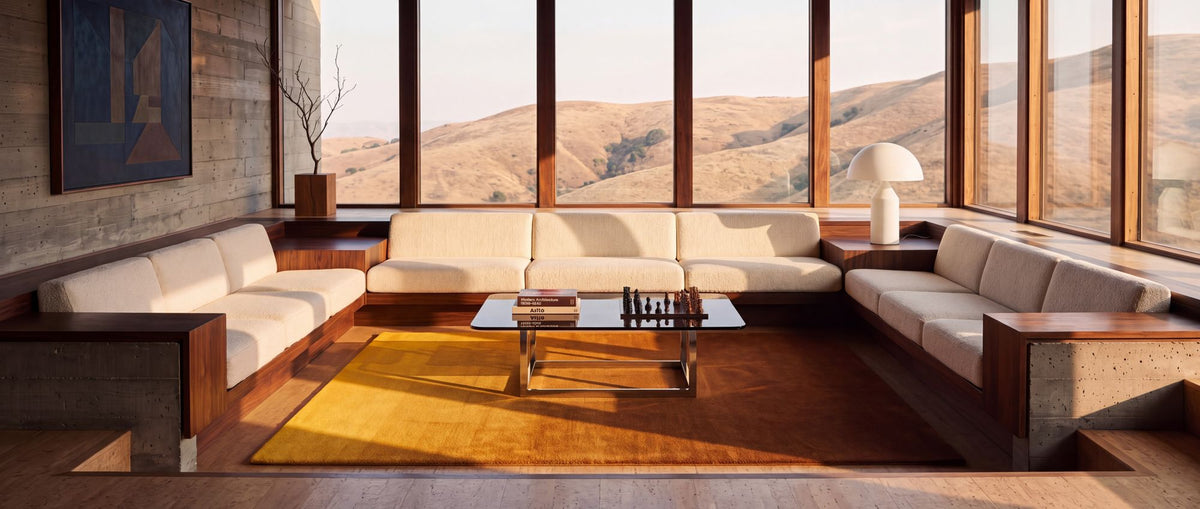
A Gabbeh dyed rug carries a colour that drifts and bands across the field, lighter in one place and deeper in another, as if it had been dyed in small batches. It is one of Rugberry's five cut pile textures, and it gives a single colour the movement of a field seen from far away.
In short
- Gabbeh Dyed is a cut pile rug texture in which the yarn is dyed unevenly, so one colour moves through lighter and deeper bands across the rug.
- Gabbeh dyeing takes its name from the Gabbeh, a thick, simply drawn tribal rug known for its loose bands of colour, called abrash.
- Gabbeh dyed colour is irregular and drifting, while Rugberry's Ombré is a planned, even gradient from one end to the other.
- Rugberry makes Gabbeh dyed rugs to measure; its Solaris collection of nine Ombré rugs in hand tufted New Zealand wool starts at ₹35,200 for 5x8 ft at the time of writing.
Where does the name Gabbeh come from?
The name comes from the Gabbeh, a thick, loosely knotted pile rug woven by nomadic weavers for their own tents. Gabbehs are known for wide fields of a single colour that is never quite the same colour from end to end.


That shifting colour happened naturally. Wool was dyed in small lots as it was needed, and each lot came out a little lighter or deeper than the last. Woven in, the lots made soft horizontal bands, the effect the trade calls abrash.
Gabbeh dyeing today recreates that look on purpose. The texture is named for the old rugs, but it is a modern, deliberate technique, chosen for a surface with life in it. Our post on abrash in rugs explains the historic effect in more depth.
How is a Gabbeh dyed rug made?
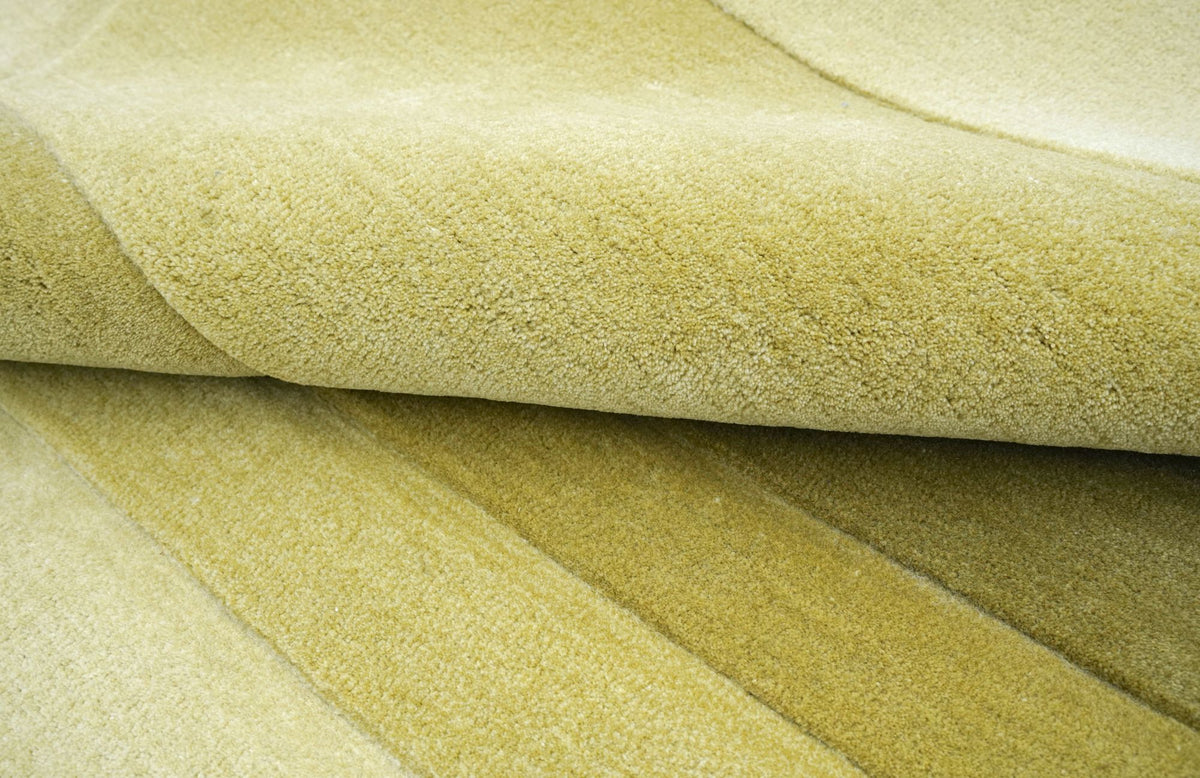
A Gabbeh dyed rug is made by dyeing the yarn in a way that leaves the colour deliberately uneven, then tufting it so that the variation falls in loose bands and drifts across the field. The pile is then sheared open as cut pile, which softens the transitions further.
There are several ways to build in the unevenness. The yarn can be dyed in separate small lots of the same recipe, it can be dipped so that the colour takes more strongly in some lengths, or two or three close shades can be planned in the tufting. The aim in every case is a colour that moves without forming a pattern.
Because the texture is in the colour rather than the pile height, a Gabbeh dyed rug stays level and even underfoot. Its texture is visual. You see movement, but you feel a smooth cut pile. Read more on dyeing in how rugs are dyed and in the glossary entry on yarn dyeing.
How is Gabbeh dyed different from Ombré and abrash?
Gabbeh dyed colour moves irregularly across the rug, Ombré moves evenly from one end to the other, and abrash is the accidental banding found in old hand dyed rugs. All three use variation in colour rather than in pile height.

| Point | Gabbeh Dyed | Ombré | Abrash |
|---|---|---|---|
| Is it planned? | Yes, made to look natural | Yes, fully controlled | No, it happens by chance |
| Direction of change | Drifts and bands, uneven | One way, end to end | Horizontal bands |
| How strong | Soft to moderate | From pale to deep | Usually subtle |
| Where it appears | Across the whole field | Across the whole length | Wherever a new dye lot begins |
| Mood | Relaxed, lived in, earthy | Calm, graphic, quiet | Antique, handmade |
| At Rugberry | Made to measure | Solaris collection | A natural part of hand dyed yarn |
The verdict: for a room that should feel calm and ordered, choose Ombré, because its gradient is even. For a relaxed room with wood, linen and plants, choose Gabbeh dyed, because its colour feels gathered rather than designed. Our ombre dyeing guide explains the planned gradient.
Which Rugberry rugs show colour with movement today?
Rugberry's Solaris collection is the stocked line that shows colour moving across the rug, as a planned Ombré rather than a Gabbeh dye. It is nine hand tufted New Zealand wool rugs at 14 to 16 mm, each moving slowly from one tone to another.

- Ombré Forest Rug: a slow gradation through greens, deepest at one end, from ₹35,200 for 5x8 ft at the time of writing.
- Ombré Pristine Rug: warm yellows deepening across the length, from ₹35,200.
- Ombré Haze Rug: a pale gradation softened as though seen through haze, from ₹35,200.
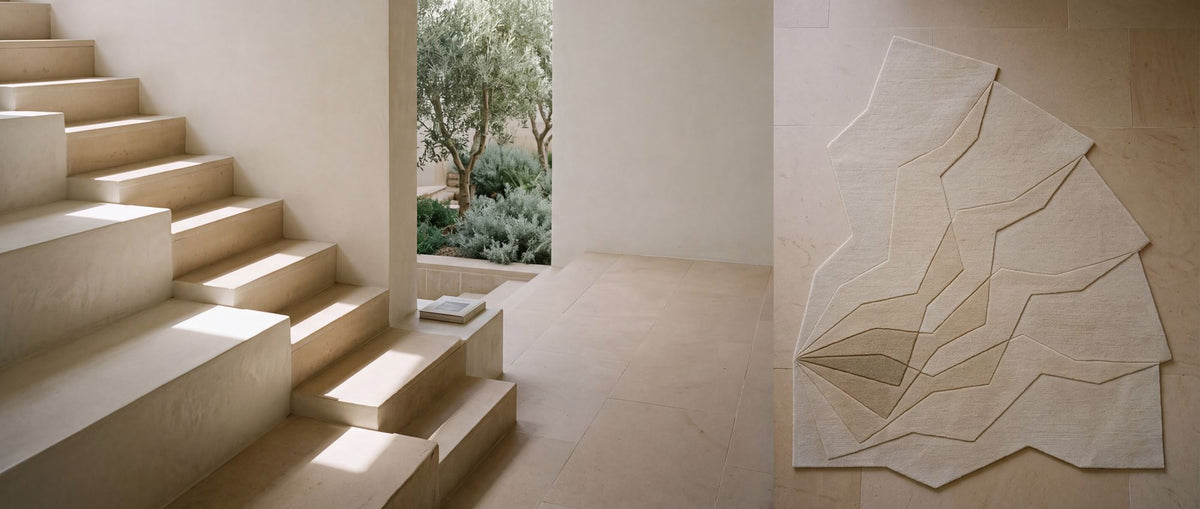
For a warm tonal surface in a different construction, the Sepia Wool & Silk Rug is handloom woven in New Zealand wool and Botanical Silk in warm browns, the tone of an old photograph, from ₹35,200 for 5x8 ft. Prices are ex GST. The full Solaris story is in the Ombré collection guide.
Ombré tells the eye where to go. Gabbeh dyed colour lets it wander.
Where does a Gabbeh dyed rug work in an Indian home?
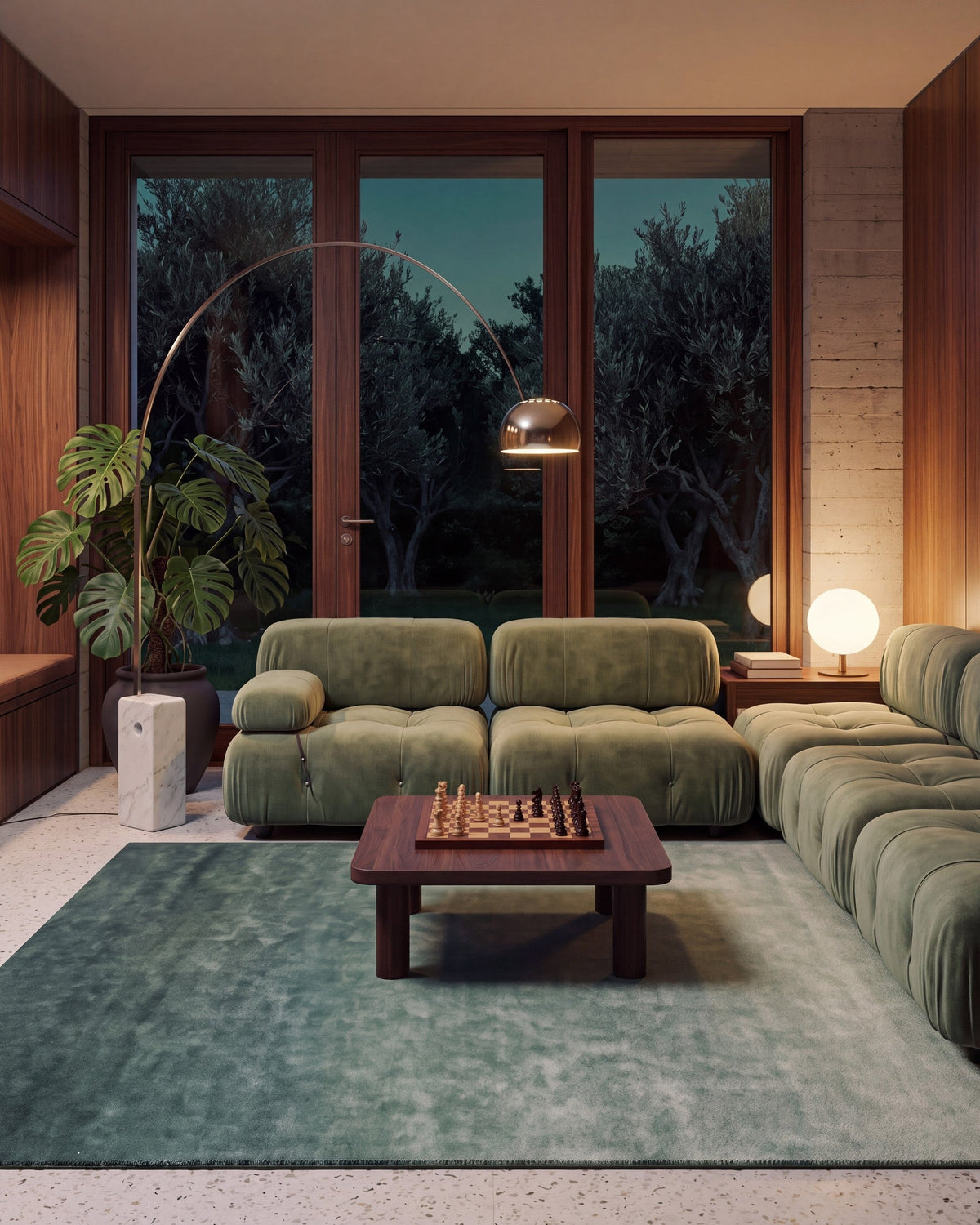
A Gabbeh dyed rug works best in rooms with natural materials and changing light: a living room with wood and cane, a bedroom with linen, a verandah facing room or a farmhouse. Its moving colour suits spaces that are relaxed rather than formal.


- Farmhouses and villas: on terracotta, Kota or wide wood boards, a Gabbeh dyed rug in rust, ochre or olive looks at home.
- Apartments with white marble: a soft Gabbeh dye in sand or stone warms the floor without adding pattern.
- Wabi sabi and Japandi rooms: the uneven colour fits a scheme that values the hand and the imperfect. See our wabi sabi rug guide.
- Family rooms: the banding hides small marks and footprints better than a flat solid.
It is less suited to a strictly minimal room in which every surface is flat and even; there an Ombré or a solid reads more calmly. Our guide to rug colour variation explains why handmade colour shifts are a feature, not a flaw.
How do you care for a rug whose colour moves?
You care for a Gabbeh dyed rug the same way as any cut pile wool rug: vacuum weekly, blot spills, turn it every six months and keep it from harsh direct sun. The one extra rule is to judge its colour only in daylight.
The bands of a Gabbeh dye can look stronger under a warm bulb at night and softer at noon. Before deciding a patch is a stain or uneven fading, look at it in daylight from a standing height. Most apparent spots turn out to be the dye doing what it was meant to do.
- Sun: strong afternoon sun through glass fades any dyed wool, so draw a sheer curtain in summer. Our rug fading guide covers this.
- Spills: blot with a white cloth and cold water, never rub, and dry quickly with a fan in monsoon months.
- Cleaning: professional cleaning only, and tell the cleaner the colour variation is intentional.
How strong should the colour movement be?
The colour movement should be strong enough to be seen from where you usually sit, and no stronger. In most Indian living rooms that means a gentle band that reads at three to four metres and disappears when you stand over the rug.
Three levels cover most requests. A barely there movement keeps the rug close to a solid, which suits formal rooms and pale marble floors. A gentle movement shows clear but soft bands, the most popular choice for family rooms. A clearly banded movement makes the colour the main feature, best in large rooms with plain furniture.
- Barely there: two close shades of one colour, such as sand and a slightly deeper sand.
- Gentle: two or three shades a step apart, such as oat, stone and taupe.
- Clearly banded: shades further apart, such as ochre and rust, or pale and deep olive.
Room size matters too. In a 5x8 ft rug, strong bands can feel busy because there is only room for one or two of them. In a 9x12 or 10x14 ft rug, the same strength has space to breathe, and the bands read as a slow drift. Our guide to rug prices by size helps balance size against budget.
Can a Gabbeh dyed rug sit with other patterns?
A Gabbeh dyed rug sits well with quiet patterns such as a ticking stripe, a small block print or a woven cane, because its own pattern is soft and has no outline. It competes with strong, large patterns such as a bold floral sofa. In that case keep the movement barely there. Our guide to a rug with a patterned sofa covers the balance.
How do you order a Gabbeh dyed rug from Rugberry?
Gabbeh dyed rugs are made to measure at Rugberry. Start with a base colour, decide how pronounced the dyed bands should be, then set the size; the piece can follow a Rugberry design or your own drawing, in any shape.
Describe the strength of movement in plain words: barely there, gentle, or clearly banded. Then ask for a swatch, but remember that a small swatch cannot show the whole drift of a large rug, so ask to see photographs of a finished piece as well. Our guide to custom rug colour matching helps you brief the colour. The ten rug textures guide places Gabbeh dyed alongside the other cut pile and loop pile textures.
Frequently asked questions
What is a Gabbeh dyed rug?
A Gabbeh dyed rug is a cut pile rug whose yarn is dyed unevenly, so one colour drifts through lighter and deeper bands. Rugberry lists Gabbeh Dyed as one of its five cut pile textures.
Is Gabbeh dyed the same as Ombré?
No. Ombré is a planned gradient that moves evenly from one end of the rug to the other, while Gabbeh dyed colour drifts irregularly across the field. Rugberry's Solaris collection is Ombré.
Is the colour variation in a Gabbeh dyed rug a defect?
No. The banding is the whole point of a Gabbeh dyed rug and is made on purpose. It recreates the natural abrash of old hand dyed rugs.
Does Rugberry sell Gabbeh dyed rugs in stock?
Rugberry makes Gabbeh dyed rugs to measure in any size and colour. For colour that moves in a stocked rug, the Solaris collection of Ombré rugs starts at ₹35,200 for 5x8 ft, ex GST, at the time of writing.
Which rooms suit a Gabbeh dyed rug?
A Gabbeh dyed rug suits relaxed rooms with natural materials, such as living rooms with wood and cane, linen bedrooms and farmhouses. It is less suited to a strictly minimal room.
Let the colour wander a little. Material first.




Leave a comment
This site is protected by hCaptcha and the hCaptcha Privacy Policy and Terms of Service apply.