


Tip Shear Rugs: Loop and Cut in One Surface
A tip shear rug starts as a loop pile with loops of more than one height, then the tops of the tallest loops are sheared off, so cut tips and closed loops sit side by side in one surface. The result is a quiet pattern made of two textures rather than two colours.
In short
- Tip Shear is a loop pile rug texture in which the tips of the taller loops are sheared open, leaving cut pile and loop pile together on the same rug.
- Rugberry lists Tip Shear among its five loop pile textures, with 2 Colour Mottling, Overtuft Scattered, Micro Loop and Straight Line.
- Tip shear draws a design through the contrast between matt loops and soft, slightly darker cut tips, so even a single colour rug shows a pattern.
- Rugberry makes tip shear rugs to measure in any size and colour; for a single surface that mixes texture in the current range, its hand tufted wool and Botanical Silk rugs start at about ₹32,000 for 5x8 ft at the time of writing.
How does a tip shear rug work, step by step?
A tip shear rug works by building a loop pile with two loop heights and then shearing the whole surface at a level that cuts only the taller loops. Everything above the blade opens into cut pile; everything below it stays as loop.


- Plan the design in heights. The pattern is drawn as areas of high loop and low loop rather than as colours.
- Tuft the loops. High loops are tufted where the design should read as cut pile, low loops everywhere else.
- Shear to one level. The shearing blade is set just below the top of the high loops, so it opens them and passes over the low ones.
- Brush and finish. The cut tips are brushed up so they bloom, which makes them read softer and slightly deeper in tone.
The final surface is close to level, because the blade has evened out the heights. The texture is in the contrast between open tips and closed loops. Our guide to rug shearing explains the blade work, and the glossary covers shearing.
Why do cut and loop look different in the same colour?
Cut and loop look different in the same colour because they meet light differently. A closed loop shows the side of the yarn, which is smooth and reflects light; a cut tip shows the end of the yarn, which absorbs light and looks deeper.


That is why a tip shear rug in one colour still shows a clear pattern. The cut areas look a shade darker and feel softer, the loop areas look paler and feel crisper. Turn the rug and the pattern shifts slightly, because the open tips lean with the pile direction.
With Botanical Silk in the yarn, the effect grows. Botanical Silk reflects more light than wool, so a loop of it glows while a cut tip of it shows a deeper sheen. The pile direction and sheen glossary entries explain more.
How is tip shear different from carving and High-Low?
Tip shear makes pattern from two kinds of pile at nearly one height, carving makes it from a groove cut into one pile, and High-Low makes it from two pile heights. All three can give a single colour rug a design, but they feel different underfoot.
| Point | Tip Shear | Carving | High-Low |
|---|---|---|---|
| Pile family | Loop pile with cut tips | Cut pile | Cut pile |
| What makes the pattern | Cut beside loop | A cut groove | Two pile heights |
| Feel underfoot | Nearly level, two textures | Level, fine channels | Stepped |
| Visible in flat light | Yes, softly | Faintly | Yes |
| Durability | High; loops resist crushing | Good | Good; high areas wear first |
| At Rugberry | Made to measure | Lamina collection | Made to measure |
The verdict: for a busy family room that still wants a tone on tone pattern, choose tip shear over High-Low, because the surface stays level and the loops resist crushing. For a quiet bedroom where shadow should do the drawing, choose carving. See the carving guide and the high low pile guide.
Tip shear gives one colour two voices: the bright loop and the deeper cut.
Which Rugberry rugs mix textures in one surface today?
Rugberry makes tip shear rugs to measure, and in the current range the closest relatives are its hand tufted rugs in New Zealand wool and Botanical Silk, where two fibres in one pile give a surface of two textures. Each is 14 to 16 mm, soft, with a low sheen that shifts as you cross the room.

- Crinkle Wool & Silk Rug: the surface folded and creased like worked paper, from ₹32,000 for 5x8 ft at the time of writing.
- Fragment Wool & Silk Rug in Ecru: broken planes meeting across the field in ecru, from ₹32,000.
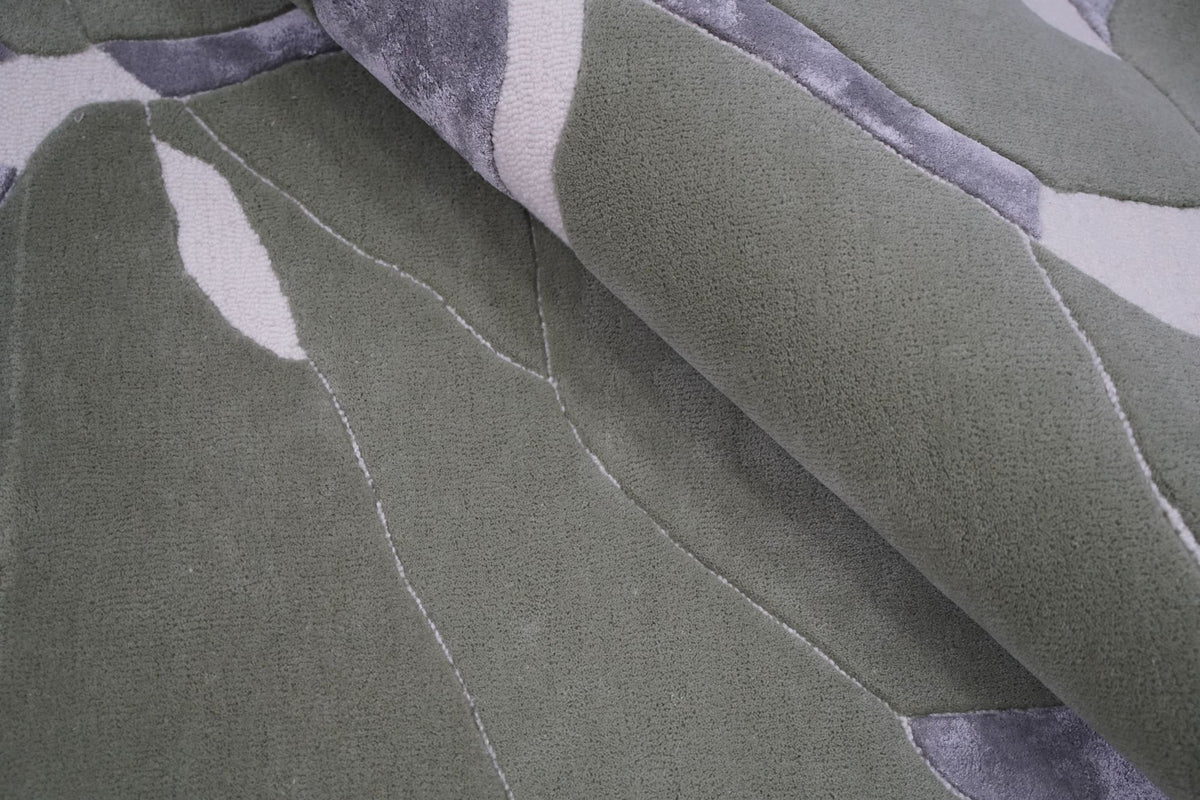
- Velocity Wool & Silk Rug: drawn in fast directional strokes in sage, grey and ivory, from ₹32,800.
These are cut pile rugs, not tip shear, but they show the same principle: two materials meeting light differently in one surface. Prices are ex GST. Each can be made to measure, and a tip shear version of a design can be discussed with the team. Compare the fibres in wool vs Botanical Silk.
Where does a tip shear rug suit an Indian home?
A tip shear rug suits rooms that want quiet pattern and good wear together: a family living room, a formal drawing room, a hotel style bedroom or a home office. Its loops stand up to traffic, and its cut areas add softness where the pattern falls.

- Drawing rooms on white marble: an ivory or stone tip shear adds a pattern that reads only as you walk across it.
- Family rooms: the loops resist crushing under a sofa and the two textures hide footprints.
- Studies: a low tip shear lets a chair roll while still carrying a design.
- Bedrooms: a tip shear in a warm colour gives softness where the cut areas fall beside the bed.
Pets are the one caution, as with any loop pile. A cat that kneads or a dog that digs can catch a loop, so trim claws and clip any snag level. Our micro loop guide covers pets and loops in more detail.
How do you care for a tip shear rug?
You care for a tip shear rug by vacuuming with suction only, brushing the cut areas back up after cleaning and clipping any snag rather than pulling it. The two textures need slightly different handling, which is easy once you know where they are.
- Weekly: vacuum with suction and the beater bar off, so the loops are not pulled.
- After vacuuming: brush the cut areas in the direction of the pile so the tips stand up and the pattern stays clear.
- Spills: blot with a white cloth from the outside in, never rub.
- Snags: clip level with sharp scissors.
- Every six months: turn the rug so wear and sun spread evenly.
Shading, where cut tips lean and look lighter or darker, is normal and part of the look. Read our daily rug care routine for a simple schedule.
How do you judge a tip shear rug before buying?
Judge a tip shear rug in side light, from standing height and from the floor, and with your hand. The pattern lives in the contrast between cut and loop, so a quick look under ceiling light will undersell it.
- Side light test: hold the swatch near a window with light falling across it. The cut areas should read as a clear, slightly deeper tone.
- Distance test: lay the swatch on the floor and look from where you will sit. The pattern should be visible but calm.
- Hand test: run a hand across the swatch both ways. The cut areas should feel softer and lean with your hand; the loops should spring back.
- Edge test: look at where cut meets loop. A clean meeting line shows careful shearing.
Then think about what will sit on the rug. A tip shear pattern under a large coffee table is partly hidden, so place the strongest part of the design where people walk and sit. Our guide to checking rug quality lists more tests, and reading a rug spec sheet explains the numbers on a quote.
Does a tip shear rug show shading?
Yes, a little, in the cut areas. Shading is the light and dark effect when cut tips lean in different directions, and it is part of every cut pile. In a tip shear rug it actually helps the pattern, because the cut areas shift tone while the loop areas stay steady. The glossary entry on shading explains why it happens.
How do you order a tip shear rug?
You order a tip shear rug through Rugberry's made to measure service, choosing the design, the colour and the size. Any size, shape or colour is possible, built on a Rugberry design or your own.
Because tip shear works in heights rather than colours, a design for it is drawn differently: every area is marked high loop or low loop. Rugberry's team can translate an existing design, so a pattern you like in two colours can be made in one colour and two textures. Ask for a swatch that shows both the loop and the cut area, and judge it in side light. Our guides to rug CAD design and the rug design process show how a design is prepared, and the ten rug textures guide compares all ten.
Frequently asked questions
What is a tip shear rug?
A tip shear rug is a loop pile rug in which the tops of the taller loops are sheared open, so cut pile and loop pile sit side by side. Rugberry lists Tip Shear as one of its five loop pile textures.
Is tip shear the same as cut and loop?
Tip shear is one way of making a cut and loop surface. The loops are tufted at two heights and the whole rug is sheared once, which opens only the taller loops.
Is a tip shear rug durable?
Yes. The loop areas resist crushing and the surface stays nearly level, so a tip shear rug suits family rooms and studies. Clip any snag level rather than pulling it.
Can a tip shear rug be one colour?
Yes. A one colour tip shear rug still shows a pattern, because cut tips look softer and deeper than closed loops. Many tip shear designs are made in a single colour for that reason.
Does Rugberry sell tip shear rugs?
Not as a ready design at the time of writing. Rugberry makes tip shear rugs to measure, in the size and colours you choose. For a listed design with two materials in one surface, look at Crinkle and Fragment in New Zealand wool and Botanical Silk, at ₹63,200 for 8x10 ft, ex GST.
One colour, two textures. Material first.






Leave a comment
This site is protected by hCaptcha and the hCaptcha Privacy Policy and Terms of Service apply.